

Quick Answer
Carbon monoxide is invisible, odourless, and can be fatal within minutes. Yet many London homes still don't have a working CO alarm. Here's everything you need to know.
The Silent Killer: What Is Carbon Monoxide?
Carbon monoxide (CO) is an invisible, odourless, and tasteless gas that can be deadly even in small concentrations. It's produced whenever fossil fuels — gas, oil, coal, wood — are burned incompletely. In a properly functioning, well-ventilated appliance, combustion is complete and CO production is minimal. When a gas appliance malfunctions, the flue becomes blocked, or ventilation is insufficient, CO can build up rapidly to dangerous levels.
It's called the 'silent killer' because there is no sensory warning. You cannot smell it, see it, or taste it. By the time symptoms appear — and they can be easily mistaken for flu — dangerous levels may already be present. Carbon monoxide replaces oxygen in your bloodstream, starving your organs. At sufficient concentrations, it kills within minutes.
The Health Risks of Carbon Monoxide Exposure
Symptoms of CO poisoning range from mild to fatal depending on concentration and duration of exposure. At lower concentrations, symptoms include headaches, dizziness, nausea, fatigue, and confusion — all of which are easily attributed to other causes. This is precisely what makes CO poisoning so dangerous: people go to bed feeling unwell and don't wake up.
Children, elderly people, and those with respiratory or cardiovascular conditions are most vulnerable. But CO is indiscriminate — at high enough concentrations, it is lethal regardless of health or age. The tragic cases that make the news are rarely in neglected properties: they happen in well-maintained homes where a single fault in a heating appliance, or a blocked flue, introduces CO into the living space undetected.
Legal Requirements in England
Since October 2022, carbon monoxide alarms are legally required in all rooms in England that contain a fixed combustion appliance — including gas boilers. This applies to both rental properties (where landlords are legally responsible for compliance) and owner-occupied homes. The legal obligation has existed for rental properties since 2015; the 2022 extension brought owner-occupied homes into scope.
A working carbon monoxide alarm is not optional if you have a gas boiler, gas fire, gas cooker, or any other combustion appliance. It is a legal requirement and, far more importantly, a life-saving device.
Why We Recommend 10-Year Sealed Battery Units
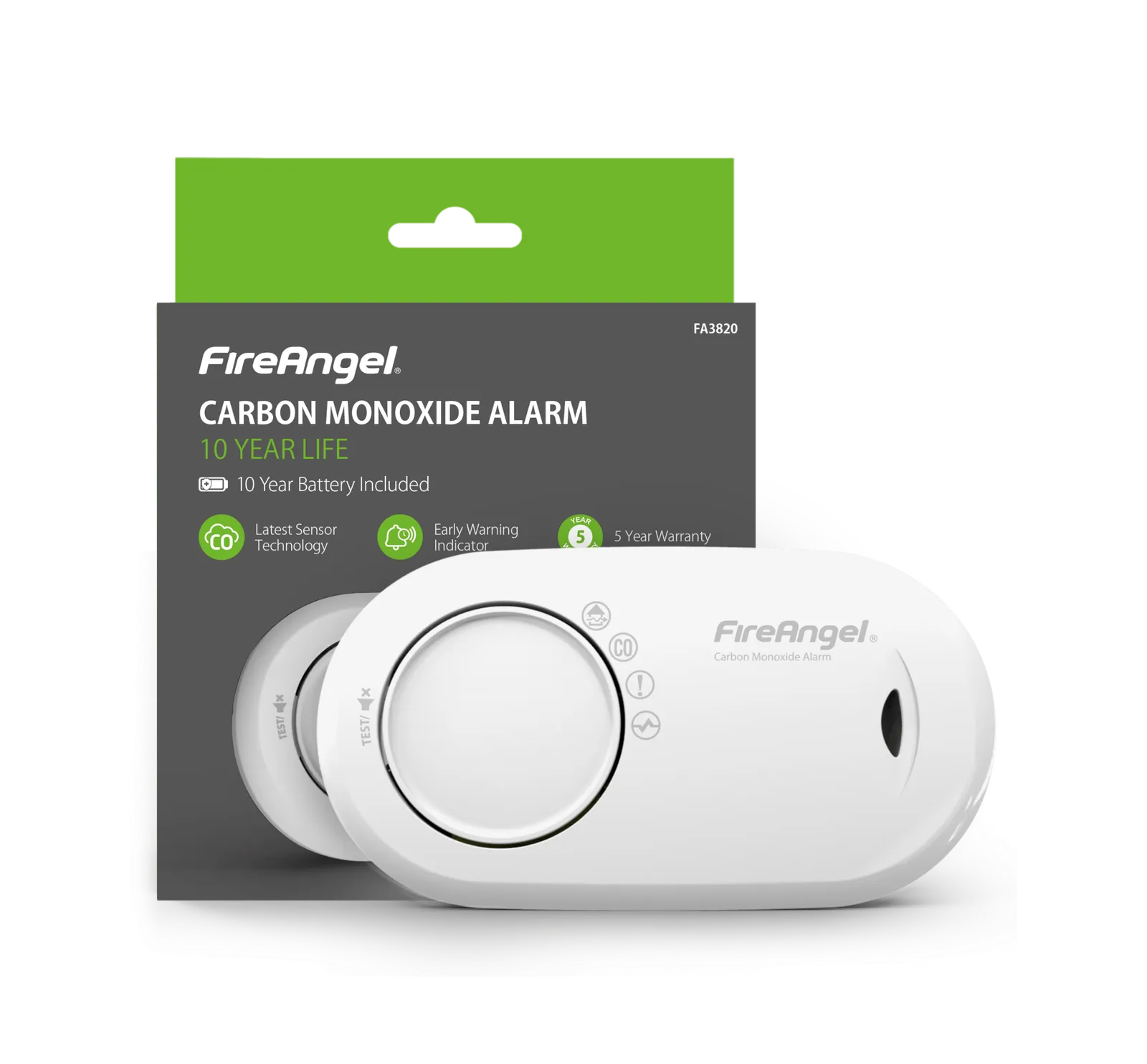
At RARE Plumbing London, we only install high-performance carbon monoxide alarms. Our standard recommendation is a 10-year sealed battery unit — such as those made by Kidde, Aico, or FireAngel — for several reasons.
A 10-year sealed unit contains a battery that is designed to last the full operational life of the alarm. There are no batteries to replace, no low-battery chirping, no risk of someone removing the battery in frustration and not replacing it. The alarm simply works, continuously, for a decade. For most homeowners, this is the most practical and reliable choice — minimum maintenance, maximum protection.
CO alarms also have a finite sensor lifespan. After approximately seven to ten years, the electrochemical sensor degrades and the alarm can no longer accurately detect CO. This is why all CO alarms have an expiry date — and why replacing the entire unit (not just the battery) after ten years is essential.
Where to Install Carbon Monoxide Alarms
For maximum protection, install CO alarms: in every room containing a combustion appliance (boiler room, kitchen if gas cooker), on each floor of the property, and near sleeping areas so they will be audible at night. CO alarms should be positioned at roughly head height — CO is approximately the same density as air and distributes throughout a space rather than rising or falling.
During our boiler service visits, we check the presence, age, and condition of CO alarms as a standard part of our inspection. If alarms are absent, expired, or incorrectly positioned, we advise accordingly and can supply and fit appropriate units during the same visit.
What to Do If Your Alarm Sounds
If your carbon monoxide alarm sounds: immediately open all windows and doors, turn off gas appliances if it is safe to do so, evacuate the property, call the National Gas Emergency Service on 0800 111 999, and seek urgent medical attention if anyone is experiencing symptoms. Do not re-enter the property until it has been inspected and declared safe by a qualified engineer.
Never ignore a sounding CO alarm. Never assume it's a fault or low battery — treat every activation as a genuine emergency until proven otherwise.
Book a Gas Safety Check with RARE
The best protection against carbon monoxide is a combination of a working alarm and a properly maintained, regularly serviced gas appliance. Our Gas Safe registered engineers carry out annual boiler services and full gas safety inspections (CP12 certificates) across Central and North London. A service visit includes checking flue integrity, combustion analysis, and safety device testing — all of which directly address the conditions that can produce CO.
Talk to a specialist today.
Our Gas Safe engineers are available same-day across Central and North London. No call-out charge quoted upfront. No obligation.