
Quick Answer
For prime London properties with complex heating and plumbing systems, annual maintenance isn't just good practice — it's the difference between a system that performs flawlessly for decades and one that fails expensively at the worst possible time. Here's what a proper PPM programme looks like.
The Heating Failure Nobody Plans For
It's always a Friday evening in January. Or the morning of Christmas Day. Or the day before twenty guests arrive for a dinner party. That's when boilers fail — not because the universe has a sense of irony, but because heating systems run hardest in the coldest weather, and the components that have been gradually degrading throughout the year finally give way under peak demand.
For most homeowners, a boiler breakdown is an inconvenience. For the owners of prime London properties — townhouses in Belgravia, lateral apartments in Mayfair, detached homes in Hampstead — it's a different kind of problem. Systems that span five floors, serve multiple zones of underfloor heating, heat multiple bathrooms simultaneously, and supply domestic hot water to a household with high expectations don't fail simply or cheaply. When they fail, the disruption is significant and the cost of emergency repair, in time, money, and inconvenience, is substantial.
Planned Preventative Maintenance exists to prevent this. Not to guarantee that nothing ever goes wrong — no maintenance programme can do that — but to identify the components and conditions that are likely to cause failures before they do, and to address them on your terms rather than in an emergency.
What PPM Actually Means in Practice
The term 'Planned Preventative Maintenance' sounds corporate, but the principle is simple: a structured programme of regular inspections, servicing, and testing designed to keep complex systems performing correctly and to catch problems early. In the context of a prime London residential property, a proper PPM programme covers far more than just an annual boiler service.
The systems in a high-specification London home form an interconnected whole. The boiler, the underfloor heating distribution, the domestic hot water cylinder, the controls and thermostats, the cold water storage tank, the water softener — each one affects the others. A magnetite contamination problem in the central heating circuit affects boiler efficiency and longevity. A failing actuator in the UFH manifold affects comfort and, indirectly, boiler cycling behaviour. A cold water tank that hasn't been inspected in years may present a Legionella compliance risk. A smart thermostat that hasn't had a firmware update may be making decisions based on incorrect logic.
A PPM programme that treats each of these in isolation — or that only addresses the boiler — misses the point. The value of a comprehensive annual visit is in the picture it builds across the whole system.
What a RARE PPM Visit Covers
Our PPM programmes are designed around the specific systems in each property. There is no standard checklist — every home is different, and a five-storey Marylebone townhouse with two boilers, seven UFH zones, a Heatmiser NeoHub system, a Megaflo cylinder, and a cold water storage tank requires a different programme from a lateral apartment in Knightsbridge with a single boiler and electric UFH. But across the range of properties we service, a comprehensive visit typically includes:
- Annual boiler service: Full combustion analysis, heat exchanger inspection, flue integrity check, safety device testing, and service record update. We work across all major premium brands — Vaillant, Viessmann, ATAG, Worcester Bosch, Baxi — with manufacturer-trained engineers.
- Gas Safety Certificate (CP12): Issued annually following a full gas safety inspection of all gas appliances in the property. Required by law for landlords; strongly advisable for any homeowner.
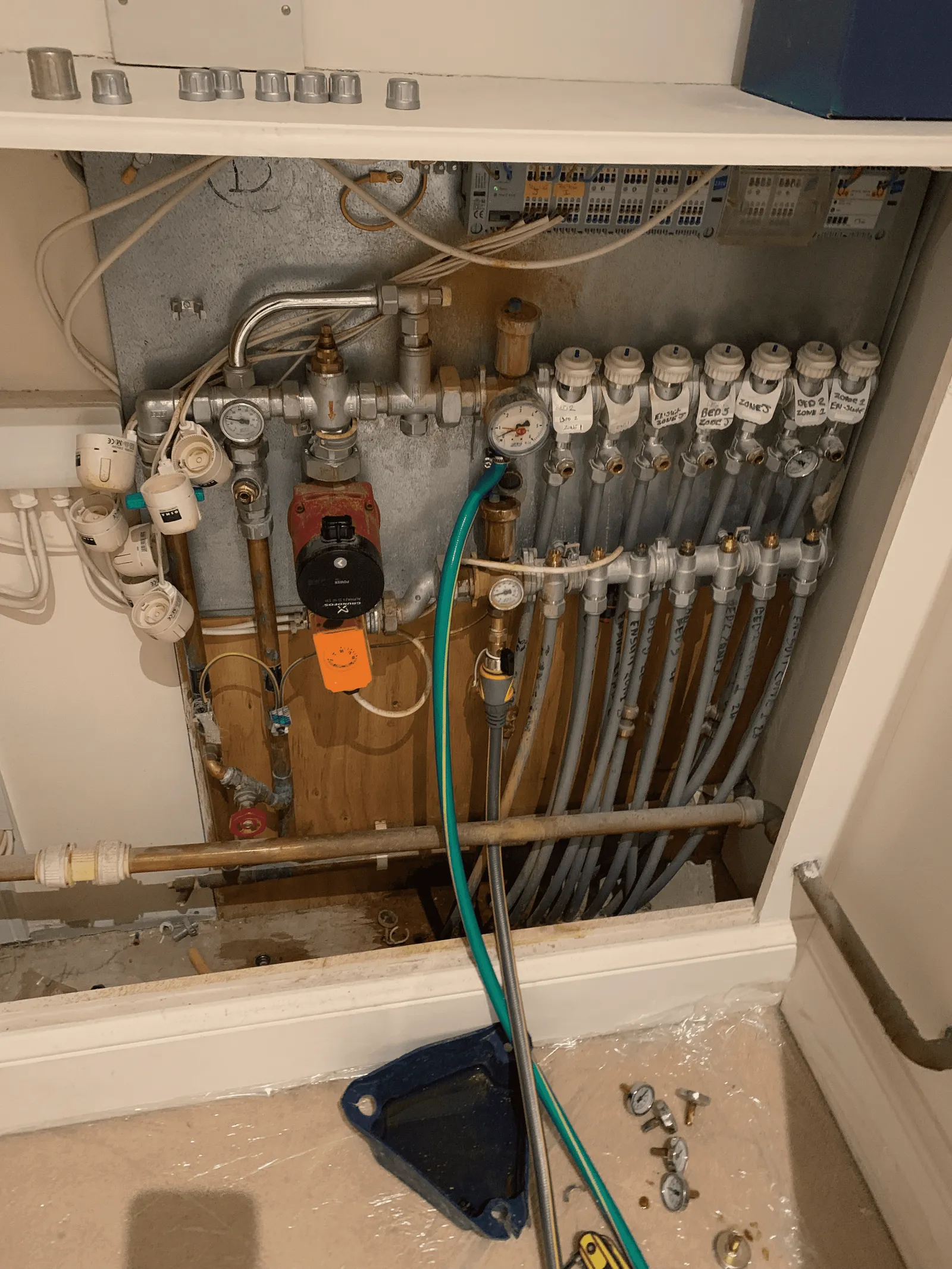
- UFH system inspection: Flow rate measurement on each manifold circuit, return temperature analysis, actuator testing on every zone, manifold condition check, and rebalancing where required.
- Smart control calibration: Heatmiser NeoHub, Honeywell evohome, Tado, or other smart control systems — we check zone programming, schedule accuracy, firmware version, and thermostat calibration. Misconfigured controls are a surprisingly common source of comfort complaints and energy waste.
- Cylinder and pressure vessel inspection: Megaflo, Telford, or equivalent — we check expansion vessels, pressure relief valves, immersion heater condition, and thermostat settings. Unvented cylinder components have specific service intervals; neglecting them is a safety issue as well as a maintenance one.
- Water quality testing: We test inhibitor concentration, pH, and conductivity. Correctly dosed heating water dramatically reduces corrosion rates and extends the life of boilers and system components. Inhibitor depletes over time and needs topping up.
- Magnetic filter service: Clean or replace the filter cartridge and check its installation for correct function. A neglected magnetic filter that becomes saturated stops working and may even release captured sludge back into the system.
- Cold water tank inspection: Visual inspection for condition, debris, and any Legionella risk factors. Required as part of a proper Legionella risk management strategy for any property with a cold water storage tank.
- Written service report: A detailed record of everything inspected, any findings, and any recommendations — with photographs. This serves as both a maintenance record and a property asset log.
Why Complex Properties Need a Different Standard of Care
A three-bedroom flat with a single combi boiler and eight radiators is a simple system. It needs an annual boiler service and occasional bleeding of radiators. A standard plumber, competent at their level, can maintain it adequately.
A Hampstead townhouse with a pressurised twin-coil cylinder, two Worcester Bosch system boilers running in sequence, seven zones of wet underfloor heating controlled by a Heatmiser NeoHub, a water softener, and a cold water storage tank in the loft is not a simple system. It requires engineers with specific knowledge of each component, the right diagnostic equipment, and the experience to understand how the parts interact.
Most standard gas engineers don't regularly work in properties of this complexity. They may be able to service the boiler competently but lack the knowledge to assess the UFH system, interpret the Heatmiser readings, or identify the significance of unusual inhibitor depletion rates. This is the gap that RARE's PPM service fills.
The Financial Case for Preventative Maintenance
The economics of PPM are straightforward when you look at the numbers honestly.
A boiler heat exchanger replacement on a premium boiler — Viessmann Vitodens, ATAG, Vaillant ecoTEC — typically costs £800–1,500 in parts alone, plus labour. In many cases, heat exchanger failure is accelerated by poor water quality or magnetite contamination — both of which a PPM programme detects and addresses. An annual water quality test and inhibitor top-up might cost £80 as part of a service visit. The same intervention as a separate callout, after the damage is done, achieves nothing.
A power flush to address severe magnetite contamination — often necessary when a system hasn't been properly maintained — costs £600–1,200 for a residential property of reasonable size. Carried out as a preventative measure when contamination is first detected, it's a fraction of this. Carried out as an emergency measure after a boiler heat exchanger has failed, it doesn't undo the damage.
Emergency callout rates for boiler failures, particularly at weekends or during cold snaps, are significantly higher than planned service costs. An engineer attending on a Saturday in January at emergency rates, for a problem that a PPM visit six months earlier would have caught, is an expensive lesson in the value of prevention.
Beyond the direct financial comparison, there is the value of certainty. A homeowner on a PPM programme knows that their systems have been professionally assessed within the last twelve months. If they travel frequently, manage multiple properties, or simply want the confidence that comes from properly maintained systems, this assurance has genuine value that's difficult to put a number on.
RARE Membership Plans
Our PPM programmes are structured around three membership tiers, designed to suit different property types and service requirements:
Loyalty: Our entry-level plan covers the essentials — annual boiler service, CP12 certificate, basic system check, and priority booking for callouts. Suitable for simpler systems or those seeking a structured maintenance foundation.
Premier Loyalty: Our most popular tier, covering everything in Loyalty plus full UFH system inspection and rebalancing, smart control calibration, cylinder inspection, water quality testing and treatment, and a detailed written service report. Suitable for most prime London homes with moderate system complexity.
Elite Loyalty: Our comprehensive programme for the most complex properties — multi-boiler systems, whole-home plant rooms, commercial-grade equipment, and properties requiring multiple annual visits. Includes all services in Premier Loyalty plus additional inspection visits, priority emergency response with a guaranteed response time, and dedicated account management.
All plans include priority booking — PPM clients are never left waiting behind non-contract customers — and preferential rates on any additional work required following a service visit.
Talk to a specialist today.
Our Gas Safe engineers are available same-day across Central and North London. No call-out charge quoted upfront. No obligation.
Related Services