
Quick Answer
A Mayfair penthouse on Curzon Street had no underfloor heating in its main reception rooms. Two engineers had attended without finding the fault. Here's how RARE diagnosed a failed actuator and Heatmiser misconfiguration — and fixed everything in a single visit without touching the floor.
The Problem No One Could Solve
It's a scenario we encounter more often than you might expect. A homeowner in one of London's most prestigious postcodes has had multiple engineers attend, paid for each visit, and still has the same problem. The situation at a penthouse apartment on Curzon Street, Mayfair was exactly this: the main living area underfloor heating had been completely cold for several months. Two previous contractors had attended. Neither had identified the fault.
The apartment itself is exceptional — a high-specification lateral apartment occupying an entire floor of a period conversion, with sweeping views over the rooftops of Mayfair. The underfloor heating serves the principal reception rooms: a drawing room, dining room, and kitchen diner spanning the full width of the building. When it stopped working, the effect on the usability of the space — particularly during a London winter — was significant.
The client had been told, speculatively, that the issue 'might be' the boiler, or 'could be' a problem with the pipework under the floor. Neither diagnosis came with evidence. Neither contractor had carried out a systematic investigation. And the suggestion that remedial work might involve lifting sections of floor — in an apartment fitted out to this standard — was understandably alarming.
Our Approach: Investigate Before You Touch Anything
When RARE Plumbing London attended, we started where we always start: with a full system assessment before any intervention. This means working through the entire heating circuit methodically — from the boiler and its controls, through the distribution pipework, to the manifold, the actuators, the zone valves, and finally the Heatmiser controller and thermostat configuration.
This approach takes longer than guessing and replacing parts. But it means that when we identify a fault, we know it's the fault — and we know exactly what's required to fix it.
What We Found
The investigation revealed two distinct problems, each of which was masking the other and together explaining why previous contractors had been unable to identify a clear cause.
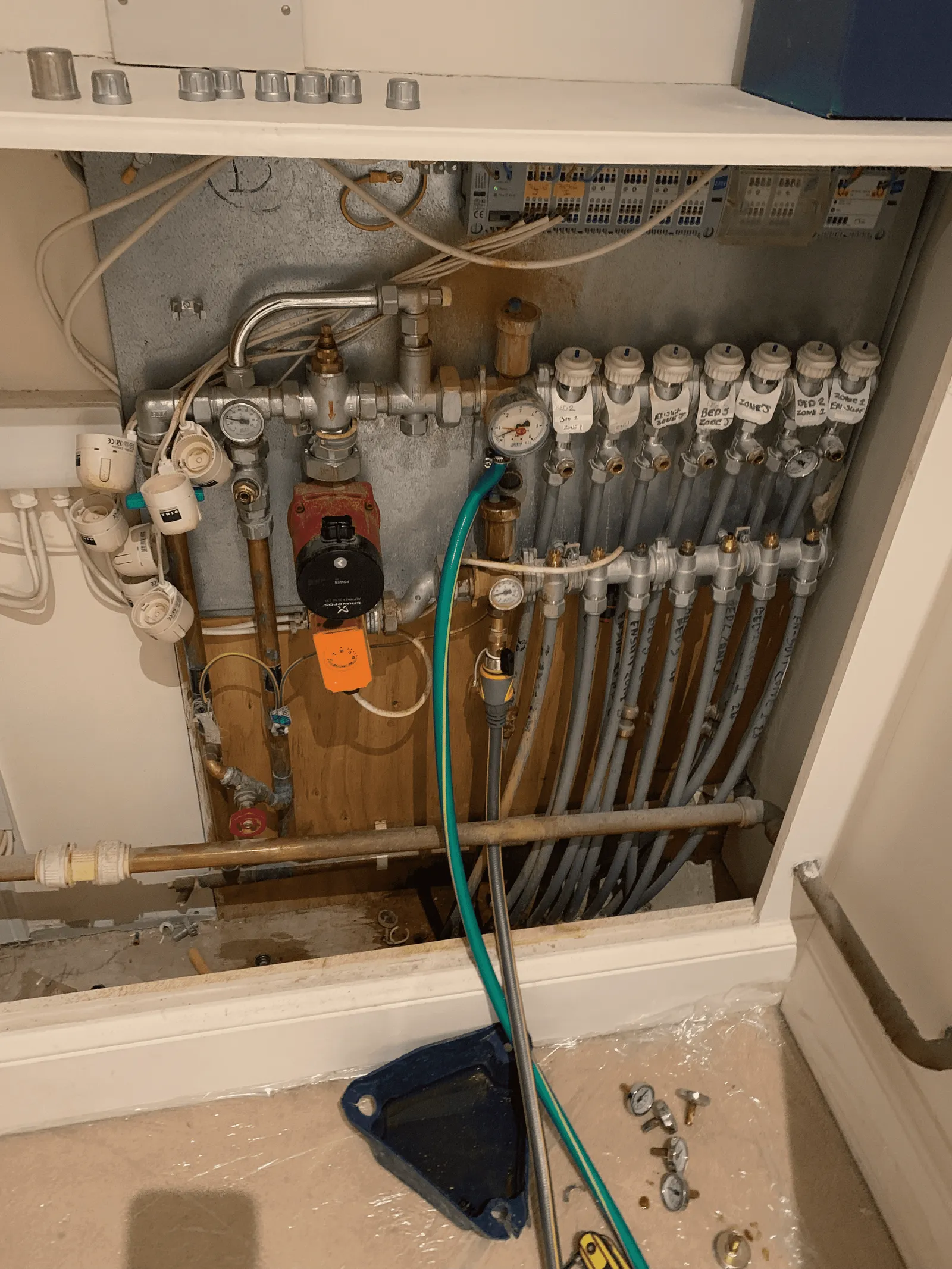
Problem one: a failed zone valve actuator. The UFH manifold serving the main living zone had an actuator that had jammed in the fully closed position. An actuator is an electromechanical component that opens and closes the zone valve in response to a demand signal from the thermostat — when heat is called for, the actuator opens, water flows through the loop, and the floor heats. When it fails in the closed position, no water flows regardless of what the thermostat demands. The zone is effectively dead. The floor stays cold.
This is not an uncommon failure mode — actuators have a finite service life and can seize, particularly in systems that haven't had regular maintenance. But it's also a failure that can be easily missed if an engineer doesn't work through the manifold component by component. Both previous contractors had focused on the boiler and the Heatmiser controller — neither had checked actuator function at the manifold level.
Problem two: a misconfigured Heatmiser NeoHub. Compounding the actuator failure, the Heatmiser NeoHub had a configuration error that meant the zone in question was not receiving a proper demand signal in any case. Even if the actuator had been functioning, the controller was not correctly addressing that zone. This misconfiguration had likely been introduced during an earlier update to the system — possibly when a new thermostat had been added elsewhere in the apartment — and had gone unnoticed because the floor had been warm enough during the milder months that the problem wasn't obvious.
The combination of these two faults — no actuator function, and no controller demand signal — meant the zone was doubly isolated. It would not have responded even if one issue had been resolved in isolation, which may partly explain why previous interventions had seemed inconclusive.
The Repair
With both faults clearly identified, the repair was straightforward. We replaced the failed actuator with a compatible OEM replacement — a job that takes less than thirty minutes and requires no access to the floor structure whatsoever. We then worked through the Heatmiser NeoHub configuration, correcting the zone addressing and testing each zone's response to demand. Every zone was verified before we left.
Total time on site for the repair phase: under two hours. No flooring was touched. No decorative surfaces were affected. The floor reached operating temperature within 45 minutes of the system being restarted.
Why This Matters for Mayfair Apartments
High-specification London apartments — particularly those with Heatmiser NeoHub or similar multi-zone smart control systems — require engineers who understand both the mechanical and digital sides of the system. A plumber who can service a boiler but isn't familiar with NeoHub configuration, or who checks the controller but doesn't test actuator function at the manifold, will miss faults of exactly this kind.
The more sophisticated a system is, the more points of potential failure it contains — and the more important it is that whoever attends has the breadth of knowledge to investigate all of them. This is a consistent theme in the properties we work in across Mayfair, Belgravia, Knightsbridge, and Marylebone: systems of genuine complexity, installed to a high standard, that require a similarly high standard of maintenance and diagnostic expertise.
The Outcome and Ongoing Relationship
The client now holds an annual PPM contract with RARE Plumbing. Each year, we carry out a full system service of the apartment: boiler service and CP12 gas safety certificate, full UFH system check including actuator testing and manifold inspection, Heatmiser calibration and firmware update, water quality testing and inhibitor top-up, and a written service report.
The kind of fault we found on that first visit — a failed actuator compounded by a controller misconfiguration — is precisely what a structured annual maintenance programme is designed to catch before it becomes a problem. Neither issue would have been present for months if the system had been properly serviced annually.
For any homeowner managing a property at this level, PPM is not an optional extra. It is the baseline standard of care that a complex mechanical system requires — and the difference between a heating system that performs flawlessly for decades, and one that fails at the worst possible time.
Talk to a specialist today.
Our Gas Safe engineers are available same-day across Central and North London. No call-out charge quoted upfront. No obligation.
Related Services