
Why Does My Boiler Keep Losing Pressure? — Causes & Fixes
The five most common causes of low boiler pressure in London homes — and what to do about each one.
Low boiler pressure is one of the most common heating complaints we receive from homeowners across Mayfair, Marylebone, Knightsbridge and the surrounding areas. The good news is that pressure loss is almost always traceable — but the cause matters enormously, because the wrong fix will leave you topping up the system indefinitely.
This guide explains the five main reasons a boiler keeps losing pressure, how to identify which one applies to your system, and what the correct remedy looks like. If your pressure is dropping by more than 0.5 bar per week, or you're topping up the system more than twice a year, you have an active fault that needs a Gas Safe engineer.
Don't just keep topping up
Refilling a pressurised system without fixing the cause dilutes your inhibitor concentration, which accelerates internal corrosion. It also masks the real fault. Find the cause — don't paper over it.
The 5 Most Common Causes
System Leak
Even a slow drip from a radiator valve, compression fitting or buried pipe joint will cause gradual pressure loss. Use the pressure gauge as a guide — if it drops by 0.5 bar or more per week, a leak is almost certainly the cause.
Failed Expansion Vessel
The expansion vessel absorbs the pressure generated as your heating water heats up. If its internal diaphragm has split or the pre-charge pressure is wrong, the vessel can no longer do its job — and the PRV vents water to compensate, dropping system pressure.
Pressure Relief Valve (PRV) Weeping
A PRV that is weeping or periodically opening will slowly drain water from the system. You may notice a damp patch or water stain near the condensate/overflow outlet. This is a safety device — it should not be capped or bypassed.
Radiator Valve Seals
Thermostatic radiator valve (TRV) bodies and lockshield valves develop leaks at their packing glands over time. The leak rate is often slow enough to go unnoticed visually but sufficient to drop boiler pressure over days.
Microbore or Underfloor Circuit Leaks
In London's luxury homes, hidden pipework in screed floors or behind plaster can develop pinhole leaks — particularly in hard water areas where scale-assisted corrosion attacks copper over time. These require leak detection equipment to locate.
How We Diagnose Pressure Loss
When RARE attends a pressure loss call-out, our process is systematic. We start with the boiler — checking the PRV outlet, the expansion vessel pre-charge pressure and the filling loop for internal leakage. We then move to the distribution system, methodically checking every visible joint, valve and radiator connection for signs of moisture or staining.
For buried or concealed leaks — common in underfloor heating circuits and hidden pipework in London's period townhouses — we use thermal imaging cameras and acoustic listening equipment to locate the source without unnecessary disruption to floors or walls.
- PRV and expansion vessel pressure test
- Filling loop isolation and leak test
- All radiator valve connections inspected
- Visible pipework checked for moisture
- Thermal imaging for concealed leaks
- Water quality and inhibitor concentration test
Boiler losing pressure in your London home?
Gas Safe registered engineers. Same-day response across Central and North London. Transparent fixed pricing.
Frequently Asked Questions
What pressure should my boiler be at?+
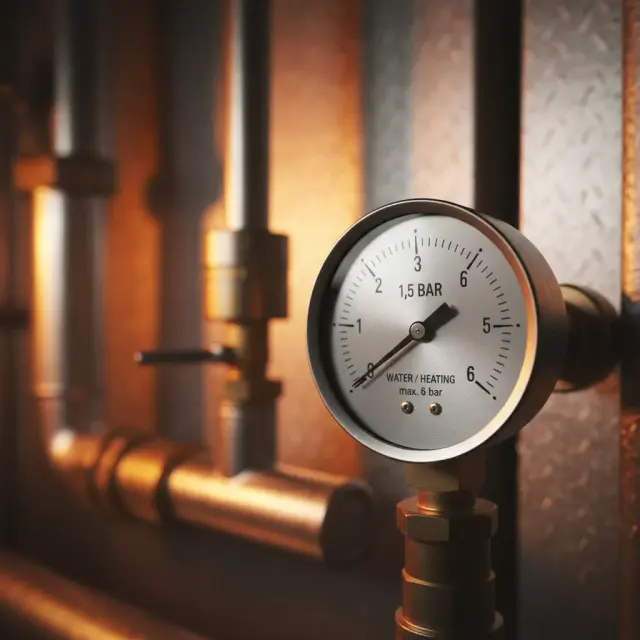
Most domestic boilers should sit between 1.0 and 1.5 bar when cold (system off). Some manufacturers specify up to 2.0 bar. Check your boiler manual — the correct range is usually marked on the pressure gauge with a green zone.
Is it safe to keep topping up my boiler pressure?+
Topping up once or twice a year is normal due to minor thermal expansion losses. If you're topping up monthly or more frequently, there is an active fault — a leak, failed expansion vessel or weeping PRV. Do not simply keep refilling; find the cause.
How do I re-pressurise my boiler?+
Most boilers have a filling loop — a braided flexible hose with two isolation valves, usually found under the boiler. Open both valves slowly while watching the pressure gauge, and close them again once the gauge reaches 1.0–1.5 bar. If in doubt, call a Gas Safe engineer.
Can low boiler pressure cause no heating?+
Yes. Most boilers have a pressure sensor that prevents firing below a minimum threshold (typically 0.5 bar) to protect the heat exchanger. If your boiler has locked out with a low pressure error, re-pressurising and resetting it should restore operation — but only if you've also addressed the underlying cause.
How much does it cost to fix boiler pressure loss?+
Costs vary by cause. Replacing an expansion vessel typically costs £200–£350 including parts and labour. Tracing and repairing a leak depends on location and access — surface leaks can be resolved in under an hour; buried pipework may require specialist leak detection.
Book a Boiler Engineer
Gas Safe registered. Same-day response across London.
020 7458 4949Book OnlineBook a Specialist Engineer
Gas Safe registered. Same-day response across London.