
What Causes Sludge in Heating Systems?
Why magnetite sludge forms, how London's hard water accelerates the process, and what it takes to remove it.
Sludge is one of the most destructive and preventable problems in central heating systems. In London — where hard water, ageing pipework and mixed-era heating installations are the norm in properties across Belgravia, Hampstead and Kensington — sludge accumulates faster than in most parts of the UK. Left untreated, it causes boiler failures, pump seizures and expensive heat exchanger replacement.
Understanding what sludge actually is, how it forms, and how to remove it correctly is essential knowledge for anyone responsible for maintaining a heating system in a prime London property.
What Is Heating Sludge?
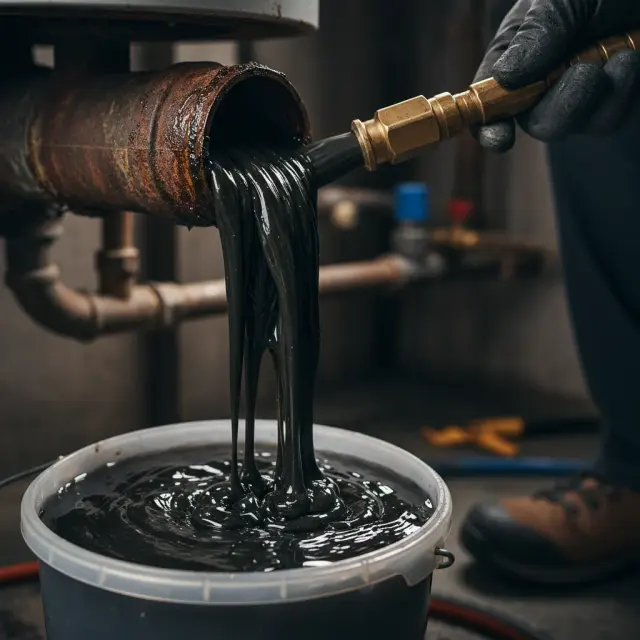
The black or dark brown substance found in heating systems is predominantly magnetite — iron oxide (Fe₃O₄) — formed by corrosion of the steel components in your heating circuit. Radiators, steel pipework and boiler heat exchangers all shed microscopic particles as they corrode. These particles circulate in the system water, where they agglomerate into a thick, abrasive sludge.
In London's hard water postcodes (W1, SW1, NW3 and across West London), calcium carbonate scale compounds the problem. Scale forms on heat exchanger surfaces, reducing heat transfer efficiency and trapping sludge particles in narrow passages. The combination of magnetite and limescale is significantly harder to remove than either alone.
Sludge is denser than water and gravitates to the lowest points in the system — typically the bottom of radiators and the inside of horizontal pipe runs. This is why cold bottoms on radiators are such a reliable indicator of contamination.
Why Does Sludge Form?
The corrosion that produces magnetite is driven by several factors, all of which are controllable with proper maintenance:
Oxygen ingress
Every time the system is opened for repairs or top-up, dissolved oxygen enters and accelerates corrosion. Systems with persistent pressure loss are topped up frequently — introducing oxygen every time.
Depleted inhibitor
Corrosion inhibitor creates a protective film on metal surfaces. Once it degrades — typically after 2–3 years without testing — corrosion resumes unchecked.
Dissimilar metals
London's period properties often contain both copper and steel pipework in the same circuit. Galvanic corrosion between dissimilar metals produces corrosion products at an accelerated rate.
Hard water scale
Limescale traps magnetite particles and provides nucleation sites for further corrosion. Systems without scale inhibition in London postcodes accumulate sludge significantly faster.
Symptoms of Sludge in Your Heating System
Power Flushing vs Chemical Flush
The appropriate treatment depends on the severity of contamination and the age of the system. For systems with significant sludge accumulation, a power flush is the most effective solution. This uses a high-flow, low-pressure machine to break up and expel sludge from every part of the circuit, followed by thorough rinsing and dosing with fresh inhibitor.
A chemical flush (also called a system flush) uses descaling and dispersant chemicals circulated through the system at normal pump speed. It is appropriate for moderate contamination and as a maintenance treatment, but will not fully remove established sludge deposits.
For underfloor heating circuits and systems in older properties, power flushing requires particular care — high flow rates through narrow manifold circuits can dislodge scale deposits that then block actuator heads or small-bore pipework. Our engineers assess the system carefully before recommending the appropriate method.
Sludge in your London heating system?
RARE carries out power flushing and chemical treatment across prime Central London. We test water quality, identify the contamination level and recommend the correct treatment for your system.
Frequently Asked Questions
How long does it take sludge to damage a heating system?+
It depends on water quality and inhibitor levels. In London's hard water areas, unprotected systems can show significant sludge accumulation within 3–5 years. With correct inhibitor and annual servicing, sludge formation is dramatically slowed.
Can I prevent sludge forming in my heating system?+
Yes. Maintain correct inhibitor concentration (test annually), fit a magnetic filter on the boiler return, and service your boiler every year. In London's hard water areas, a scale reducer on the filling loop is also advisable.
Is sludge covered by boiler warranty?+
Generally not. Most manufacturers require evidence of annual servicing and correct inhibitor levels to honour warranty claims. Sludge damage caused by lack of maintenance is typically excluded.
What is a magnetic filter?+
A magnetic filter (such as a Magnaclean or Fernox TF1) fits on the boiler return pipe and captures magnetite particles before they circulate and accumulate. They require cleaning annually at the boiler service.
How do I know if my heating system has sludge?+
The most reliable indicator is water colour when you bleed a radiator — clean water should be almost clear or very slightly tinted. Brown or black water indicates magnetite sludge. Cold spots at the bottom of radiators are another strong indicator.
Book a System Assessment
Water quality testing and power flush service across London.
020 7458 4949Book OnlineBook a Specialist Engineer
Gas Safe registered. Same-day response across London.