

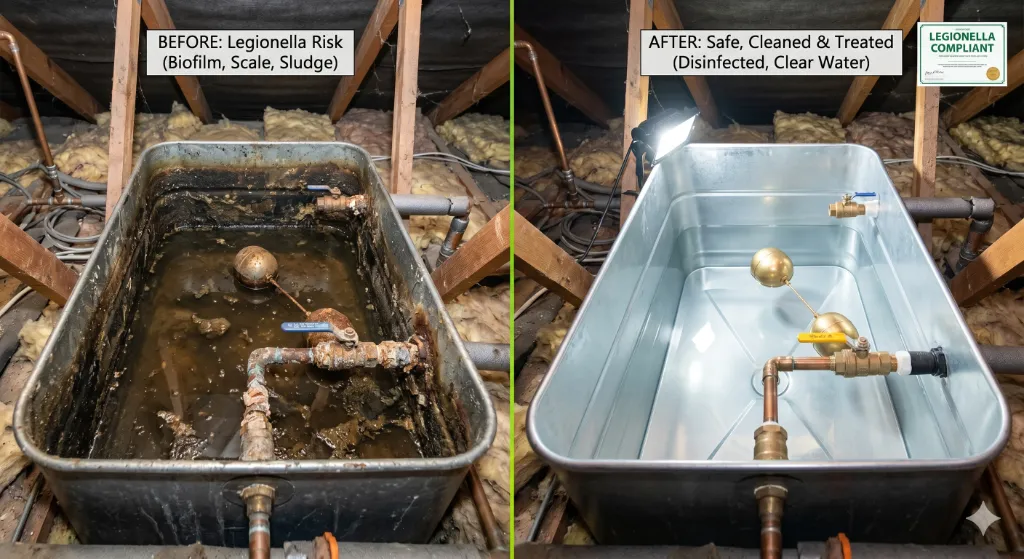
What every property manager and managing agent needs to know about Legionella compliance under ACoP L8 — risk assessments, tank cleaning, water testing and record-keeping.
Quick Answer
A Legionella risk assessment is a legal requirement under ACoP L8 for any managed building with a water system. It identifies risks in cold water tanks, pipework and outlets, and must be reviewed at least every two years, or sooner if the system changes. Property managers who fail to hold a current assessment risk enforcement action and personal liability.
At a Glance
Typical Causes
Stagnant water, infrequently used outlets, tanks not cleaned in 2+ years
Average Repair Time
1 day per property for assessment and tank cleaning
Emergency?
No — but overdue assessments should be treated as urgent
Approx. Cost Range
From £250 per property, tank cleaning from £180
Who Should Deal With It
A qualified water hygiene engineer
Domestic or Commercial
Both — required wherever a managed water system exists
Risk Level
High if left unmanaged — health and legal risk
Legionella Risk Assessments for Property Managers: A Complete Guide
For property managers operating in prime Central London, maintaining the highest standards of building safety is not merely a professional expectation—it is a legal mandate. Among the most critical health and safety obligations is the management of water systems to prevent the proliferation of Legionella pneumophila. At RARE Plumbing London, we have been supporting property portfolios with expert water hygiene solutions since 2013, ensuring full compliance with ACoP L8 and HSG274 guidelines.
Understanding Your Legal Duty
The Health and Safety at Work etc. Act 1974 and the Control of Substances Hazardous to Health Regulations 2002 (COSHH) place a duty on property managers, landlords, and duty holders to assess and control the risk of exposure to Legionella bacteria. Failure to manage these risks can lead to severe health consequences for tenants and significant legal liabilities for the property manager.
A comprehensive Legionella Risk Assessment (LRA) is the foundation of your water safety strategy. It involves identifying potential sources of risk within your water systems, evaluating the susceptibility of occupants, and implementing a robust control scheme. For large, multi-occupancy, or luxury residential developments, this is an ongoing process rather than a one-time task.
Identifying High-Risk Water Systems
Legionella bacteria thrive in water systems that operate between 20°C and 45°C. In high-end London properties, complex plumbing systems often feature various components that require regular monitoring:
- Cold water storage tanks that may suffer from stagnation or temperature fluctuations.
- Calorifiers and hot water cylinders that require precise temperature monitoring to prevent bacterial growth.
- Dead legs in pipework where water can sit undisturbed for long periods.
- Showerheads and taps that are infrequently used.
- Complex Commercial Boiler Services systems that integrate with building-wide heating and hot water distribution.
If your property’s storage tanks have not been inspected recently, we recommend reviewing our Legionella & Tank Cleaning services to ensure your systems remain compliant and safe.
The Components of a Professional Risk Assessment
A professional assessment goes beyond a simple visual check. It involves a systematic audit of the water hygiene infrastructure. Key steps include:
- Asset Register: Documenting every water-carrying component within the building.
- Temperature Profiling: Measuring temperatures at both the flow and return points of the system to ensure compliance with the "hot above 50°C, cold below 20°C" rule.
- System Design Audit: Identifying design flaws, such as redundant pipework or materials that may encourage biofilm growth.
- Management Procedures: Reviewing existing maintenance records and designating a "Responsible Person" to oversee ongoing water safety duties.
Common Symptoms
Causes
- 1Cold water storage tanks that have never been professionally cleaned or inspected
- 2Infrequently used outlets creating stagnant water and dead legs in the system
- 3Water temperatures sitting in the 20–45°C range where Legionella bacteria multiply
- 4Ageing or damaged tank covers allowing contamination ingress
- 5No documented water hygiene regime for the building
- 6Recent changes to the water system (refurbishment, new outlets) without a follow-up assessment
Ongoing Management and PPM
A risk assessment is only as effective as the remedial actions that follow. Property managers should adopt a proactive stance toward Planned Preventative Maintenance (PPM). Regular monitoring, including weekly flushing of little-used outlets and monthly temperature checks, is essential.
For property managers looking to streamline their compliance efforts, our PPM Membership provides a structured approach to scheduled inspections. By delegating your water hygiene monitoring to RARE Plumbing London, you ensure that every inspection is documented, every deviation is reported, and your properties remain fully compliant with ACoP L8 standards at all times.
Conclusion
Managing the risk of Legionella is a significant responsibility, but with the right technical support, it becomes a manageable component of your property maintenance strategy. Whether you are managing a single luxury apartment block or a large portfolio, RARE Plumbing London offers the expertise, Gas Safe registration, and local knowledge required to protect your assets and your residents.
Frequently Asked Questions
How often should a Legionella Risk Assessment be reviewed?
While there is no fixed interval, ACoP L8 recommends that assessments be reviewed whenever there is reason to suspect the assessment is no longer valid, such as changes to the water system, new information regarding risks, or a change in occupancy patterns. A professional review is typically recommended every two years.
What happens if a risk is identified during an assessment?
If significant risks are identified, a remedial action plan is generated. This may include cleaning and disinfection of storage tanks, removing redundant pipework, or adjusting thermostat settings on boilers to ensure water temperatures remain outside the growth range for Legionella.
Who is legally responsible for Legionella compliance?
The "Duty Holder"—usually the property manager, landlord, or building owner—is responsible for ensuring that a risk assessment is completed and that a written scheme of control is in place. While you can appoint a third party to conduct the work, the legal responsibility remains with the duty holder.
Do domestic properties require a Legionella assessment?
Yes, any property rented out as a domestic dwelling has a requirement for a basic risk assessment. The level of complexity will depend on the size and age of the property, but the legal requirement to ensure the water system is safe remains constant for all landlords.
Why choose RARE Plumbing London for water hygiene?
As specialists in prime Central London property maintenance since 2013, we combine high-end plumbing expertise with deep regulatory knowledge. Our Gas Safe registered engineers are fully trained in ACoP L8 compliance, ensuring your buildings are managed with precision, care, and professional accountability.
Engineering Insight
How Our Engineers Diagnose It
We begin with a full inspection of the cold water system: tanks, distribution pipework, and all outlets, identifying dead legs and infrequently used points.
Water temperatures are recorded at sentinel taps — both cold and hot — to confirm they sit outside the bacteria's preferred growth range.
Water samples are taken from tanks and sent to an accredited laboratory for Legionella testing.
Tanks are visually inspected for sediment, biofilm, cover condition and structural integrity, with photographs taken for the report.
Findings are compiled into a written ACoP L8 compliant risk assessment with a clear action list and recommended review date.
Preventative Maintenance
Frequently Asked Questions
ACoP L8 recommends a review at least every two years, or sooner if there's a change to the water system, occupancy, or if a previous assessment identified issues that need re-checking. Many property managers choose annual reviews for higher-risk buildings.
Talk to a specialist today.
Our Gas Safe engineers are available same-day across Central and North London. No call-out charge quoted upfront. No obligation.
Related Services