
Oversized Boiler Problems — Why Bigger Isn't Better
How an oversized boiler causes short cycling, uneven heating and premature failure — and what to do about it in London homes.
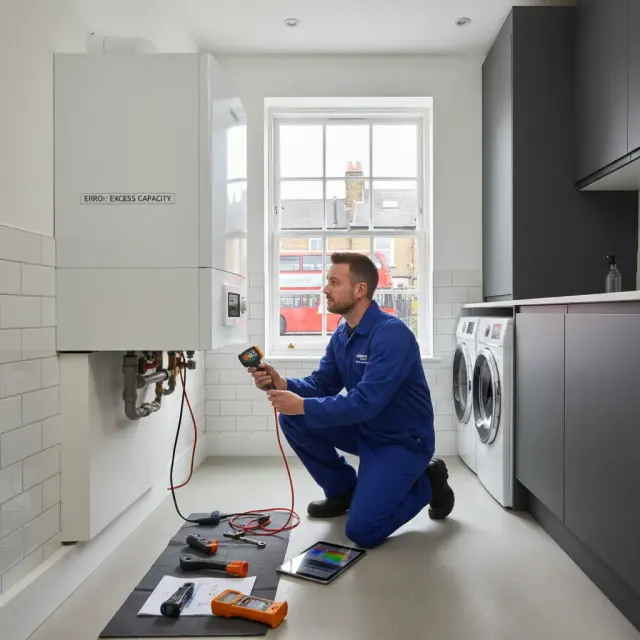
One of the most damaging and preventable mistakes in boiler installation is oversizing — fitting a boiler that is significantly more powerful than the property requires. In prime London properties across Hampstead, Holland Park and Belgravia, where contractors sometimes err on the side of "bigger is safer," oversized boilers are remarkably common.
The consequences of oversizing are not immediately obvious. The boiler fires, the radiators get hot, the hot water works. The problems accumulate quietly over months and years — increasing fuel bills, persistent comfort issues, and ultimately a boiler that fails years before it should.
Understanding what oversizing actually does to a heating system — and how to identify it — is essential for any homeowner or property manager responsible for a complex London heating installation.
What Is Short Cycling?
When a boiler is too large for its system, it heats the water to setpoint temperature far faster than the heating circuit can absorb the heat. The thermostat or boiler aquastat sees the target temperature reached almost immediately, and the burner shuts off. A few minutes later, the water cools slightly and the boiler fires again.
This rapid on-off pattern is called short cycling. It directly causes several problems: the boiler never reaches efficient operating temperature (the flue gas analysis looks poor, efficiency is significantly below rated); the gas valve, burner and ignition components cycle far more frequently than they were designed to; and thermal stress on the heat exchanger from repeated heating and cooling leads to premature failure.
A correctly sized boiler should run for at least 10–15 minutes per cycle during the coldest design conditions. If yours is cycling faster than this, it warrants investigation.
Signs Your Boiler May Be Oversized
Why Does Oversizing Happen?
Oversizing most commonly occurs when a contractor replaces an existing boiler with the next model up "to be safe," rather than calculating the property's actual heat loss. It also occurs when a property has been extended or refurbished — insulation levels improved, windows replaced — but the boiler has not been re-assessed against the updated heat loss figure.
In London's period townhouses, this problem is particularly common. A Belgravia or Marylebone house that had its original Victorian radiator system sized for an open fire backup — with oversize cast iron radiators throughout — may have had significant heat losses originally. Upgrades to double glazing, insulation and draught-proofing over the years reduce the heat loss substantially, but the boiler is simply upsized at each replacement without reconsidering the distribution system.
How RARE Assesses and Corrects Oversizing
Our approach begins with a BS EN 12831 heat loss calculation for the property. This accounts for every room's dimensions, glazing area, wall construction, roof and floor insulation levels, and the local design outdoor temperature. The result gives us the maximum heat demand the system should ever need to meet.
We then compare this figure to the installed boiler's output. Where the boiler is significantly oversized (more than 20% above the calculated design load), we have three options: de-rate the boiler's maximum output via the engineer menu settings, install a correctly sized replacement, or — where the hydraulic design is also deficient — redesign the system to include appropriate buffering.
- BS EN 12831 heat loss calculation for your property
- Comparison of boiler output to design heat load
- Assessment of modulation capability and minimum output
- Recommendation on de-rating, replacement or redesign
- Implementation and commissioning with combustion analysis
Think your boiler might be oversized?
RARE carries out boiler sizing assessments and system redesigns across prime Central London. Gas Safe registered engineers. Transparent pricing.
Frequently Asked Questions
How do I know if my boiler is oversized?+
The clearest sign is short cycling — the boiler fires and reaches setpoint temperature far too quickly, then shuts off. If your boiler is running for fewer than 10 minutes at a time and cycling more than 6–8 times per hour during cold weather, oversizing is likely. A heating engineer can confirm by calculating your property's design heat loss and comparing it to the boiler's output.
Can I derate an oversized boiler?+
On most modern modulating boilers, yes. The maximum output can be reduced in the engineer menu — sometimes called the "burner load" or "maximum CH output" setting. This does not affect the boiler mechanically but limits how hard it fires. This is not a permanent solution if the oversizing is extreme, but can significantly reduce short cycling.
Does boiler size affect hot water performance?+
It can do. Some combi boilers route full output through the DHW circuit on demand — oversizing rarely causes problems for hot water. However, on system boilers with cylinders, oversizing causes the cylinder to charge very quickly and the boiler to short cycle during cylinder heating cycles.
What is the correct way to size a boiler?+
Correct sizing requires a heat loss calculation for the property — accounting for floor area, glazing, insulation levels, construction type and design outdoor temperature. In the UK this is done using BS EN 12831. For prime London properties, this should also account for any listed building restrictions that limit insulation upgrades.
Is it worth replacing an oversized boiler?+
If the boiler is under eight years old and can be adequately de-rated, replacement is usually not necessary. For older boilers where the oversizing has caused significant wear — particularly to the heat exchanger and gas valve — replacement with a correctly sized unit will typically pay back in energy savings within three to five years.
Book a Boiler Assessment
Heat loss calculation and sizing review for London properties.
020 7458 4949Book OnlineRelated Services
Book a Specialist Engineer
Gas Safe registered. Same-day response across London.