
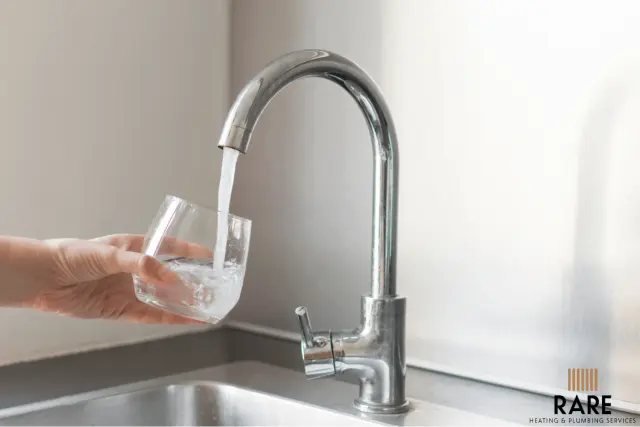
London's water is classified as "very hard" — 290–350mg/l in most prime central postcodes. This is the single biggest preventable cause of boiler damage, appliance failure and high energy bills that we encounter in London homes.
How Hard is London's Water?
Water hardness is measured in milligrams of calcium carbonate per litre (mg/l). The UK average is around 200mg/l. Scotland's water is typically below 50mg/l — extremely soft. London sits at 290–350mg/l in most central postcodes — "very hard" by any classification.
This hardness comes from the geology of South East England. London's water supply is drawn largely from the Thames and from boreholes in the chalk aquifer beneath the city. As water moves through chalk and limestone, it dissolves calcium carbonate and magnesium bicarbonate at high concentrations. By the time it reaches your tap, it is significantly harder than water supplied to most UK cities.
Thames Water publishes hardness data by postcode. For properties across Mayfair, Knightsbridge, Belgravia, Marylebone and South Kensington, water consistently tests in the "very hard" band — a daily invisible challenge for every boiler, cylinder and appliance in the building.
London Hard Water by Area
| Area | Postcode | Hardness (approx.) |
|---|---|---|
| Mayfair | W1 | 310–340 mg/l |
| Marylebone | W1U | 300–340 mg/l |
| Knightsbridge | SW1X | 310–350 mg/l |
| Belgravia | SW1W | 310–350 mg/l |
| Hampstead | NW3 | 290–330 mg/l |
| St John's Wood | NW8 | 290–330 mg/l |
| Notting Hill | W11 | 300–340 mg/l |
| South Kensington | SW7 | 310–350 mg/l |
Source: Thames Water hardness data. Figures are approximate and may vary by supply zone.
What Does Hard Water Do to Your Home?
When hard water is heated, dissolved calcium and magnesium precipitate out and form solid limescale. This is the white chalky residue on your kettle element, the mineral crust around your shower head, the deposits on tiles and glassware. Inside hidden pipework, boilers and cylinders, the same process occurs — but invisibly, and with far more serious consequences.
Boiler heat exchanger damage
Scale insulates the heat exchanger, causing overheating and failure. The most common and expensive boiler repair in London.
Cylinder element failure
Limescale coats immersion heater elements in Megaflo and unvented cylinders, reducing efficiency and causing element burnout.
Blocked pipework
Long-term scale accumulation narrows internal pipe diameter, reducing water pressure and flow throughout the property.
Appliance damage
Washing machines, dishwashers and coffee machines all suffer shortened lifespans in hard water areas without protection.
How Limescale Destroys a Boiler
A boiler's heat exchanger works by transferring heat from the burner into the water. When limescale coats the inside of the heat exchanger, it acts as an insulator — the boiler has to work harder and run hotter to achieve the same output. Energy consumption rises, operating temperature increases, and the heat exchanger is subjected to thermal stress it was not designed to handle.
The result is overheating, micro-cracking, and eventually complete heat exchanger failure. Replacing a heat exchanger typically costs £500–£1,200 + VAT — sometimes more than the cost of a water softener. For premium boilers like Vaillant ecoTEC, Viessmann Vitodens and ATAG, manufacturers specify water treatment in hard water areas and may decline warranty claims for scale-related damage.
Water Softener Options for London Homes
Whole-house ion exchange water softener — the gold standard. Installed where the mains enters the property, the softener exchanges calcium and magnesium ions for sodium, producing genuinely soft water (0 ppm hardness) throughout the entire home. Protects all pipework, all appliances, your boiler, your cylinder, your skin and your laundry. Annual salt replenishment required. Supply and installation from £800–£3,200 + VAT.
BWT OnePipe Pearlwater — the most advanced system currently available. Delivers whole-house softening from a single pipeline and adds a mineralised drinking water outlet at the kitchen tap — removing the traditional drawback of softened tap water. As authorised BWT installers, RARE Plumbing can specify, supply and install this system across London. Read our full BWT OnePipe Pearlwater guide.
Electrolytic scale inhibitor — a passive device fitted to the mains supply that reduces (but does not eliminate) scale formation. No salt, no maintenance, no ongoing running costs. Significantly cheaper than a full softener and appropriate for rental properties, flats or where space is extremely limited. Less effective than a full softener for properties with premium boilers.
Magnetic filter (Magnaclean) — fitted to the heating circuit return, not the mains supply. Captures magnetite and sludge particles before they can accumulate in the boiler or radiators. An essential addition to any London heating system, but addresses sludge rather than hardness. Read our guide on heating system sludge.
The ROI of a Water Softener in London
The financial case for water softening in London is compelling. Studies consistently show that just 1.6mm of limescale on a heating element increases energy consumption by approximately 12%. In a London property with a premium boiler running eight months of the year, this compounds significantly.
Beyond energy savings, a water softener extends the life of your boiler, cylinder, washing machine and dishwasher. It reduces cleaning time and chemical use (soap and detergent lather far more effectively in soft water). And it protects against the cost of heat exchanger or cylinder replacement.
For London's prime residential market, the ROI on a quality water softener is typically achieved within 3–5 years — after which every year of extended appliance life and reduced energy consumption is a direct saving.
Power Flushing to Remove Existing Scale
If scale has already accumulated in your heating system, a power flush is often necessary before installing a water softener. Our engineers use high-velocity water flow and specialist descaling chemicals to remove deposits throughout the system — clearing scale from radiators, pipework and the boiler itself before clean, softened water is introduced.
Protect your home from London's hard water
We survey, specify and install water softeners across Mayfair, Marylebone, Hampstead and all prime London areas.
Frequently Asked Questions
Does London have hard water?
Yes — London has some of the hardest water in the UK. Thames Water mains water in central London typically measures 290–350mg/l (as calcium carbonate), classified as "very hard". Water travelling through chalk and limestone geology in the South East picks up calcium and magnesium at very high concentrations, far above the UK average of around 200mg/l.
What are the signs of limescale damage in my home?
Common signs include white chalky deposits on taps, shower heads and tiles; a kettling or rumbling sound from your boiler; reduced hot water pressure; higher than normal energy bills; and shortened appliance lifespans. In severe cases, limescale can cause boiler heat exchanger failure — one of the most expensive boiler repairs.
What is the difference between a water softener and a scale inhibitor?
A water softener completely removes hardness minerals via an ion exchange process, producing genuinely soft water (0 ppm hardness) throughout your home. A scale inhibitor is a passive device that treats water to reduce (but not eliminate) scale formation — it's less effective but significantly cheaper. For London homes with premium heating systems, a full softener is nearly always the better long-term investment.
Will a water softener protect my boiler warranty?
Yes, in most cases. Premium boiler manufacturers including Vaillant, Viessmann and ATAG specify maximum water hardness levels and may decline warranty claims related to scale damage in areas with very hard water. Installing a WRAS-approved water softener demonstrates you've taken appropriate steps to protect your system.
Is softened water safe to drink?
Softened water is safe for most people, but it has a slightly elevated sodium content compared to tap water. For drinking, many households retain a separate unsoftened cold water supply to the kitchen tap, or use a system like BWT OnePipe Pearlwater which delivers mineralised drinking water alongside whole-house softening from a single pipeline.
How much does water softener installation cost in London?
A whole-house water softener typically costs £800–£3,200 + VAT for supply and installation in London, depending on property size, access and unit specification. Premium systems like the BWT OnePipe Pearlwater (£2,800–£3,200 + VAT) are at the top end, but also include the integrated magnesium- and zinc-mineralised drinking water capability. The long-term ROI — in energy savings, reduced repairs and extended appliance life — is usually achieved within 3–5 years.