
For hotels, offices and managed buildings, plumbing failures mean lost revenue, not just inconvenience. How strategic planned maintenance cuts emergency callouts and downtime.
Quick Answer
The most effective way to reduce plumbing downtime in a commercial building is a planned preventative maintenance (PPM) programme: scheduled inspections of boilers, pumps, valves, water storage and pipework that catch failures before they interrupt operations. Buildings on structured PPM typically see 60–80% fewer emergency callouts, and the cost of the programme is usually far below the revenue lost to a single day of closed bathrooms, failed hot water or an escape of water.
The real cost of plumbing downtime
When plumbing fails in a commercial building, the invoice for the repair is rarely the biggest number. A hotel that loses hot water sells no rooms that night and refunds the ones it sold. An office with failed WCs can breach workplace regulations within hours. An escape of water above a trading floor or guest rooms creates remediation costs, insurance excesses and reputational damage that dwarf the burst fitting that caused them.
Reactive maintenance — waiting for failure, then calling an emergency plumber — guarantees that failures happen at the worst possible time, because components fail under peak load: hot water systems in the morning rush, heating during the first cold week, pumps during full occupancy.
What strategic maintenance actually means
Strategic commercial plumbing maintenance is not 'more frequent repairs'. It's a planned programme built around three questions:
- What can fail? — an asset register of every boiler, pump, valve, cylinder, tank, TMV and pipe run in the building
- What does failure cost? — ranking assets by operational impact, not replacement cost. A £40 float valve above a server room outranks a £4,000 pump with a standby twin.
- What prevents it? — a maintenance calendar that matches each asset's inspection and service interval, with compliance tasks built in
Causes
- 1Reactive-only maintenance — waiting for failure instead of preventing it
- 2No asset register, so critical components are invisible until they fail
- 3Seized isolation valves turning small repairs into building-wide shutdowns
- 4Scale and sludge accumulation in unmonitored plant
- 5Compliance tasks (Legionella, TMVs) treated as paperwork rather than maintenance
The core elements of a commercial PPM programme
Plant room and heating
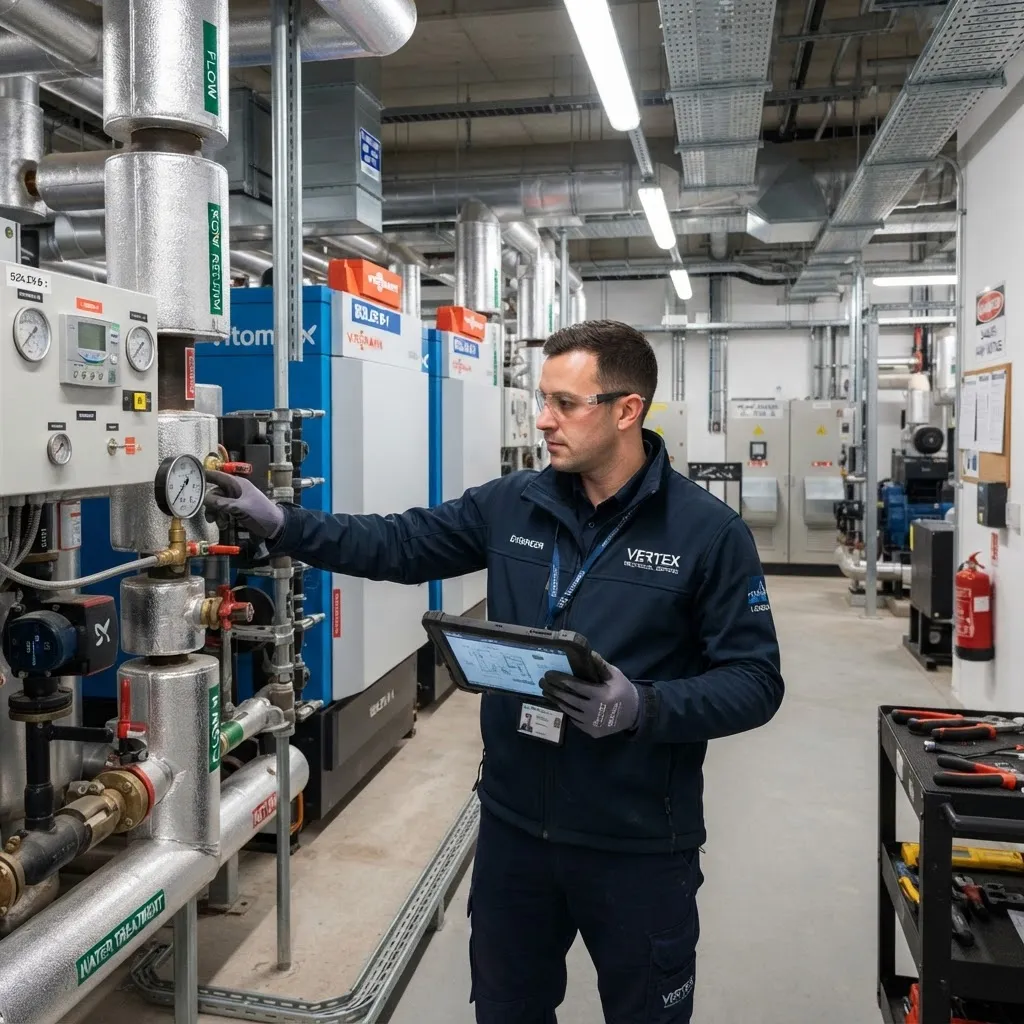
Annual (or biannual) servicing of commercial boilers, burner checks, flue gas analysis, pump inspections, pressure vessel checks and expansion vessel recharging. Most 'sudden' boiler failures announce themselves months in advance through readings a service engineer will catch.
Water hygiene and compliance
Cold water tank inspection and cleaning, Legionella risk assessments, temperature monitoring regimes and TMV servicing. These are legal duties under ACoP L8 for anyone in control of commercial premises — and failures here can close a building outright.
Distribution and fixtures
Scheduled checks of isolation valves (a seized valve turns a five-minute repair into a building-wide shutdown), flexible hoses, WC internals, urinal controls, and drainage runs. Quarterly walk-throughs catch the slow leaks, weeping joints and hairline failures that become floods.
Documentation
Every visit logged, every reading recorded, every recommendation tracked. Beyond compliance, the data shows failure patterns — which risers scale fastest, which plant is nearing end-of-life — so replacement is budgeted, not emergency-priced.
What the numbers look like
- Buildings moving from reactive to planned maintenance typically cut emergency callouts by 60–80% within the first year
- Planned work costs a fraction of emergency work — no out-of-hours rates, no expedited parts, no consequential damage
- Plant life extends measurably: a maintained commercial boiler routinely reaches 15–20 years; a neglected one often fails inside 10
Building the right programme for your building
A 20-room boutique hotel, a multi-tenant office and a residential block with concierge each need different schedules — but the method is the same: survey, asset register, risk ranking, calendar, documentation. We run PPM programmes for hotels, offices, estates and concierge-managed buildings across London, with 24/7 emergency response included for the failures no programme can fully eliminate.
Learn more about our commercial plumbing services and PPM maintenance plans, or read how estate managers reduce boiler breakdowns.
Preventative Maintenance
Frequently Asked Questions
A scheduled programme of inspections and servicing across a building's plumbing assets — boilers, pumps, tanks, valves and pipework — designed to catch developing failures before they interrupt operations, rather than repairing after breakdown.
Talk to a specialist today.
Our Gas Safe engineers are available same-day across Central and North London. No call-out charge quoted upfront. No obligation.
Related Services