
London's hard water quietly destroys boilers, cylinders, taps and appliances. Here's how a professionally installed water softener protects your home — and what installation actually involves.
Quick Answer
A water softener removes the calcium and magnesium that make London water hard, preventing limescale from forming inside your boiler, hot water cylinder, appliances and fittings. Professionally installed, a whole-house softener typically costs £1,800–£4,500 including installation and can extend appliance lifespan by years while cutting energy bills.
Why London homes need hard water treatment
London sits on chalk, so its water is among the hardest in the UK — typically 250–300ppm of calcium carbonate. Every litre that passes through your home leaves mineral deposits behind. Over time, limescale coats heat exchangers, narrows pipework, fouls shower valves and shortens the life of dishwashers, washing machines and coffee machines.
Just 1.6mm of scale on a boiler heat exchanger can reduce heating efficiency by around 12%. In practice, we see boilers in unprotected London homes failing five to seven years earlier than they should — and premium fittings from brands like Dornbracht or THG Paris suffering visibly within two.
What a water softener actually does
A whole-house water softener uses ion-exchange resin to swap calcium and magnesium ions for sodium ions before water enters your plumbing. The result is genuinely soft water throughout the property — not just conditioned or 'inhibited' water.
Water softener benefits at a glance
- Boiler and cylinder protection — heat exchangers and immersion elements stay scale-free, protecting warranties and efficiency
- Longer appliance life — dishwashers, washing machines and taps last significantly longer
- Lower energy bills — scale-free heating surfaces transfer heat efficiently
- Better bathrooms — no white residue on glass, stone or brassware; softer skin and hair
- Less cleaning — limescale prevention means kettles, showers and sinks stay spotless
Whole house filtration vs point-of-use solutions
Jug filters and tap-mounted units only treat drinking water at a single outlet — they do nothing for your boiler, cylinder or bathrooms. Electronic 'descalers' alter scale behaviour but don't remove hardness minerals. For genuine limescale prevention across the whole property, a plumbed-in ion-exchange softener at the incoming main is the only proven solution. We install and recommend BWT softeners, alongside Harvey and Hague systems.
Causes
- 1London mains water is very hard (250–300ppm calcium carbonate) due to chalk aquifers
- 2Heating water accelerates scale formation — boilers and cylinders are hit hardest
- 3Premium fittings and appliances are particularly sensitive to scale damage
- 4Unprotected systems lose efficiency progressively as scale builds
What professional installation involves
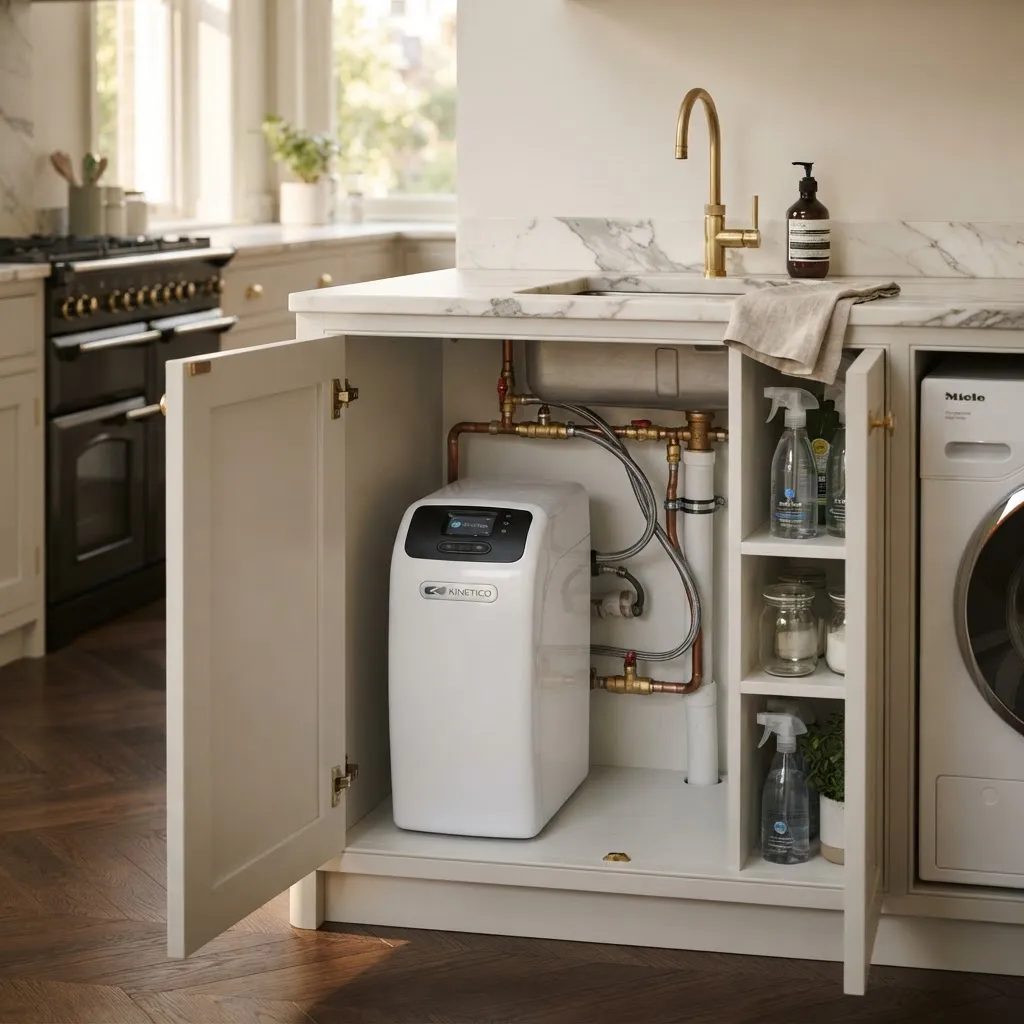
- Survey — we assess your incoming main, stopcock location, available space and water pressure. Softeners need a drain connection and a small amount of space, usually under the kitchen sink, in a utility room or garage.
- Bypass and connection — the softener is fitted on the rising main with a bypass valve, so your supply is never interrupted.
- Hard water drinking tap (optional) — many clients keep one unsoftened tap for drinking water.
- Commissioning — we set the hardness level, test the output and show you how to top up block salt or tablet salt.
A straightforward installation takes half a day. Complex properties — basements, mansion flats, or homes with unusual mains routing — may take a full day.
What does water softener installation cost in London?
Expect £1,800–£2,800 for a quality compact softener supplied and installed in a typical London home, and £3,000–£4,500 for premium high-flow units suited to larger properties with multiple bathrooms. Running costs are modest — block salt typically costs £5–£10 per month for a family home. Against a £4,000+ boiler replacement brought forward by years, protection pays for itself.
Choosing the right softener
The right unit depends on occupancy, bathroom count, flow rate and space. Our comparison guides cover the market leaders: BWT vs Harvey, BWT vs Hague and our BWT Perla Silk review. Or read our full guide to water softener installation in London.
Preventative Maintenance
Frequently Asked Questions
A quality compact softener supplied and installed typically costs £1,800–£2,800. Premium high-flow units for larger homes with multiple bathrooms run £3,000–£4,500. Running costs are around £5–£10 per month in block salt.
Talk to a specialist today.
Our Gas Safe engineers are available same-day across Central and North London. No call-out charge quoted upfront. No obligation.
Related Services