

Quick Answer
Discover why central heating needs inhibitor in 2026. Learn how inhibitors protect your system, ensure compliance, and maintain efficiency.
TL;DR:
- A central heating inhibitor prevents internal corrosion and sludge buildup, protecting system components.
- UK regulations mandate proper dosing, testing, and documentation to maintain warranties and efficiency.
A central heating inhibitor is a chemical additive that prevents internal corrosion and sludge formation inside your heating system. Without it, metal components corrode, magnetite sludge accumulates in radiators, and your boiler works harder to deliver the same heat. Under BS 7593:2019, using a corrosion inhibitor at the manufacturer’s specified concentration is mandatory for all UK domestic heating systems. Ignoring this requirement voids manufacturer warranties and breaches building regulations. This guide explains how inhibitors work, what compliance demands, and how to maintain protection year after year.
Why central heating needs inhibitor: the core reason
Inhibitors are not optional additives. They are fundamental chemical protectants that form a barrier preventing the leading cause of system failures: magnetite sludge and internal corrosion. Without this barrier, oxygen in the system water reacts with steel radiators and copper pipework, producing iron oxide particles. Those particles accumulate as a thick black sludge, blocking flow and forcing your boiler to consume more energy to compensate.
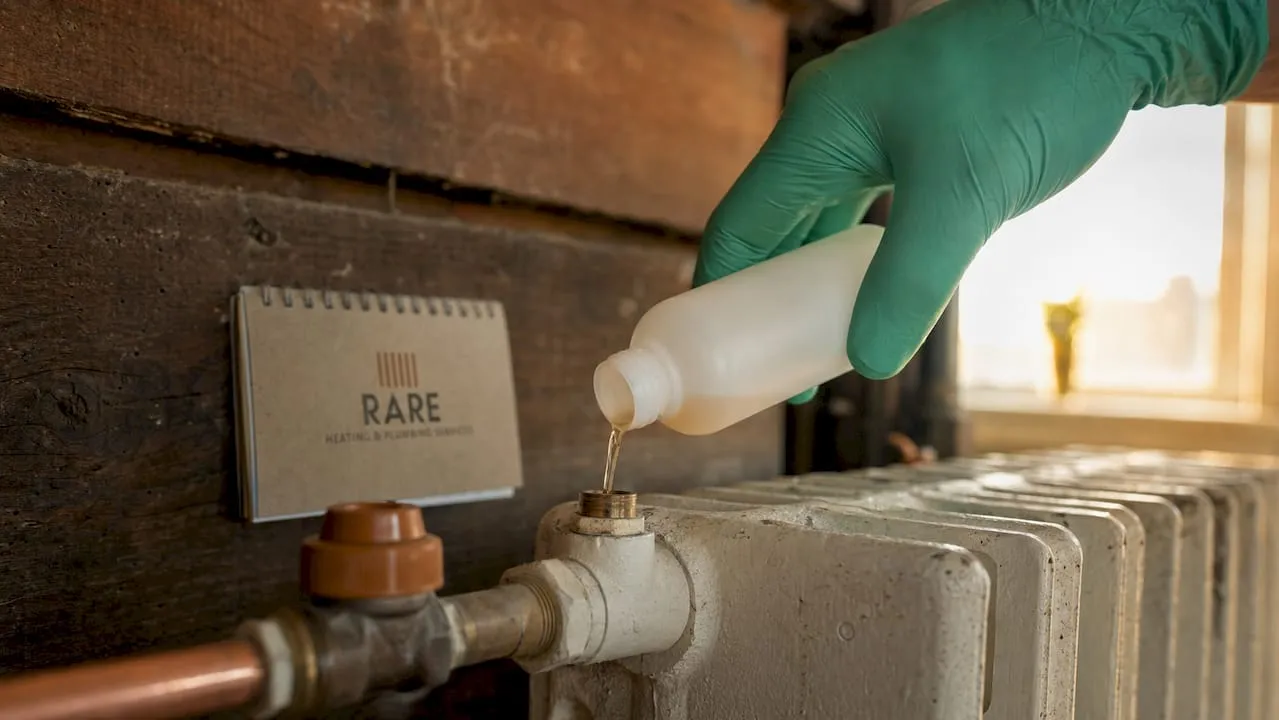
The impact on efficiency is direct and measurable. Cold spots at the bottom of radiators, a boiler that cycles on and off frequently, and a pump that strains audibly are all signs of sludge build-up. Treating the problem after it develops costs far more than preventing it with a correctly dosed inhibitor from the outset.
How does an inhibitor work to protect central heating systems?
An inhibitor works by coating the internal surfaces of your pipework, radiators, and heat exchanger with a thin protective film. This film physically separates the metal from the oxygenated water circulating through the system. The result is that corrosion reactions slow dramatically, and the production of magnetite particles drops to negligible levels.
The chemistry involves two mechanisms working together:
- Film formation: The inhibitor molecules bond to metal surfaces, creating a barrier that blocks oxygen and acidic compounds from reaching the steel or copper beneath.
- pH buffering: Inhibitors maintain the system water within a slightly alkaline pH range. Acidic water accelerates corrosion; alkaline water suppresses it.
- Scale suppression: Hard water deposits calcium and magnesium scale on heat exchanger surfaces. Many inhibitors include scale inhibitors that prevent this build-up, which is particularly relevant for London properties with hard mains water.
- Aluminium compatibility: Modern boilers often use aluminium heat exchangers. Aluminium-compatible inhibitors are required for these systems, as standard formulations can accelerate corrosion in aluminium components.
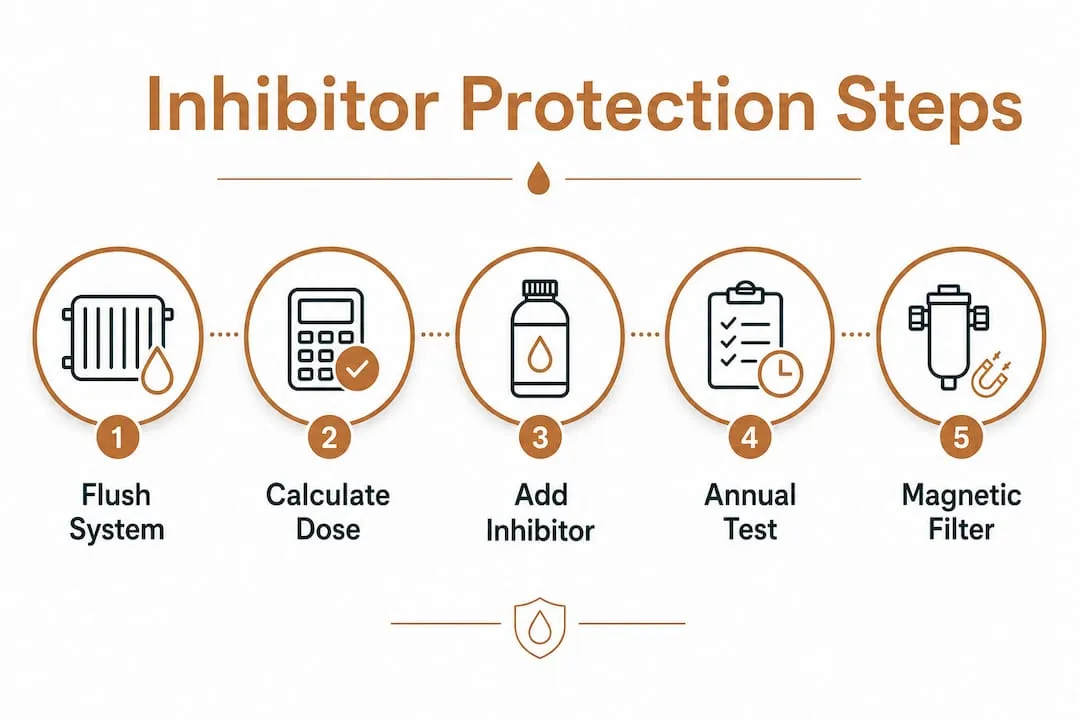
A magnetic filter works alongside an inhibitor but does not replace it. The filter traps existing magnetite debris to protect the pump and heat exchanger, while the inhibitor prevents new corrosion from forming. Both are required for a fully protected system.
Pro Tip: If your system has a magnetic filter, clean it annually. A filter clogged with magnetite cannot trap new particles, and the inhibitor alone cannot remove debris already in circulation.
What are the compliance and maintenance requirements for inhibitors?
UK law sets clear obligations for inhibitor use. BS 7593:2019 is the governing standard, and it applies to every domestic central heating installation in the country. Compliance is not discretionary.
The key requirements under BS 7593:2019 are:
- Dose at the correct concentration. The standard requires dosing at the manufacturer’s specified rate, typically 1 litre per 100 litres of system water volume. Under-dosing leaves metal surfaces unprotected.
- Verify concentration after dosing. Simply adding inhibitor is insufficient. You must test the concentration using a brand-specific test kit or send a water sample for laboratory analysis.
- Document the results. Test results must be recorded on the Benchmark Commissioning Checklist. This document is the primary evidence that a system was commissioned correctly.
- Re-test annually. Annual inhibitor concentration verification is required to maintain manufacturer warranties. A single dosing at installation does not satisfy ongoing compliance.
- Top up when levels fall. If testing reveals low concentration, top up immediately and retest to confirm adequate protection.
The consequences of non-compliance are significant. Boiler manufacturers routinely deny warranty claims where inhibitor records are absent or incomplete. Building Regulations Part L, which governs energy efficiency, also references BS 7593:2019 as a compliance pathway. A system without documented inhibitor use can fail a Part L assessment. For property managers overseeing multiple units, the compliance requirements for managed buildings extend this obligation across every heating circuit in the portfolio.
| Requirement | Detail |
|---|---|
| Dosing standard | BS 7593:2019 mandates inhibitor at manufacturer’s specified concentration |
| Verification method | Brand-specific test kit or laboratory water sample analysis |
| Documentation | Results recorded on Benchmark Commissioning Checklist |
| Frequency | Annual re-testing and top-up as required |
| Consequence of failure | Warranty voided; potential breach of Building Regulations Part L |
How to properly maintain your central heating system with inhibitors
Correct maintenance starts before you add a single drop of inhibitor. A contaminated system must be cleaned first.
Flush before you dose
Adding inhibitor to a heavily sludged system without a prior flush renders the treatment largely ineffective. The inhibitor cannot reach metal surfaces through a layer of magnetite and debris. A chemical clean or powerflush removes existing contamination and allows the inhibitor to bond properly to clean metal. This step is non-negotiable for any system showing signs of sludge.
Calculate the correct dose
Dosing accuracy matters. System volume calculation uses the number of radiators plus the boiler and pipework volume. As a practical guide, one 500 ml dose covers approximately 10 single-panel radiators, or roughly 1 litre per 100 litres of system water. Measure your system before purchasing inhibitor, not after.
Adding inhibitor to your system
The method depends on your system type:
- Sealed systems: Add inhibitor through the filling loop or a radiator bleed valve using a dosing pot or inhibitor pump.
- Open-vented systems: Add inhibitor directly to the feed and expansion tank in the loft.
- After adding: Run the system for 30 minutes at full temperature to circulate the inhibitor throughout all radiators and pipework.
Signs that inhibitor levels are low
Watch for these indicators between annual checks:
- Cold spots at the bottom of radiators (sludge settling)
- Kettling noise from the boiler (scale on the heat exchanger)
- Discoloured water when bleeding radiators (rust and magnetite in suspension)
- Reduced heat output despite the boiler running normally
Pro Tip: Test your inhibitor concentration every autumn before the heating season begins. A winter boiler check is the ideal time to combine inhibitor testing with a full system inspection.
What common misconceptions surround central heating inhibitor use?
Several persistent misunderstandings lead homeowners to under-protect their systems. Correcting them saves money and avoids warranty disputes.
- “I dosed it once, so it’s fine.” Inhibitor degrades over time. Oxygen ingress and water top-ups dilute concentration continuously. An inhibitor’s active protection lasts approximately 12 months in a well-maintained, leak-free system. Annual retesting is not optional.
- “My magnetic filter does the same job.” A filter captures particles already in the water. It does not prevent new corrosion from forming. Both the filter and the inhibitor serve distinct functions, and neither replaces the other.
- “Any inhibitor will work in my boiler.” Modern boilers with aluminium heat exchangers require a compatible formulation. Using the wrong product can accelerate corrosion rather than prevent it. Always check the boiler manufacturer’s specification before purchasing.
- “Adding more inhibitor gives better protection.” Over-dosing does not improve protection and can cause foaming or interfere with system components. Follow the manufacturer’s dosing rate precisely.
Heating professionals stress that strict adherence to BS 7593:2019 is the single most effective step to avoid premature system failures and protect manufacturer warranty rights. Annual verification of inhibitor concentration is the most commonly missed obligation in practical maintenance, and it is the most common reason warranty claims are denied.
For properties with underfloor heating circuits, the same principles apply. The spring underfloor heating maintenance guide covers inhibitor requirements specific to those systems, where flow rates and pipe materials differ from standard radiator circuits.
Key takeaways
A correctly dosed and annually verified inhibitor is the single most cost-effective protection against the corrosion and sludge that cause central heating failures and void boiler warranties.
| Point | Details |
|---|---|
| Inhibitor is mandatory | BS 7593:2019 requires inhibitor dosing in all UK domestic heating systems. |
| Annual testing is required | Concentration must be verified by test kit or lab analysis every year to maintain warranties. |
| Flush before dosing | Adding inhibitor to a sludged system is ineffective without a prior chemical clean or powerflush. |
| Filters do not replace inhibitors | Magnetic filters trap existing debris; inhibitors prevent new corrosion. Both are needed. |
| Use the correct formulation | Aluminium heat exchangers require a compatible inhibitor to avoid accelerated damage. |
Paresh’s view: inhibitor is the cheapest insurance you will ever buy
After more than 25 years working on heating systems across Central London, I have seen the same pattern repeat itself. A homeowner skips the annual inhibitor check because the system seems fine. Two or three years later, the boiler fails, the warranty claim is rejected, and the repair bill runs into thousands. The inhibitor top-up would have cost less than a dinner out.
What surprises me most is how often the problem is not ignorance but assumption. People assume the engineer who installed the boiler sorted it. Engineers assume the homeowner will maintain it. Nobody tests. Nobody documents. And then the warranty is worthless precisely when it is needed most.
My advice is straightforward. Treat inhibitor maintenance the same way you treat a boiler service: book it annually, use a Gas Safe registered engineer, and keep the paperwork. If you manage multiple properties, build inhibitor testing into every annual heating check as a non-negotiable line item. The cost is negligible. The protection is real.
One more thing: if you are buying a property and the seller cannot produce a Benchmark Commissioning Checklist with inhibitor records, factor a full system flush and re-dose into your purchase negotiations. You are almost certainly inheriting an unprotected system.
— Paresh
How Rareplumbing supports your inhibitor compliance
Rareplumbing’s Gas Safe registered engineers carry out inhibitor testing, dosing, and full system documentation as part of every boiler service in London. Every visit includes a written record suitable for warranty evidence under BS 7593:2019.
For properties with hard water, Rareplumbing also installs water softener systems that reduce scale build-up and extend inhibitor effectiveness. Annual summer maintenance packages cover system flushing, inhibitor re-dosing, and concentration verification before the heating season begins. Fixed quotes are provided before any work starts, with no hidden charges. Contact Rareplumbing to book an inhibitor check or full system assessment.
FAQ
What does a central heating inhibitor actually do?
A central heating inhibitor forms a protective film on internal metal surfaces to prevent corrosion and magnetite sludge formation. It also buffers pH and suppresses scale, keeping the system efficient and components protected.
How often should inhibitor be added to a central heating system?
Inhibitor concentration must be tested annually using a test kit or laboratory analysis. Top up whenever levels fall below the manufacturer’s specified concentration to maintain BS 7593:2019 compliance and warranty protection.
Can I add inhibitor myself, or do I need an engineer?
Homeowners can add inhibitor through a radiator bleed valve or filling loop, but an engineer is required to verify concentration accurately, document results on the Benchmark Commissioning Checklist, and confirm warranty compliance.
Does a magnetic filter mean I do not need inhibitor?
No. A magnetic filter traps existing magnetite particles but does not prevent new corrosion. Inhibitor and a magnetic filter serve different functions and both are required for full system protection.
What happens if I use the wrong inhibitor in my boiler?
Using an incompatible inhibitor in a boiler with an aluminium heat exchanger can accelerate corrosion rather than prevent it. Always use the formulation specified by the boiler manufacturer to avoid damage and warranty issues.
Recommended
Talk to a specialist today.
Our Gas Safe engineers are available same-day across Central and North London. No call-out charge quoted upfront. No obligation.
Related Services