

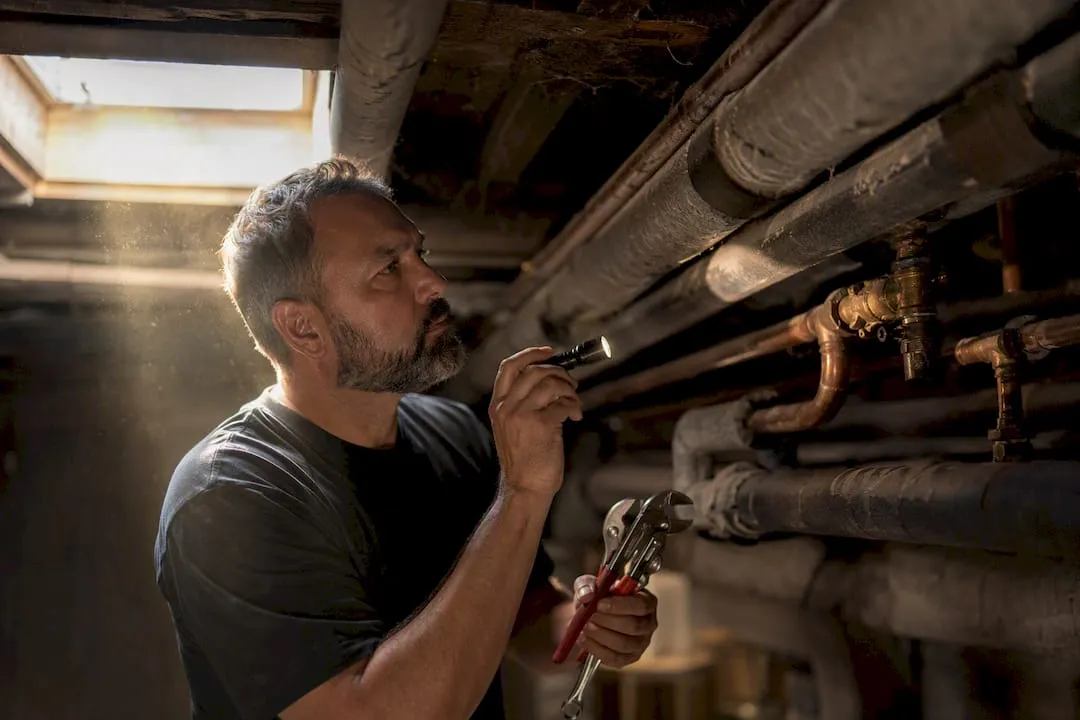
Quick Answer
Learn how a void property plumbing check can prevent costly damage and health risks by ensuring efficient maintenance when properties are empty.
A void property plumbing check is a structured inspection and maintenance routine carried out whenever a property stands empty between tenancies, designed to prevent waterborne health risks and stop small defects turning into expensive damage. Its two goals are straightforward: control the growth of legionella bacteria in stagnant water, and catch leaks, dried traps or failed components before they cause an insurance claim.
The first visit to any void property should follow the same sequence, regardless of size or value:
- Locate the stopcock and test that it turns and shuts off cleanly
- Run every sentinel outlet (the taps and appliances furthest from the mains) for several minutes each
- Inspect visible pipework under sinks, behind toilets and at radiator joints for drips or corrosion
- Check the boiler’s mode and controls, switching to frost protection where appropriate
- Test that drains and toilets flush freely without gurgling or backing up
- Timestamp the visit and log any readings taken
Stagnant water sitting between 20 and 45°C is the temperature band in which legionella bacteria multiply, according to HSE guidance for landlords. Landlords have a legal duty to assess and manage that risk, which starts with documenting exactly what you found and when.
Key Takeaways
A void property plumbing check combines legionella control, leak detection and documented temperature testing to protect both tenant health and the landlord’s legal position.
| Point | Details |
|---|---|
| Act on first visit | Locate the stopcock, run sentinel outlets and inspect visible pipework within hours of the tenancy ending. |
| Watch the temperature band | Stagnant water between 20 and 45°C favours legionella growth, so flushing and monitoring matter most in that range. |
| Flush weekly, verify before re-letting | Weekly flushing suits multi-week voids; a full pre-let flush must confirm cold below 20°C and hot at 50°C or above. |
| Keep every record | Timestamped logs of temperatures, flushing and remedial work are the evidence insurers and courts rely on. |
| Book RARE for documented compliance | Rareplumbing provides timestamped inspection reports and temperature readings for Central London void properties. |
Why void properties create specific plumbing risks
An occupied property flushes its own system dozens of times a day without anyone thinking about it. A void one doesn’t, and that changes the physics of the pipework entirely.
Water left standing in pipes stops moving oxygen through the system, and biofilm, a slimy bacterial layer, starts forming on internal pipe surfaces within days. That biofilm is exactly where legionella bacteria thrive, particularly once the water sits within the 20 to 45°C range that HSE identifies as the growth window for the organism.
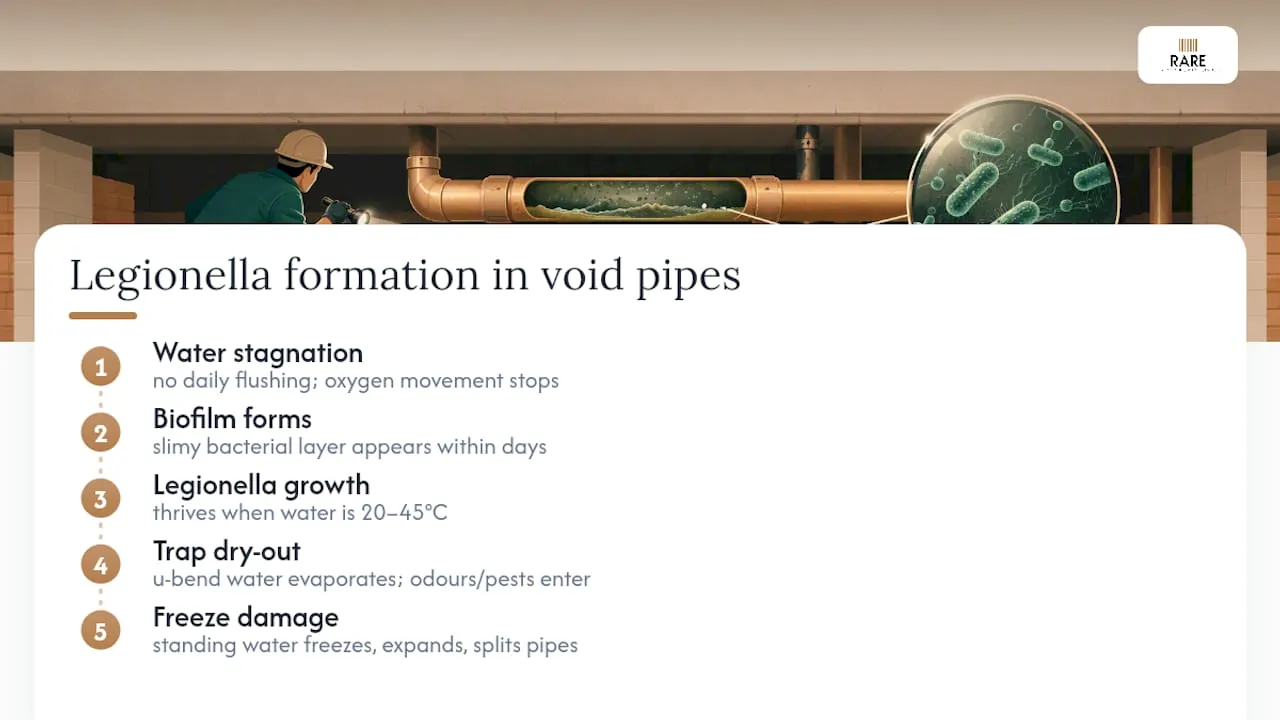
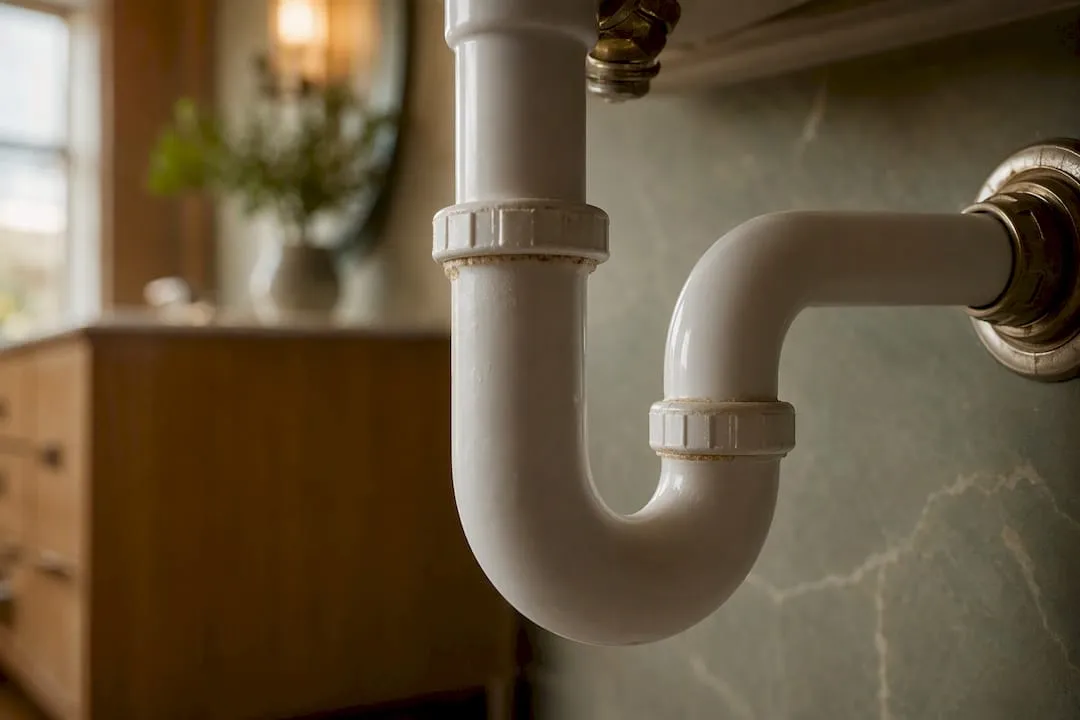
U-bends in sinks, showers and floor drains rely on a small reservoir of water to block sewer gases and pests from entering the property. Left long enough, that water evaporates entirely, leaving the trap dry and the property exposed to odours and, in commercial settings, potential contamination routes.
Winter brings a second threat entirely: standing water in unheated pipework freezes, expands, and splits copper or plastic pipe. A frozen pipe that fails while nobody is present can run for days before anyone notices, and the resulting hidden-leak damage, soaked floors, collapsed ceilings, ruined plaster, routinely runs into thousands of pounds before it’s even discovered.
Immediate actions when a tenancy ends: a first-visit checklist
The first visit after a tenant vacates sets the tone for everything that follows; see this tenant screening checklist for landlords to coordinate your tenant-transition processes efficiently. Get this sequence right and you reduce both health risk and financial exposure from day one.
- Find and test the stopcock. Turn it fully off and on to confirm it isn’t seized. If it’s faulty or difficult to reach, label the property file immediately and flag it for repair.
- Set the heating appropriately. In cold months, put the boiler into frost-protection mode rather than switching it off entirely; note the setting and date in your records.
- Run every sentinel outlet. Let taps, showers and appliances run for several minutes, checking for drips or slow drainage as you go.
- Inspect under sinks, behind toilets and at radiator valves. Look for damp patches, staining or active drips, not just obvious leaks.
- Check drains and U-bends. Clear any obvious blockages and top up traps that have dried out with a cup of water.
- Log meter readings and secure the property. Photograph anything unusual before you leave.
Pro Tip: Run one outlet at a time and listen for gurgling or delayed drainage elsewhere in the property. That “cross-talk” between fittings often reveals a partially blocked stack before it becomes an emergency call-out, a technique detailed in CIPHE’s guidance on building water systems.
Legionella management during a void: assessment, flushing and testing
Managing legionella risk in an empty property isn’t about testing every tap every week. HSE guidance is explicit that a proportionate, documented approach matters more than blanket sampling, and that monitoring records themselves are the primary evidence of compliance rather than a certificate from a lab.
For most residential voids, that proportionate approach looks like this:
- Complete a written risk assessment as soon as the property becomes void, identifying stored-water tanks, dead legs and any complex plant
- Flush all outlets weekly for voids running longer than a few weeks
- Before re-letting, carry out a full flush and record temperatures at every outlet
- Sample, disinfect or drain stored-water systems only where the risk assessment or a failed temperature check indicates it’s necessary
Where a legionella risk is identified, ACoP L8 requires a written scheme setting out the control measures, who is responsible for each one, monitoring frequencies, and how results and remedial actions are recorded.
That written scheme, plus a dated flushing log, is what you’d hand to an inspector, insurer or solicitor if the property’s history was ever questioned. Skipping the paperwork doesn’t reduce the risk, it just removes your ability to prove you managed it.
Pre-letting plumbing inspection checklist before re-letting
Before any void property goes back on the market, every outlet needs testing against a specific standard, not a casual glance.
- Run all cold taps until the temperature stabilises, confirming it drops below 20°C.
- Run hot taps until delivery temperature reaches at least 50°C at the outlet within a reasonable time.
- Flush every toilet twice to confirm the cistern refills and the pan clears properly.
- Run each shower under full flow and test any thermostatic mixer valves for correct temperature control.
- Open and close radiator valves, bleed each radiator, and check pipework for damp staining or corrosion.
- If a hot-water cylinder is fitted, confirm its thermostat is set to 60°C.
- Note any outlet that fails to meet these figures for further investigation before handover.
Any outlet that doesn’t reach 50°C hot or stay below 20°C cold at the tap should be flagged and re-tested rather than passed, based on the pre-let flush procedure industry guidance recommends. Document every temperature, the time it was taken, and any remedial work carried out. This record becomes the evidence that the property met the local authority’s void lettable standard, which typically requires water installations to be leak-free and the stopcock accessible before a new tenant moves in.
Managing extended voids and long-term monitoring
A void running for months poses a different question: keep the heating on at low background level, or drain the system down entirely? Draining removes the freeze risk, but CIPHE guidance warns it increases corrosion risk and means the system must be properly recommissioned and pressure tested before anyone moves back in.
- Maintain minimum background heat where practical, rather than draining, for voids under a few months
- Drain fully only where the void is long-term and recommissioning can be properly resourced
- Consider continuous flow and leak sensors with auto-isolation for properties with multiple or extended voids
- Increase physical inspection frequency in proportion to void length and building complexity
Pro Tip: For portfolios with several voids running at once, continuous monitoring sensors that auto-isolate the water supply on leak detection catch failures between physical visits, precisely when most escape-of-water damage actually happens.
When to call a competent person for void plumbing issues
Some situations sit beyond routine checks and need a qualified engineer.
- Any property with a stored cold-water tank or cylinder that hasn’t been assessed in the last 12 months
- Repeated failure to reach 50°C hot or below 20°C cold at outlets after re-testing
- Visible contamination, discolouration or odour in stored water
- Complex plant such as commercial cylinders, plate heat exchangers or multiple risers
A competent person carries out a full risk assessment, tank cleaning, disinfection and sampling where indicated. Your dated inspection logs and temperature records are exactly what insurers and legal advisers rely on if a dispute over damage or habitability ever arises.
How RARE Heating & Plumbing Services supports void property checks
Rareplumbing carries out void checks for property managers and landlords across Central London’s high-value residential and commercial stock, combining leak detection, tank cleaning and legionella control in a single documented visit.
- Full flush and temperature verification at every outlet, recorded with timestamps
- Cold water tank cleaning and disinfection where stored systems are present
- Leak detection surveys for properties showing damp or unexplained meter movement
- Written remedial reports property managers can hand directly to insurers or freeholders
For properties with complex plant or multiple voids, booking an engineer visit rather than relying on internal staff removes the guesswork from compliance.
Three traps and paperwork habits engineers rely on
Most emergency call-outs I’ve seen traced back weren’t sudden failures, they were slow ones nobody wrote down. Listening for cross-talk between fittings during a quiet inspection catches partial blockages before they become floods. A simple habit, photograph every reading with a timestamp, ends most insurance disputes before they start. And a five-minute flush done consistently beats an elaborate check done rarely.
— Paresh
How RARE can help with your void property plumbing check
Beyond routine checks, there are other ways to manage a void, ad-hoc contractors, in-house maintenance staff, or leaving the property unchecked between tenants and hoping nothing goes wrong. None of those give you a documented, insurable record if something does. Rareplumbing is the alternative: a Gas Safe registered team offering a 2-hour emergency response across Central London, with fixed quotes agreed before any work begins, so there are no surprise costs on a property that’s already sitting empty and unproductive.
Book a void check and you receive a timestamped inspection report, full temperature readings at every outlet, and a written quote for any remedial work identified, everything you need for your insurer or freeholder file. For commercial portfolios, Rareplumbing’s commercial plumbing specialists handle multi-unit voids on the same documented basis. Start by booking a maintenance visit for your next void property.
Sources
- Legionella and landlords’ responsibilities - HSE
- Mitigating the risk of building water systems - CIPHE
- Legionella – What are the risks of legionella in my void? - Clearway
FAQ
What does it mean if a property is void?
A void property is one that’s unoccupied between tenancies or sales, with no one running water, heating or drains on a daily basis, which is exactly what raises plumbing and legionella risk.
What is a void inspection?
A void inspection is the physical check of a property’s condition while it’s empty, covering plumbing, heating, security and general fabric to confirm nothing has deteriorated and it’s safe to re-let.
Do landlords have to clean black mould?
Yes, landlords must address damp and mould as part of keeping a property fit for habitation, and persistent mould linked to a plumbing leak should be treated as a defect requiring repair, not just surface cleaning.
How do you prove a property is uninhabitable?
Uninhabitability is typically evidenced through documented defects, such as failed heating, contaminated water, or unresolved leaks, backed by dated inspection records, photographs and temperature logs of the kind a void plumbing check produces.
How often should I flush a void property’s plumbing?
Weekly flushing of all outlets suits most voids running longer than a few weeks, with a full flush and temperature check required immediately before re-letting.
Recommended
Talk to a specialist today.
Our Gas Safe engineers are available same-day across Central and North London. No call-out charge quoted upfront. No obligation.
Related Services