
Quick Answer
Local London installer's 2026 cost guide. Expect £1,500–£12,000 by system; learn planning and access risks, running costs, and how to secure a fixed-price...
Expect to pay between £1,500 and £3,000 for a single-room split system, £3,500 to £7,000 for a multi-split covering two to four rooms, and £6,000 to £12,000 or more for a whole-home ducted or VRF system in London. These figures cover supply and installation but exclude planning consent, scaffold hire or electrical upgrades. Book a survey with an F‑Gas-registered installer before committing to any quote.
TL;DR:
- Property type and access issues significantly influence installation costs, with listed buildings and narrow spaces increasing scope and expenses.
- Higher SEER inverter systems have higher upfront prices but deliver substantially lower ongoing electricity costs over their lifespan.
- Strict heritage, conservation, or leasehold restrictions in London can require planning or listed building consent, adding weeks to project timelines and potential costs.
- Fixed-price quotes from qualified installers that account for access, consent, and heritage considerations reduce the risk of unexpected expenses during installation.
- Running costs for a well-chosen inverter split system typically range from £15 to £30 per month during summer in London, depending on system size and usage.
How much does air conditioning cost in London right now?
London homeowners generally pay a regional premium for air conditioning installation compared to other parts of the UK, primarily due to higher labour rates and logistical challenges in the city.
The table below sets out typical London price bands by system type.
| System type | Typical London price range | Best suited to |
|---|---|---|
| Single split (1 room) | £1,500 to £3,000 | Bedrooms, home offices, single reception rooms |
| Multi-split (2 to 4 rooms) | £3,500 to £7,000 | Flats and terraced houses needing several rooms cooled |
| Ducted / whole-home (VRF) | £6,000 to £12,000 or more | Detached and larger period properties, whole-floor cooling |
These ranges cover supply and standard installation work: units, pipework, and commissioning. They do not include planning fees, structural alterations, or major electrical upgrades, all of which are common in central London’s older housing stock and get covered in the sections below.
What determines the cost of each system type?
A single split system is the simplest job on the list: one indoor unit, one outdoor condenser, and a short refrigerant pipe run between them. Costs climb as the system gets more complex, not just bigger.
- Single split: one room, minimal pipework, fastest install, lowest cost per room covered.
- Multi-split: one outdoor condenser feeding two to four indoor units, so pipework routing and electrical load both increase.
- Ducted / VRF: concealed ductwork through ceiling voids, multiple zones, and far greater design and commissioning time.
Labour typically accounts for a larger share of the bill than the hardware itself once you move beyond a single split, because routing pipework through solid walls, floors, or existing ceiling voids in Victorian and Edwardian properties takes considerably longer than a straightforward new-build install.
Higher SEER-rated inverter systems cost more upfront but use significantly less electricity per hour of running time, according to Which?'s testing of premium air conditioner brands. For a typical double bedroom, a good single split with a modern inverter compressor runs around £1,800 to £2,400 installed; the same room with a budget non-inverter unit might cost less initially but run noisier and less efficiently for the life of the system.
Does your property type change the price?
Property type in London affects cost almost as much as system size does, mostly through access and consent, not the equipment itself.
- Flats and leasehold properties: managing agents often require written consent before any external condenser installation, and lease terms occasionally forbid it outright.
- Period and listed properties: any external alteration, including a condenser bracket on a façade, typically needs listed building consent, and unauthorised work can lead to enforcement action requiring removal at the owner’s expense.
- Terraced houses in central boroughs: tight rear gardens and narrow side access frequently mean hiring a mobile elevating work platform (MEWP) or scaffold just to reach a suitable condenser position, adding cost that a detached suburban property would never incur.
- Detached properties: generally the easiest and cheapest to install on, with more flexibility for condenser placement and fewer neighbour or party-wall considerations.
What’s actually included in a typical AC quote?
A properly itemised quote from a reputable London installer should be transparent about what you’re paying for and what sits outside the fixed price.
- Standard inclusions: the indoor and outdoor units, refrigerant pipework and insulation, electrical connection to an existing supply, commissioning and performance testing, and the F‑Gas paperwork confirming the system was installed and gas-charged legally.
- Common extras charged separately: scaffold or MEWP hire for difficult access, structural work such as core-drilling through solid walls, planning application fees where consent is needed, and any electrical board upgrade if your existing supply can’t take the additional load.
- What to check before signing: warranty length on both parts and labour, whether commissioning records are provided in writing, and whether an ongoing service plan is available or needs arranging separately.
Do you need planning permission for air conditioning in London?
Permitted development rights cover many domestic AC installations in the UK without requiring formal planning permission, but London properties trigger the exceptions more often than the national average. Conservation areas, listed buildings, units visible from a public highway, and properties covered by an Article 4 Direction commonly remove that automatic right across boroughs like Kensington and Chelsea, Westminster, and Camden.
Listed buildings almost always need separate listed building consent for any external alteration, regardless of whether permitted development would otherwise apply. Installing without it risks enforcement action, and heritage consultants recommend engaging with a conservation officer early in the process to avoid a redesign after the survey has already happened.
Practical checklist before you commit:
- Run a pre-application check with your local planning authority if your property sits in a conservation area.
- Get written consent from your managing agent if you’re in a leasehold flat.
- Confirm listed status and consent requirements before ordering equipment, not after.
- Expect decision timescales of several weeks for planning enquiries, longer for full listed building consent applications.
Pro Tip: Ask your installer for photographic evidence of the proposed condenser location as part of the survey. It speeds up any planning conversation and gives you a paper trail if a neighbour or managing agent later raises an objection.
How much does air conditioning cost to run in London?
Running costs depend heavily on which system you choose and how efficiently it’s specified for the room. A modern inverter split cooling a double bedroom through a typical London summer might add somewhere in the region of £15 to £30 a month to your electricity bill during peak use; a larger living-room unit or a multi-split running across several zones will sit noticeably higher.
- Higher SEER-rated inverter units modulate output rather than switching fully on and off, which cuts both running cost and noise compared with older non-inverter systems.
- Annual servicing typically costs £80 to £150 per system and keeps warranty cover valid, alongside preserving efficiency as filters and coils age.
- Properties with several systems, such as managed buildings or larger period homes, benefit from a structured maintenance schedule rather than reactive callouts.
Premium brands such as Daikin and Mitsubishi Electric cost more to install but deliver materially lower running costs over a ten-to-fifteen-year lifespan, which for high-value London properties tends to be the better long-term decision than chasing the lowest quote.
How long does an AC installation take in London?
Installation time scales directly with system complexity, and London sites often carry additional lead time before work even starts on site.
- Single-room split: 4 to 8 hours on site for a straightforward install with reasonable access.
- Multi-split (2 to 4 rooms): 1 to 3 days, depending on pipe run length and how many walls need penetrating.
- Ducted or VRF systems: 2 to 5 days, plus additional time if scaffold, a MEWP, or neighbour notification is required beforehand.
A thorough survey before work begins catches access problems, electrical capacity issues, and consent requirements ahead of time, which is where most on-site delays and cost overruns actually originate.
How do you get a fair, comparable AC quote in London?
Comparing quotes properly means asking every installer the same set of questions rather than judging on headline price alone.
- Request proof of F‑Gas registration and cross-check it against the national register before any refrigerant work starts.
- Ask for evidence of public liability insurance and, where gas-fired heating interacts with the project, Gas Safe registration.
- Query proposed condenser placement directly: where it sits, how noise is mitigated, and how access for future servicing is handled.
- Compare quotes on specification, warranty terms, commissioning documentation, and what’s explicitly excluded, not just the bottom-line figure.
Well-documented installations with a written fixed-price quote and commissioning paperwork also make period London properties considerably easier to sell or refinance, since surveyors and buyers favour installations with a clear paper trail.
Pro Tip: A genuine fixed-price quote should already account for likely access complications on a survey visit. If a quote changes significantly once work starts, that’s usually a sign the original survey wasn’t thorough enough. Rareplumbing’s air conditioning specialists provide fixed quotes before any work begins, precisely to avoid that scenario.
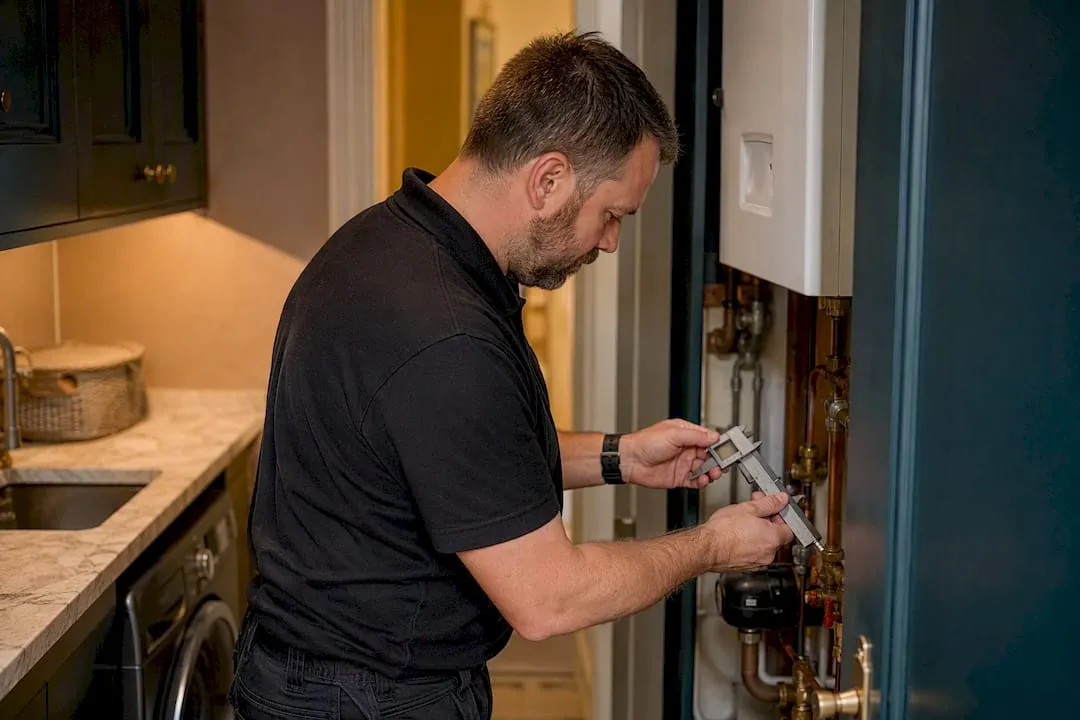
Case study: a multi-room Daikin install in South Kensington
A South Kensington client needed multi-room cooling across a period property with strict aesthetic requirements and limited rear access. Rareplumbing specified a Daikin multi-split system chosen for its quiet operation and discreet indoor unit design, with condenser placement carefully agreed to satisfy both the managing agent and the building’s heritage sensitivities.
The brief was cooling across three rooms without visible pipework or a condenser that dominated the rear elevation. A Daikin multi-split let us keep indoor units slim and route pipework through an existing service void, so the finished job barely altered the property’s appearance.
The installation was completed within the agreed fixed price, with full commissioning documentation handed over on completion, precisely the kind of paper trail that protects a property’s value at resale.
Why specification matters more than the lowest quote
The lowest quote rarely accounts for London’s access costs or a property’s heritage constraints, and cutting corners there tends to cost more later in redesign, running costs, or resale friction. Where budget allows, a higher-efficiency system pays for itself through comfort, quieter operation, and a cleaner sale down the line.
— Paresh
Get a fixed-price AC quote from a London specialist
Rareplumbing gives you a genuine fixed price before any work starts, so the survey findings on access, consent, and condenser placement are already priced in rather than added later as surprise costs. Every engineer is Gas Safe registered and F‑Gas certified, with over 25 years working across Central London’s flats, terraces, and listed properties, meaning planning and heritage complications get factored into the quote rather than discovered halfway through the job. If you’re ready to move beyond estimates, book a survey through Rareplumbing’s air conditioning service or browse recent luxury installation case studies to see the standard of finish you can expect.
FAQ
Is it expensive to run air conditioning in the UK?
Running costs vary by system and usage, but a well-specified inverter split in a London bedroom typically adds roughly £15 to £30 a month during summer use, with larger multi-split systems costing proportionally more.
Is it worth installing air conditioning in the UK?
For London properties, particularly period homes and south-facing flats that overheat in summer, a properly specified system improves comfort and can support resale value when installed with proper documentation and consent.
How much does it cost to install air conditioning in the UK?
London installation costs typically range from £1,500 to £3,000 for a single-room split, £3,500 to £7,000 for a multi-split covering several rooms, and £6,000 to £12,000 or more for a whole-home ducted system.
Is it legal to install air conditioning in the UK?
Yes, but installers must hold F‑Gas registration to handle refrigerant, and many London properties, particularly listed buildings and those in conservation areas, require planning or listed building consent before installation.
Recommended
Talk to a specialist today.
Our Gas Safe engineers are available same-day across Central and North London. No call-out charge quoted upfront. No obligation.
Related Services