
Quick Answer
Learn how central heating circulation works in your home. Discover how to spot issues, improve comfort, and understand your heating system.
TL;DR:
- Central heating circulation involves a pump moving hot water through a closed pipe system to distribute heat. Modern A-rated pumps consume less energy, and variable-speed models adjust output to system demand, reducing noise and wear. Proper system design, balancing radiators, and routine maintenance ensure efficient heat delivery and fault prevention.
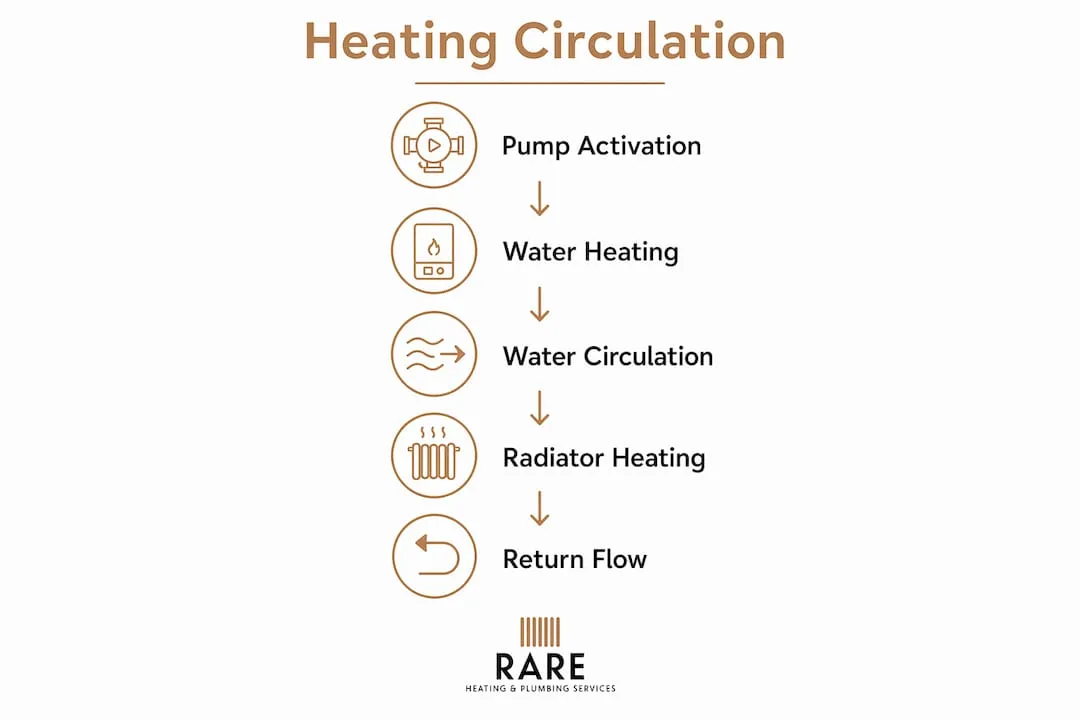
Central heating circulation is defined as the pump-driven movement of hot water through a closed loop of pipes, radiators, and controls to distribute heat across a property. The circulating pump sits at the heart of every wet central heating system in the UK, pushing water from the boiler through radiators and back again in a continuous cycle. Understanding how central heating circulation works helps you spot faults early, make sense of engineer recommendations, and spend money on upgrades that actually improve comfort. This guide covers the central heating circulation process from pump mechanics to system design, hydraulic balancing, and modern energy regulations.
How does the central heating pump circulate water?
The circulating pump is the engine of your heating system. It contains a spinning impeller that pushes water through the pipework, overcoming the resistance created by bends, valves, and radiators. The pump does not generate heat. Its sole job is to keep water moving so the boiler’s heat reaches every room.

The relationship between pressure and flow is described by the pump curve. A pump must be selected so its curve exceeds the system resistance curve at the operating point. In practice, a typical domestic pump needs 4–6 metres of head pressure to overcome circuit resistance, with common sizes being 15/50 or 15/60 for most homes. Choosing the wrong size wastes energy and causes noise.
Older fixed-speed pumps consumed up to 80W continuously. Modern A-rated pumps consume between 5W and 25W under normal demand, and carry an Energy Efficiency Index (EEI) of ≤0.23, mandatory in the UK since 2013. That reduction in running cost adds up significantly over a heating season.
Variable-speed pumps go further by automatically adjusting output to match system demand. When thermostatic radiator valves close in warmer rooms, the pump senses rising pressure and slows down rather than forcing water through a restricted circuit. This prevents noise, reduces wear, and cuts energy use further.
Pump placement matters too. Sealed pressurised systems favour placing the pump on the flow pipe, which improves pressurisation and prevents the air ingestion problems that plagued older open-vented systems where the pump sat on the return.
- The impeller spins to push water, not heat it.
- Head pressure of 4–6 metres suits most UK homes.
- A-rated pumps use 5–25W versus up to 80W for legacy models.
- Variable-speed pumps reduce output automatically when valves close.
- Flow-pipe placement reduces air locks in sealed systems.
Pro Tip: If your pump feels hot to the touch but the radiators are cold, the impeller may be stuck. Switch the pump off, locate the bleed screw on the pump head, and turn it gently with a flat-head screwdriver to free the shaft before calling an engineer.
What are S-plan and Y-plan systems, and how do they affect circulation?
Most UK homes use either an S-plan or a Y-plan configuration. Both designs control when and where hot water flows, but they do so with different valve arrangements.
S-plan systems use two separate 2-port zone valves, one for the heating circuit and one for the hot water cylinder. Each valve opens independently when its thermostat calls for heat. Once a valve opens fully, its end switch closes, which signals the boiler and pump to fire. This means heating and hot water can run simultaneously without affecting each other.
Y-plan systems use a single 3-port valve with a mid-position that allows both circuits to run at once, or a diverter position that sends all flow to one circuit. Y-plan is simpler and cheaper to install, but the single valve is a single point of failure. If it sticks, you lose either heating or hot water entirely.
| Feature | S-plan | Y-plan |
|---|---|---|
| Valve type | Two 2-port valves | One 3-port valve |
| Simultaneous heating and hot water | Yes, independently | Yes, via mid-position |
| Cost and complexity | Higher install cost | Lower install cost |
| Failure risk | Isolated per circuit | Single point of failure |
| Best suited to | Larger homes, multiple zones | Smaller homes, simpler systems |
Failed motorised zone valves are a common cause of heating faults. The end switch inside the valve must close to complete the circuit that activates the boiler and pump. When the switch fails, the boiler never fires even though the thermostat is calling for heat. This is worth knowing before you assume the boiler itself is faulty.
How do TRVs and hydraulic balancing improve heat distribution?
Thermostatic radiator valves (TRVs) give you room-level temperature control by restricting flow to a radiator once the air temperature reaches the set point. TRVs prevent overheating and energy waste by reducing flow to rooms that have already reached their target temperature. They do not replace the main room thermostat; both work together.
Hydraulic balancing is the process of adjusting the lockshield valve on each radiator so that water distributes evenly across the whole circuit. Without balancing, water takes the path of least resistance. Radiators closest to the pump heat up quickly while those at the far end of the circuit stay cold at the bottom or never reach full temperature.
Balancing involves partially closing the lockshield valves on radiators nearest the boiler, which forces more flow to the distant ones. A heating engineer uses a clip-on thermometer to measure the temperature difference between the flow and return pipes on each radiator, aiming for a differential of around 10–12°C. This is not a DIY job to rush, but homeowners can check whether their radiators heat evenly as a first diagnostic step.
Pro Tip: Never close all your TRVs simultaneously. With every valve shut, the pump has nowhere to send water and pressure spikes. Always leave at least one radiator, typically the one in the hallway, with its TRV fully open or removed to act as a bypass.
- TRVs restrict flow once room temperature is met.
- Hydraulic balancing prevents water bypassing distant radiators.
- Lockshield valves on near radiators are partially closed to redirect flow.
- A 10–12°C flow-to-return differential is the target on each radiator.
- One radiator should always remain unrestricted as a system bypass.
How do energy regulations and modern technologies affect circulation?
The EU Energy-related Products (ErP) regulations set a mandatory EEI of ≤0.23 for circulating pumps, enforced in the UK since 2013. This standard effectively banned the old fixed-speed pumps that dominated British homes for decades. Modern pumps cut energy usage by up to 80% compared to those legacy models. For a home running its pump eight months a year, that saving is material.
Heat pumps change the circulation picture significantly. Unlike gas boilers, which deliver rapid bursts of high-temperature water, heat pumps operate at lower flow temperatures over longer run-times. This steady, low-temperature flow suits underfloor heating or oversized radiators far better than standard radiators designed for 70–80°C flow temperatures. If you are considering a heat pump, your existing circulation system may need redesigning to match the different thermal dynamics. You can read more about how boiler and heat pump choices affect your system’s performance.
The practical implication for homeowners is straightforward. If your pump is more than ten years old, replacing it with a modern variable-speed A-rated model is one of the most cost-effective energy efficiency upgrades available. The payback period is short, and the improvement in system control is immediate.
What practical steps help homeowners maintain good circulation?
Good circulation maintenance prevents the majority of common heating faults. Most problems trace back to three causes: trapped air, sludge build-up, and valve failure.
- Bleed your radiators annually. Air collects at the top of radiators and blocks water flow. Use a radiator key to open the bleed valve until water appears, then close it. Start with the radiator furthest from the boiler and work back towards it.
- Check for sludge. Black, oily water when you bleed a radiator indicates magnetite sludge from corroding pipework. A magnetic filter fitted to the return pipe captures this debris before it reaches the pump. Power flushing removes existing sludge from the whole system.
- Listen to your pump. Grinding or whining sounds suggest worn bearings or a partially seized impeller. A pump that runs silently but produces no flow may have a completely stuck impeller.
- Test your zone valves. If one radiator is not working despite the thermostat calling for heat, check whether the motorised valve serving that zone is opening fully. A stuck valve is often cheaper to replace than a new pump.
- Do not increase pump speed to fix cold radiators. Trapped air or sludge is the more common cause. Forcing water through a blocked system causes noise and accelerates wear without solving the underlying problem.
- Call a Gas Safe registered engineer for any work involving the boiler, gas connections, or sealed system pressurisation. Pump replacement on a sealed system requires re-pressurising the circuit correctly after the work is done.
If your central heating stops working entirely, check the system pressure gauge first. A sealed system that has dropped below 1 bar will not circulate properly until it is re-pressurised via the filling loop.
Key takeaways
Central heating circulation relies on a correctly sized, A-rated pump working within a balanced, well-maintained closed-loop system to deliver consistent heat efficiently throughout a property.
| Point | Details |
|---|---|
| Pump drives the system | The circulating pump moves water through the loop; it does not generate heat. |
| System design matters | S-plan and Y-plan configurations determine how zone valves control heating and hot water independently. |
| Balancing prevents cold spots | Adjusting lockshield valves distributes flow evenly so all radiators reach temperature. |
| Modern pumps save energy | A-rated variable-speed pumps use 5–25W versus up to 80W for older fixed-speed models. |
| Sludge and air cause most faults | Annual bleeding and a magnetic filter prevent the majority of circulation problems. |
What I have learned from 25 years of heating systems in London
People assume that turning the pump speed up will fix a cold radiator. It almost never does. What I see repeatedly in London properties is a system that has never been hydraulically balanced since installation. The radiators nearest the boiler are roasting, the ones at the far end of the house are lukewarm, and the homeowner has been paying to heat half their home for years.
The other misconception is that a new boiler solves everything. A new boiler on an unbalanced, sludge-filled system will perform no better than the old one. The boiler is only as good as the circulation system behind it. Investing in a power flush, a magnetic filter, and proper balancing before or alongside a boiler replacement makes a measurable difference to comfort and bills.
Variable-speed pumps are genuinely worth the upgrade cost. The old fixed-speed pumps ran at full power regardless of demand. A modern variable-speed unit senses system pressure and backs off when TRVs close. The system runs quieter, the pump lasts longer, and the energy saving is real.
My honest advice: get your system balanced properly at least once, fit a magnetic filter, and replace any pump over ten years old with an A-rated variable-speed model. Those three steps will do more for your heating than almost anything else short of a full system redesign.
— Paresh
How Rareplumbing can help with your heating circulation

Rareplumbing’s Gas Safe registered engineers have spent over 25 years working on central heating systems across Central London, from straightforward pump replacements to full S-plan and Y-plan conversions. Every job starts with a fixed quote before any work begins, so there are no surprises on the invoice.
Whether you need a modern variable-speed pump installed, a power flush to clear sludge, or a full heating system service to bring your circulation back to peak performance, Rareplumbing provides the expertise to get it right first time. For properties considering a heat pump transition or underfloor heating integration, the team can assess whether your existing pipework and pump sizing are compatible. Contact Rareplumbing for a fixed quote, or explore the heating and plumbing services available across Central London.
FAQ
What is central heating circulation?
Central heating circulation is the continuous movement of hot water driven by a pump through a closed loop of pipes and radiators. The thermostat controls when the pump and boiler operate, and water returns to the boiler to be reheated once it cools.
Why are some of my radiators cold?
Cold radiators are most commonly caused by trapped air, sludge build-up, or an unbalanced system where water bypasses distant radiators. Hydraulic balancing and annual bleeding resolve the majority of these issues.
How do I know if my circulating pump has failed?
A failed pump is often silent when the heating is running, or it produces a grinding noise. A pump that feels very hot but produces no flow likely has a stuck impeller, which a Gas Safe engineer can diagnose and replace.
What is the difference between S-plan and Y-plan heating?
S-plan uses two separate 2-port zone valves for independent control of heating and hot water. Y-plan uses a single 3-port valve, which is simpler but represents a single point of failure if the valve motor or end switch fails.
How often should a central heating pump be replaced?
A well-maintained pump typically lasts 10–15 years. If your pump is older than ten years and still a fixed-speed model, replacing it with a modern A-rated variable-speed unit will reduce energy consumption and improve system reliability.
Recommended
Talk to a specialist today.
Our Gas Safe engineers are available same-day across Central and North London. No call-out charge quoted upfront. No obligation.
Related Services