
Quick Answer
Learn how to install a magnetic filter effectively to protect your boiler, keep heating costs down, and avoid costly repairs.
A magnetic filter protects your boiler by trapping ferrous sludge before it reaches the heat exchanger, and it’s normally fitted on the return pipe close to the boiler. For gas systems, a Gas Safe registered engineer must carry out the work; electric or renewable heating systems need an MCS or NICEIC registered installer instead. Most installations take between one and three hours, with supply-and-fit typically costing £130 to £300.
TL;DR:
- The cost of installing a magnetic filter, including supply and fitting, generally ranges from £130 to £300, with larger or more difficult pipework increasing expenses.
- The filter should be fitted on the return pipe near the boiler, ideally just after the last radiator return and before the boiler inlet, to intercept sludge effectively.
- Annual cleaning of the magnetic core and flush of the filter body are necessary to maintain efficiency and preserve warranty coverage, especially in systems with heavy debris.
- Most installations take between one and three hours, requiring standard tools and sometimes additional time for complex or older systems.
- Only registered Gas Safe, MCS, or NICEIC engineers should carry out the installation on gas, electric, or renewable systems, with proper documentation and fixed-price quotes.
What happens during magnetic filter installation?
A magnetic filter installation follows a fairly consistent sequence regardless of boiler make or property size. Knowing the order helps you judge whether an engineer is working properly and gives you a sense of how long you’ll be without heating. First, the heating is turned off and allowed to cool to avoid scalding and to make draining easier.
- Isolate the circuit or the whole system, depending on where the filter is going and how the pipework is laid out.
- Drain the relevant section. A partial drain is quicker and disrupts less of the system, but restricted access sometimes forces a full drain instead.
- Fit isolation valves on either side of the chosen filter location, then cut the pipe to the length the filter body needs.
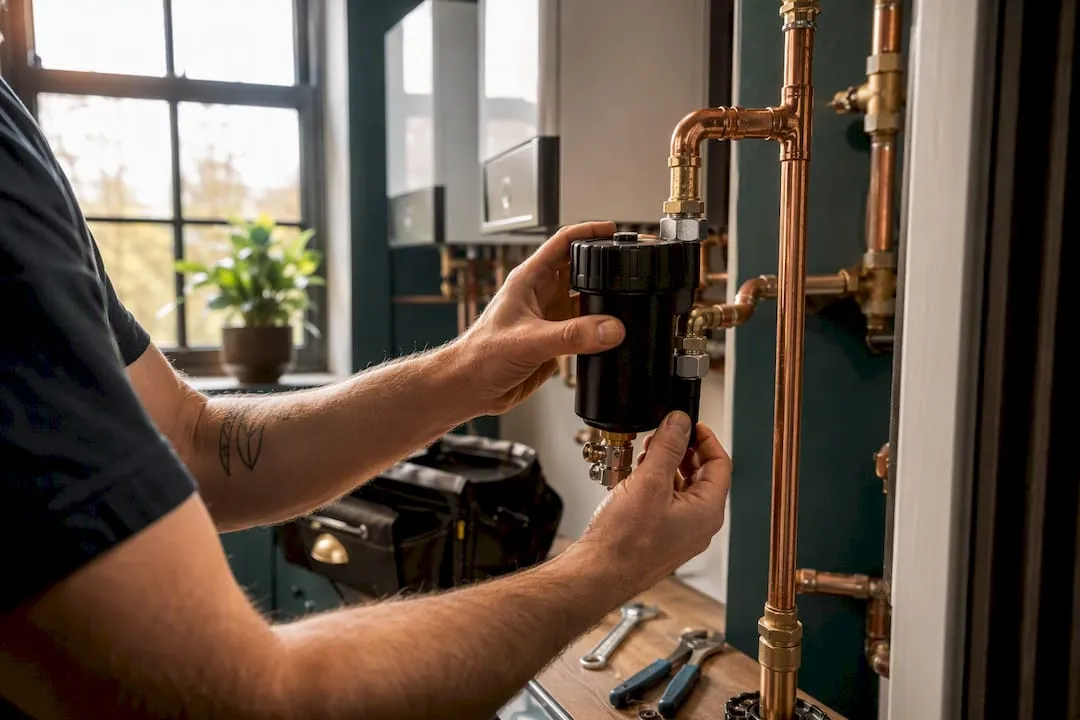
- Install the filter body, tightening every connection and setting the orientation so the unit can be opened for cleaning later without dismantling half the pipe run.
- Refill and repressurise the system, bleed the radiators to clear trapped air, and run the boiler through a full heating cycle to check performance.
- Check every joint for leaks and note down the work carried out, including any inhibitor added.
Installers generally follow this same isolate, drain, fit, refill sequence, and Gas Safe engineers are the ones who should be doing it on gas systems, according to Boiler Central’s guidance on magnetic filters.
Pro Tip: Ask your engineer to photograph the filter’s final position and the pipework before they leave. It’s a five-second job for them and gives you a permanent record for warranty claims or future service visits.
Where should a magnetic filter be fitted?
The return pipe is the standard fitting point, because it intercepts sludge on its way back to the boiler, protecting both the heat exchanger and the circulating pump. Manufacturers such as ADEY specify return-pipe fitting and recommend positioning the filter as close to the boiler as the pipework allows, often just after the last radiator return and before the boiler inlet.
- Most filter bodies rotate through 360 degrees, so an engineer can angle the unit to suit a cramped airing cupboard or a boiler mounted hard against a wall.
- That rotation matters more than it sounds. It’s often the difference between a filter that’s easy to open for its annual clean and one that needs partial dismantling every time.
- Leave a genuine hand’s width of clearance in front of the filter wherever the layout allows, so the magnet can be withdrawn without disturbing surrounding pipework.
What tools and time does the job need?
A straightforward retrofit uses fairly standard kit: isolation valves, compression fittings, PTFE tape, a drain hose, an adjustable spanner set, and leak detection fluid for the final check.
- Some engineers carry flushing or dosing adapters, a remote drain hose for filters in awkward positions, and spare seals in case the originals are damaged during fitting. Typically, a retrofit on an accessible boiler takes a few hours, but more complex jobs or older systems may require additional time due to parts sourcing or adaptation.
How much does magnetic filter installation cost?
Supply-only units typically cost £50 to £150, while a combined supply-and-fit job commonly totals £130 to £300. The gap between those figures comes down to a few predictable factors.
Sludge build-up can cut boiler efficiency by 10 to 15%, which means the cost of a filter is often recovered through lower running costs and fewer breakdown call-outs over the system’s life.
- Brand and filter size vary the unit price, and larger commercial-grade filters cost more than domestic units.
- Pipework difficulty adds labour time, especially where valves need repositioning or boxed-in pipes must be exposed first.
- A required powerflush before fitting adds a separate cost on top of the filter itself.
- Local labour rates shift the fitting cost more than most homeowners expect, particularly in London.
Always ask for a written quote before work starts, confirm the engineer’s Gas Safe or MCS registration, and check whether your boiler’s extended warranty is conditional on fitting a filter, since some manufacturers make this a warranty requirement. If you’re already seeing black water at the radiator bleed valve or a cold pump housing, don’t wait for a scheduled visit. Book an engineer promptly rather than risk a heat exchanger repair that costs far more than the filter itself.
How often should a magnetic filter be cleaned?
Annual cleaning is the standard recommendation from most manufacturers, usually carried out alongside the boiler’s yearly service.
- Isolate the filter using the valves fitted either side of it during installation.
- Remove the magnetic core and rinse the collected sludge into a bucket rather than down a drain.
- Flush the filter body with clean water until no further debris comes through.
- Reassemble and reopen the isolation valves, checking for leaks before closing up.
Annual servicing preserves the filter’s effectiveness and keeps you compliant with the warranty terms many manufacturers attach to their products, some of which run to ten years on the filter body. Systems with heavy debris, or those that have recently had a powerflush, may need cleaning every six months until sludge levels settle. Keep a simple record of the date, any inhibitor topped up, and the condition of the debris removed. It’s the kind of paperwork that turns into evidence if a warranty dispute ever arises.
What are the signs your system needs attention?
Cold patches at the bottom of radiators, black or grey water when you bleed a valve, and a pump that’s noisier than usual all point to sludge circulating in the system.
- Bleeding a small sample of water from a radiator valve into a clear glass is a safe, five-minute check any homeowner can do.
- If the sample runs black rather than clear, sludge is present somewhere in the circuit.
- A magnetic filter alone won’t clear a heavily contaminated system. Viessmann’s guidance is clear that fitting a filter before a powerflush risks rapid clogging and repeat service visits within weeks.
- Recurring faults after a filter’s already fitted usually mean the system needs a powerflush rather than another filter.
Why choose a Gas Safe registered team for this work
Twenty five years of service history means little without the paperwork to back it up, which is why every fixed quote from Rareplumbing sets out exactly what’s included before a single tool comes out of the van. Our team is Gas Safe registered, and installations on electric or heat pump systems are handled by engineers who hold the relevant electric boiler accreditation. A fixed quote covers the filter, fitting, and a signed record of the work, which matters if a manufacturer later queries warranty compliance. Every job includes documentation of the pressure test and any inhibitor added, so you have proof of correct installation on file rather than a verbal assurance.
When is a magnetic filter genuinely worth the investment?
A supply-only filter suits a confident DIYer on a non-gas system, but on a gas boiler the legal position is straightforward: it’s a job for a Gas Safe engineer. For most homeowners, paying for supply-and-fit plus an annual service costs little more over five years than buying the unit alone, and it keeps the warranty intact. Property managers should book the service alongside the annual boiler check and keep dated records for every unit under their care.
— Paresh
Book a fixed-price magnetic filter installation
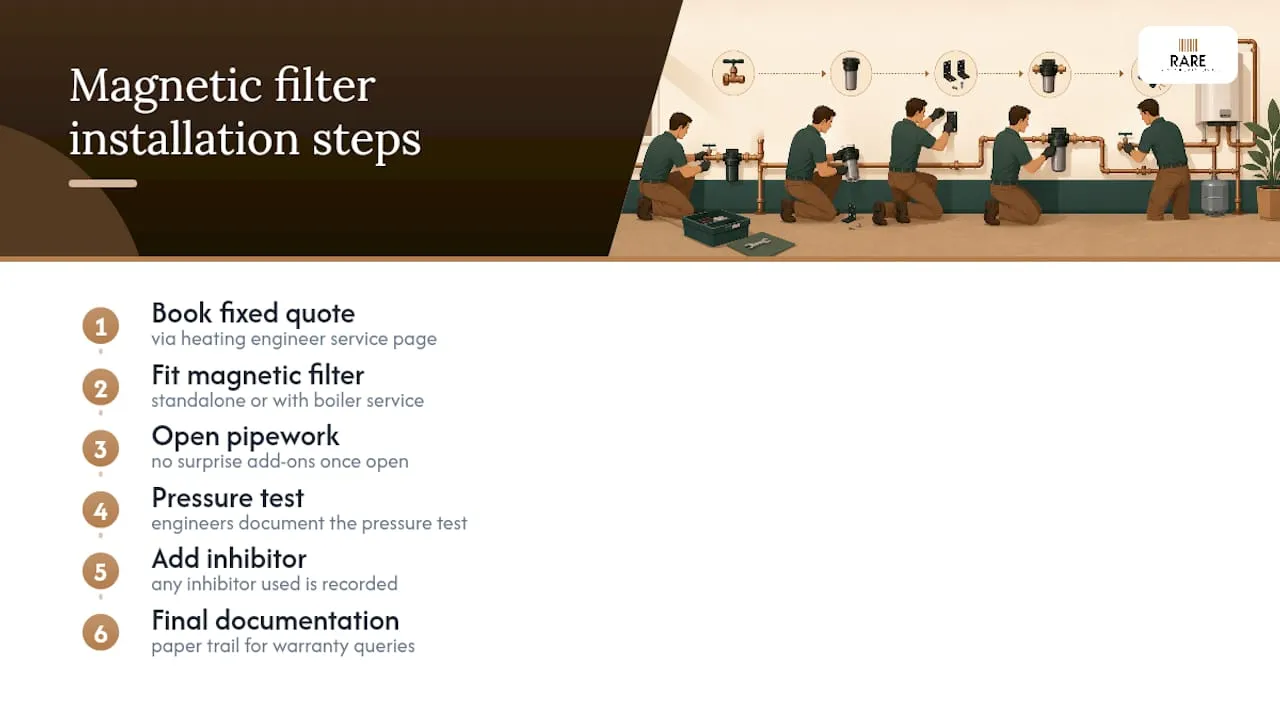
Rareplumbing fits magnetic filters as a standalone job or alongside a boiler service, and every quote is fixed before work starts, so there are no surprise add ons once the pipework’s open. Our Gas Safe registered engineers document the fitting, the pressure test, and any inhibitor used, giving you the paper trail manufacturers ask for when a warranty is queried. Central London properties can also add the filter clean to an annual maintenance plan, so it’s never forgotten between boiler services. If your radiators are running cold at the bottom or you’re simply protecting a new boiler from day one, get a fixed quote through our heating engineer service page and we’ll confirm a visit within 2 hours for emergencies, or a scheduled slot for planned installation work.
Where to check filter specifications and warranty terms
Manufacturer manuals, such as Keston’s magnetic filter user guide, set out installation diagrams, orientation options, and the servicing steps required to keep a warranty valid. Checking the specific model’s documentation before installation avoids assumptions about clearance, drain adapters, or cleaning intervals that vary between brands.
Sources
- ADEY Magnetic Filters | What is a Boiler Magnetic Filter?
- Fitting a magnetic filter near the boiler costs in your area
- Magnetic Filter for Boilers 2026 | What It Is & Is It Worth It?
- Keston magnetic filter user guide (installation & servicing)
- Are magnetic filters worth it? | Viessmann
FAQ
How much does it cost to install a magnetic filter on a boiler?
Supply-only units run £50 to £150, while a professionally fitted filter typically costs £130 to £300 in total, depending on brand and pipework access.
Is it worth fitting a magnetic filter?
Yes, in most cases. Sludge can reduce boiler efficiency by 10 to 15%, and many boiler warranties now require a filter to be fitted to stay valid.
Do you install a magnetic filter on the flow or return pipe?
Filters are fitted on the return pipe, close to the boiler, since this position captures sludge before it reaches the heat exchanger and pump, as ADEY’s installation guidance confirms.
How long does a magnetic filter last?
The filter body itself often carries a ten-year manufacturer warranty, but it needs cleaning at least annually to keep working effectively and to stay within warranty terms.
Can I fit a magnetic filter myself?
On a gas central heating system, no. UK law requires a Gas Safe registered engineer to carry out this work; electric or heat pump systems need an installer with equivalent MCS or NICEIC accreditation.
Recommended
Talk to a specialist today.
Our Gas Safe engineers are available same-day across Central and North London. No call-out charge quoted upfront. No obligation.
Related Services