
Quick Answer
Discover common heating issues in high-end rentals. Learn how to prevent costly repairs and ensure tenant comfort in luxury properties.
TL;DR:
- Heating system faults are the main cause of emergency repairs in luxury London rentals, often stemming from complex equipment like HIUs and digital plant systems. Proper proactive maintenance and specialist diagnosis are essential to prevent recurring issues and ensure legal compliance under the Landlord and Tenant Act.
Heating system faults are the leading cause of emergency repair obligations in luxury rental properties across Central London. Common heating issues in high-end rentals arise from system complexity, not just age. Heat Interface Units (HIUs), underfloor heating, and digitally controlled plant room systems all behave differently from a standard domestic boiler, and general maintenance approaches frequently miss the mark. Under Section 11 of the Landlord and Tenant Act 1985, property managers must keep heating installations in proper working order. Getting ahead of faults protects tenants, avoids costly emergency callouts, and keeps you legally compliant.
1. What are the most common heating issues in high-end rentals?
The six faults below account for the majority of luxury rental heating problems seen in Central London properties. Each one has a distinct cause and a clear path to resolution.
Complete heating failure
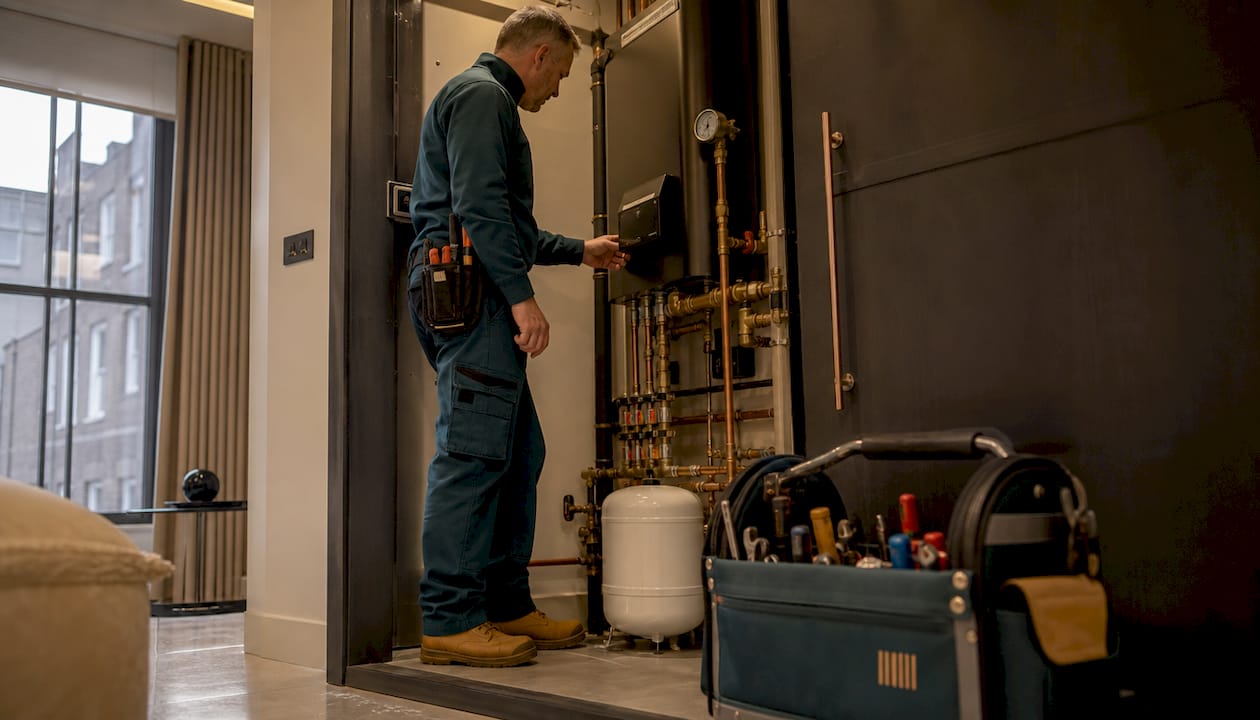
A total loss of heating is the most urgent fault a property manager can face. Complete failure is classified as an emergency repair, requiring a response within 24–48 hours in winter. In high-end properties, this often traces back to a tripped HIU, a failed pump, or a plant room fault rather than a simple boiler lockout.
HIU misdiagnosis
HIU faults are frequently misdiagnosed by engineers unfamiliar with the technology. Unlike a standard boiler, an HIU regulates flow rate, pressure balance, and heat exchanger calibration. A general heating engineer may reset the unit and leave, only for the fault to return within days. Specialist knowledge is not optional here.
Overheating electronics in utility cupboards
Cramped utility cupboards cause overheating of printed circuit boards (PCBs) and sensors, producing intermittent lockouts that are difficult to reproduce during a callout. The fault often clears when the cupboard door is opened, which misleads engineers into thinking the system is fine. Ventilation checks must be part of every service visit.
Pro Tip: If a tenant reports a fault that clears before the engineer arrives, ask whether the utility cupboard was opened. Overheating electronics are the most common cause of self-clearing faults in luxury flats.
Repeated pressure drops
Slow pressure loss points to a developing leak, a faulty expansion vessel, or a failing pressure relief valve. In high-rise buildings, blocked valves and worn pumps can cause pressure imbalances that affect multiple apartments simultaneously. A single pressure drop is not always a crisis, but repeated drops signal a fault that will worsen without intervention.
Sensor and control module errors
Digitally controlled systems in luxury apartments rely on sensors to regulate temperature zones. When a sensor drifts out of calibration, one room overheats while another stays cold. These faults rarely trigger an obvious error code, so they are often logged as “no fault found” by engineers who do not carry calibration equipment.
Blocked strainers and valve issues
Blocked strainers and valve faults restrict flow and reduce heat output across an entire floor or building. In high-rise systems, this is a cascading problem. One blocked strainer can starve multiple HIUs of adequate flow, leading to complaints from several tenants at once.
2. How do UK landlord regulations shape heating maintenance in luxury rentals?
Legal obligations set the minimum standard for heating maintenance in rental properties. Property managers who understand the law avoid disputes, penalties, and reputational damage.
Section 11 of the Landlord and Tenant Act 1985 requires landlords to keep heating installations in repair and proper working order for the duration of a tenancy. The Homes (Fitness for Human Habitation) Act 2018 adds a further layer, requiring that the property remains fit to live in. A heating system that works technically but fails to heat rooms adequately can still constitute a breach.
Key obligations every property manager must know:
- Emergency failures in winter require a response within 24–48 hours. Courts treat complete heating loss in cold months as a health hazard.
- Partial failures carry more flexible timelines, but health risk assessments still apply. A system that heats some rooms but not others is not automatically low priority.
- Any tenant contact triggers the duty to repair. Courts confirm landlords cannot wait for a formal written notice before acting. A phone call or text message is sufficient.
- Inspection records and repair logs support your legal defence if a dispute reaches court or an insurer requests evidence.
- Adequacy of heating is assessed separately from repair. A system in working order that cannot maintain a reasonable temperature may still breach the 2018 Act.
Pro Tip: Keep a timestamped log of every tenant report, even informal ones. Courts treat the moment of notification as the start of your repair obligation, not the date of a formal letter.
3. What maintenance best practices prevent heating problems in high-end rentals?
Proactive maintenance is the most cost-effective strategy for managing rental property heating issues. Unmaintained systems can increase energy consumption by up to 20%, and the cost of an emergency callout consistently exceeds the cost of a scheduled service.
The following practices reduce fault frequency and protect your legal position:
- Bi-annual servicing for continuously running equipment. Plant room units, decentralised fan systems, and wine cellar climate controls require servicing every six months. Annual servicing is insufficient for systems that run year-round.
- Ventilation checks in every utility cupboard. Maintaining clear airflow around HIU and boiler electronics prevents the overheating faults described above. This takes minutes during a service visit and prevents hours of diagnostic work later.
- Tenant education on early warning signs. Repeated minor issues often precede emergencies. Tenants who know to report pressure drops, unusual noises, or uneven heating enable you to act before a fault becomes a failure.
- Scheduled boiler servicing to maintain warranties. Most manufacturer warranties require annual servicing by a Gas Safe registered engineer. Missing a service can void the warranty and leave you liable for the full cost of a replacement.
- Use of specialist technicians for HIU systems. General heating engineers lack the training to diagnose HIU-specific faults accurately. Engaging a qualified heating engineer with HIU experience reduces repeat callouts and misdiagnosis.
Pro Tip: Ask your service provider to photograph utility cupboard ventilation clearances at every visit. This creates a visual record that protects you if an overheating fault is later disputed.
4. How to handle heating emergencies in high-end rental properties
A structured response to heating failures protects tenants, satisfies legal requirements, and limits reputational damage. Speed and documentation are equally important.
- Log the report immediately. Record the time, date, and nature of the tenant’s report. This timestamp is your legal starting point under Section 11.
- Assess the severity. A complete heating failure in winter is an emergency. A single cold radiator in a well-heated flat is not. Triage determines your response timeline.
- Engage a specialist technician within the legal window. For complete failures in winter, the 24–48 hour response window is not a guideline. It is the standard courts apply when assessing landlord conduct.
- Provide temporary heating if repairs will take longer than expected. Temporary electric heaters are a landlord’s responsibility when full repair cannot be completed immediately in winter. Options such as electric panel heaters can bridge the gap effectively.
- Communicate with the tenant throughout. Silence during a repair process damages trust. A brief update every 24 hours maintains goodwill and reduces the likelihood of a formal complaint.
- Document every step. Record engineer attendance times, parts ordered, and repair completion. This log is your defence if the tenant later disputes the adequacy of your response.
Key takeaways
Heating failures in high-end rentals are almost always preventable with specialist maintenance and a clear understanding of your legal obligations under Section 11 of the Landlord and Tenant Act 1985.
| Point | Details |
|---|---|
| HIU faults need specialist engineers | General heating engineers frequently misdiagnose HIU faults, leading to repeat callouts and unresolved issues. |
| Any tenant report triggers your duty | Courts treat informal messages as the start of your repair obligation, not formal written notices. |
| Bi-annual servicing prevents emergencies | Continuously running systems require servicing every six months to maintain efficiency and compliance. |
| Ventilation prevents overheating faults | Checking utility cupboard airflow at every service visit eliminates a common source of intermittent lockouts. |
| Temporary heating is a legal requirement | When winter repairs cannot be completed immediately, providing portable heaters is a landlord obligation, not a courtesy. |
What I have learned from years of heating work in luxury London flats
The faults that cause the most damage in high-end rentals are rarely dramatic. They are quiet. A sensor drifting by two degrees. A strainer slowly restricting flow. A PCB running five degrees too hot inside a sealed cupboard. By the time a tenant notices, the fault has often been developing for weeks.
The biggest mistake I see property managers make is treating HIU systems like boilers. They are not. The diagnostic process is different, the parts are different, and the failure modes are different. Sending a general heating engineer to an HIU fault is like sending a GP to perform surgery. The intention is right, but the outcome rarely is.
Tenant education is underused as a maintenance tool. Tenants in luxury properties notice when something feels off, but they often do not report it because they assume it is normal or they do not want to cause inconvenience. A simple one-page guide explaining what to report and how to report it can cut emergency callouts significantly.
The legal timeframes under Section 11 are tighter than most property managers realise. A text message from a tenant at 9PM on a Friday starts the clock. Waiting until Monday morning to respond is not reasonable in winter. Building a relationship with a specialist provider who offers genuine out-of-hours response is not a luxury. It is a compliance requirement.
— Paresh
Rareplumbing’s specialist support for property managers in London
Property managers overseeing high-end rentals in Central London need a heating partner who understands HIUs, plant room systems, and the legal obligations that come with luxury tenancies.
Rareplumbing has over 25 years of experience working with complex heating systems in London’s most demanding residential properties. The team is Gas Safe registered and specialises in the precise diagnostic work that HIU and modern digital systems require. A Rareplumbing membership gives property managers priority scheduling, regular maintenance visits, and a 2-hour emergency response, with fixed quotes provided before any work begins. For property managers who need reliable heating system support without the uncertainty of variable costs, Rareplumbing is the direct solution.
FAQ
What causes complete heating failure in luxury rental flats?
Complete heating failure in luxury flats most commonly results from HIU faults, plant room pump failures, or tripped system controls rather than standard boiler breakdowns. Specialist diagnosis is required because these systems differ fundamentally from domestic boilers.
How quickly must a landlord fix heating in winter?
Section 11 of the Landlord and Tenant Act 1985 requires landlords to respond to complete heating failures within 24–48 hours in winter. Any tenant report, including informal messages, starts this obligation immediately.
How often should heating systems in high-end rentals be serviced?
Continuously running systems such as plant room units and decentralised fans require bi-annual servicing. Standard boilers and HIUs should be serviced at least annually by a Gas Safe registered engineer to maintain warranties and legal compliance.
Why do HIU faults keep recurring after repair?
HIU faults recur when engineers without specialist training reset the unit without addressing the root cause, such as flow rate imbalance, sensor calibration errors, or blocked heat exchangers. Engaging an engineer with specific HIU experience resolves the underlying fault rather than the symptom.
What temporary measures must landlords provide during a heating failure?
When a full repair cannot be completed immediately in winter, landlords must provide temporary heating such as portable electric heaters. This is a legal obligation under Section 11, not a discretionary gesture.
Recommended
Talk to a specialist today.
Our Gas Safe engineers are available same-day across Central and North London. No call-out charge quoted upfront. No obligation.
Related Services