

Quick Answer
Understand your responsibilities with the landlord boiler servicing obligations guide for 2026. Protect your tenants and avoid costly penalties.
Landlords in England and Wales are legally required to arrange an annual gas safety check by a Gas Safe registered engineer under the Gas Safety (Installation and Use) Regulations 1998. This is not optional. Non-compliance risks unlimited fines or imprisonment of 6–15 years for serious injury or death. Beyond the legal minimum, Section 11 of the Landlord and Tenant Act 1985 requires landlords to keep heating installations in repair and proper working order. This guide covers every obligation you need to meet in 2026, from documentation to emergency repairs, so you can protect your tenants and your property.
What is the difference between a gas safety check and a boiler service?
Most landlords treat these two things as interchangeable. They are not, and confusing them is one of the most common compliance mistakes in rental property management.
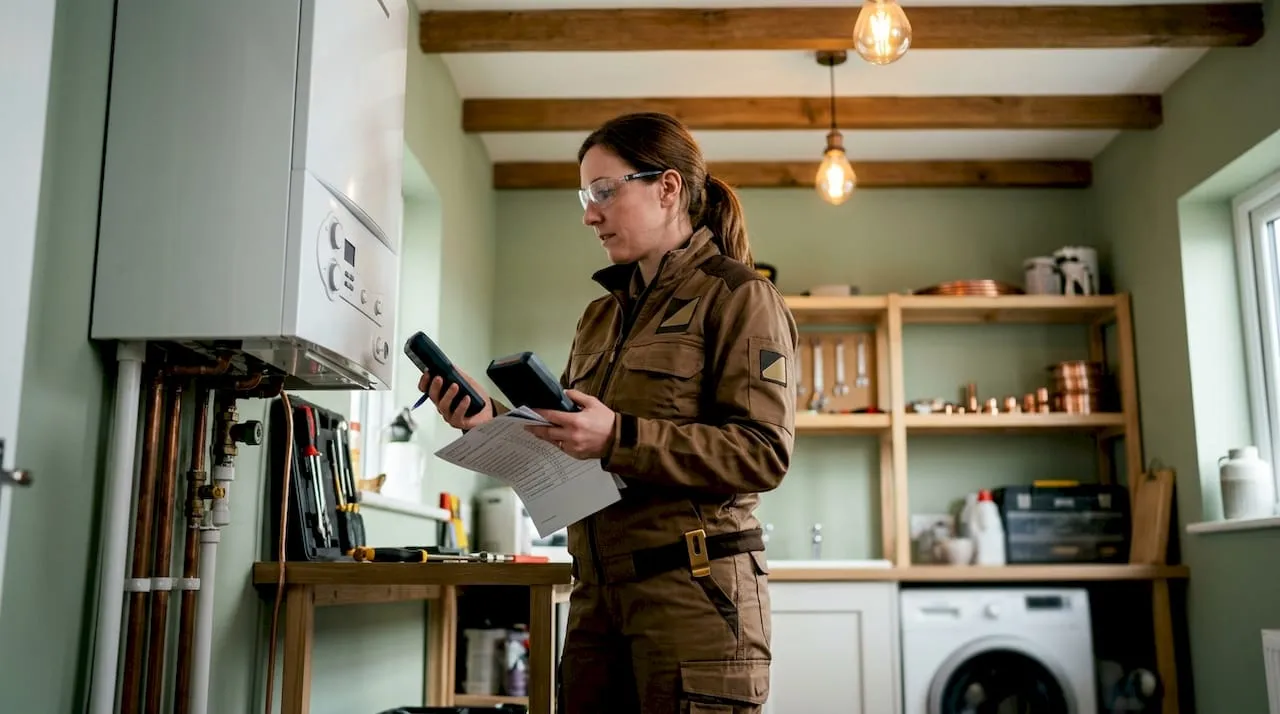
A gas safety check is a legal requirement. A Gas Safe registered engineer inspects all gas appliances, flues, and pipework to confirm they are safe to use. The engineer issues a Gas Safety Record, commonly called a CP12 certificate, once the check passes. This inspection does not include cleaning internal components, testing efficiency, or replacing worn parts. It confirms safety, nothing more.
A boiler service is a maintenance procedure. The engineer cleans the heat exchanger, checks the burner, tests combustion efficiency, inspects seals and valves, and replaces minor parts where needed. Annual boiler servicing is not a legal requirement, but most manufacturers require it to keep the warranty valid. Under Section 11 of the Landlord and Tenant Act 1985, you must keep heating installations in proper working order, which in practice means servicing is expected.
- Gas safety check: Confirms appliances are safe. Produces a CP12 certificate. Legally mandatory every 12 months.
- Boiler service: Cleans, tests, and maintains the appliance. Prevents breakdowns. Required by most manufacturers for warranty validity.
- Combined visit: One engineer, one call-out fee, both tasks completed together.
Delaying servicing until a breakdown occurs leads to expensive emergency repairs. A boiler that has not been serviced is also more likely to fail a gas safety check, creating a compliance problem on top of a repair bill.
Pro Tip: Book a combined gas safety check and full boiler service in a single visit. Combined servicing typically costs £90–£150, compared to double call-out fees for separate visits.
What are the legal timelines and documentation requirements?
Timing and paperwork are where many landlords fall short. The rules are specific, and there is no grace period built into the legislation.
Key legal deadlines
- Annual gas safety check: Must be completed every 12 months. Strict 12-month intervals apply with no grace period. A check completed one day late constitutes a regulatory breach.
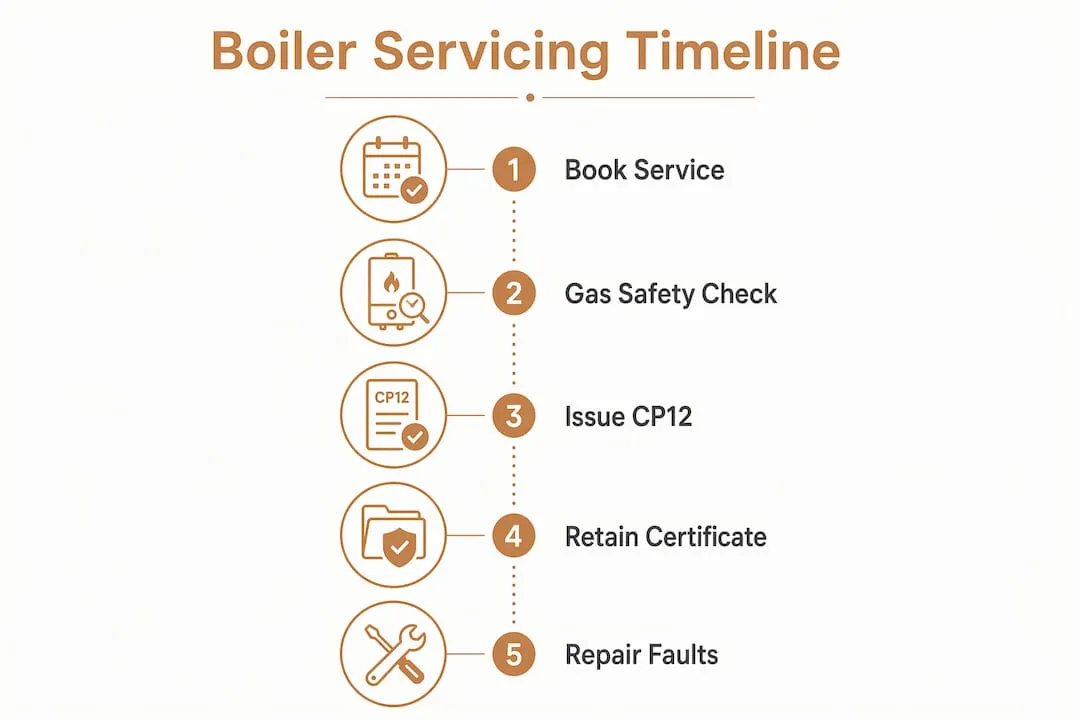
- Issuing the Gas Safety Record: You must provide the CP12 certificate to existing tenants within 28 days of the check. New tenants must receive it before their tenancy begins.
- Record retention: You must keep Gas Safety Records for at least two years.
- Access notice: You must give tenants at least 24 hours’ written notice before entering the property for a non-emergency service visit.
Documentation summary
| Document | Who receives it | Deadline | Retention period |
|---|---|---|---|
| Gas Safety Record (CP12) | Existing tenants | Within 28 days | Minimum 2 years |
| Gas Safety Record (CP12) | New tenants | Before tenancy starts | Minimum 2 years |
| Service report | Landlord records | After each visit | Recommended indefinitely |
| Repair invoices | Landlord records | After each repair | Recommended indefinitely |
Most landlords avoid the risk of missed deadlines by setting up a recurring annual contract with a Gas Safe registered engineer. The engineer contacts you when the check is due, schedules the visit, and issues the paperwork automatically. This removes the administrative burden and eliminates the risk of a late check.
Pro Tip: Set a calendar reminder 6 weeks before your CP12 expiry date. This gives you time to book a Gas Safe engineer without rushing, even during the busy autumn period when demand peaks.
How to conduct boiler servicing and maintenance effectively
Arranging a service is straightforward. Doing it well, so that it protects you legally and keeps your tenants comfortable, requires a little more thought.
Finding a qualified engineer
Only Gas Safe registered engineers can legally work on gas appliances in the UK. You can verify any engineer’s registration on the Gas Safe Register website using their licence number. Always check before booking. Rareplumbing’s Gas Safe registered team has over 25 years of service history in Central London, covering both residential and commercial properties.
Timing your annual service
Schedule the service in late summer or early autumn, ideally between august and october. Boiler demand is low during this period, so engineers are more available and response times are faster. A boiler serviced before the cold weather arrives is far less likely to fail in january when your tenant needs it most.
What a full boiler service covers
A thorough service includes the following checks and tasks:
- Inspection of the heat exchanger for cracks or corrosion
- Cleaning of the burner and combustion chamber
- Testing of gas pressure and flow rate
- Inspection of all seals, gaskets, and valves
- Flue integrity check and combustion analysis
- Testing of all safety devices and controls
- Visual inspection of pipework for leaks or damage
Communicating with tenants
Clear communication with tenants about boiler operation and prompt fault reporting significantly reduces emergency repair costs. Include a short guide in your tenancy pack explaining how to use the boiler correctly, how to bleed radiators, and how to report faults. Tenants who understand the system are less likely to misuse it and more likely to flag problems early.
Pro Tip: Ask your engineer to leave a brief note for the tenant after each service, confirming the boiler is safe and in good working order. This builds tenant confidence and reduces unnecessary calls to you.
What to do when a boiler breaks down
A boiler failure in a rental property is not just an inconvenience. It is a legal matter with a clear timeline for action.
Under the Homes (Fitness for Human Habitation) Act 2018, landlords must repair total heating or hot water failures within 24–48 hours. If repairs cannot be completed within that window, you must provide temporary heating at no cost to the tenant. The legal standard requires a minimum of 18°C in bedrooms and 21°C in living rooms at an external temperature of minus 1°C.
Ignoring a heating failure is not a low-risk option. Tenants can report the issue to the local council, triggering a Housing Health and Safety Rating System (HHSRS) inspection. A category one hazard finding can result in an improvement notice, emergency prohibition order, or civil penalty. Landlords who repeatedly fail to act face prosecution under the Housing Act 2004.
Here is how to manage a breakdown effectively:
- Respond immediately. Contact a qualified engineer as soon as the tenant reports the fault. Do not wait to assess whether it is serious.
- Communicate clearly. Tell the tenant what is happening, when the engineer will arrive, and what the likely outcome is. Silence breeds complaints.
- Provide interim heating. If repairs will take more than 24 hours, arrange portable electric heaters. This is a legal obligation, not a goodwill gesture.
- Document everything. Record the date and time of the tenant’s report, your response, the engineer’s visit, and the repair outcome. This protects you if a dispute arises.
- Emergency access. Emergency repairs override the standard 24-hour access notice requirement, but you should still notify the tenant as soon as possible and document the reason for immediate entry.
Rareplumbing offers rapid boiler repairs with a 2-hour emergency response across Central London, which directly supports landlords in meeting the 24–48 hour legal repair window.
Key takeaways
Landlords must arrange an annual Gas Safe inspection, issue the CP12 certificate within 28 days, and repair heating failures within 24–48 hours to stay legally compliant in 2026.
| Point | Details |
|---|---|
| Annual gas safety check | Legally required every 12 months under the Gas Safety (Installation and Use) Regulations 1998. |
| CP12 documentation | Issue to tenants within 28 days; retain records for at least two years. |
| Boiler servicing | Not legally mandated but required by most manufacturers and expected under Section 11. |
| Repair timelines | Fix heating or hot water failures within 24–48 hours or provide temporary heating at no cost. |
| Combined visits | Book gas safety check and boiler service together to reduce costs and simplify compliance. |
Why I think most landlords are solving the wrong problem
After years of working with landlords across Central London, the pattern I see most often is this: landlords focus on the annual gas safety check as if ticking that box means the job is done. It does not.
The CP12 certificate proves the appliance is safe on the day it was inspected. It says nothing about whether the boiler will still be running efficiently in february when your tenant is calling you at 7 in the morning. The landlords who avoid emergency call-outs and tenant disputes are the ones who treat the service visit as the main event and the safety check as a by-product of it.
The other thing I have seen cause real problems is poor tenant communication. A tenant who does not know how to repressurise the boiler will call you in a panic over something that takes 90 seconds to fix. A simple one-page guide in the tenancy pack, written in plain English, eliminates a surprising number of those calls. Treat your tenants as partners in looking after the heating system, not just occupants who report problems.
The HHSRS heating standards are also worth understanding properly. Most disputes arise from perceived heating inadequacy, not from a boiler that has technically failed. A boiler that runs but cannot reach 21°C in the living room is still a compliance problem. Monitor heating output, not just appliance status.
— Paresh
How Rareplumbing supports landlords with boiler compliance
Landlords managing properties in Central London need a service partner who understands both the legal obligations and the practical realities of rental property maintenance.
Rareplumbing’s landlord membership includes annual boiler servicing and gas safety checks carried out by Gas Safe registered engineers, with fixed pricing and full documentation provided after every visit. Members receive priority scheduling and a 2-hour emergency response for heating failures, which keeps you within the 24–48 hour legal repair window. Rareplumbing also handles all CP12 paperwork and service records, so your compliance file is always up to date. For landlords who want certainty rather than guesswork, a membership plan removes the administrative burden entirely.
FAQ
Is an annual boiler service a legal requirement for landlords?
An annual boiler service is not a legal requirement, but the annual gas safety check is mandatory under the Gas Safety (Installation and Use) Regulations 1998. Most boiler manufacturers also require annual servicing to keep the warranty valid.
How long does a landlord have to fix a broken boiler?
Landlords must repair total heating or hot water failures within 24–48 hours under the Homes (Fitness for Human Habitation) Act 2018. If repairs take longer, temporary heating must be provided at no cost to the tenant.
What is a CP12 certificate and when must it be issued?
A CP12 is the Gas Safety Record issued after a successful annual gas safety check. Landlords must provide it to existing tenants within 28 days and to new tenants before the tenancy begins.
Can a landlord enter a property without notice for boiler repairs?
Emergency repairs override the standard 24-hour written notice requirement. Landlords should still notify the tenant as soon as possible and document the reason for immediate entry to protect against any dispute.
What happens if a landlord fails to arrange a gas safety check?
Non-compliance with the Gas Safety (Installation and Use) Regulations 1998 can result in unlimited fines or imprisonment of 6–15 years if a serious injury or death occurs as a result of the breach.
Recommended
Talk to a specialist today.
Our Gas Safe engineers are available same-day across Central and North London. No call-out charge quoted upfront. No obligation.
Related Services