

Quick Answer
Discover the role of heating controls in offices to enhance comfort, reduce energy costs, and lower carbon emissions for a sustainable workplace.
TL;DR:
- Heating controls in offices determine how and when heat is delivered, reducing energy waste and improving comfort. Upgrading to smart controls or BEMS can cut energy consumption by up to 50%, especially with demand-led adjustments for hybrid work environments. Regular monitoring and maintenance are essential for maximizing performance and achieving cost and carbon savings.
Heating controls are the systems that regulate when, where, and how much heat a building delivers. In commercial offices, their role extends well beyond comfort. Poor controls waste 20–30% of energy in UK commercial buildings, a figure that translates directly into inflated energy bills and unnecessary carbon emissions. CIBSE guidance, including TM39 and TM54, sets the standard for how building services should be monitored and managed. For facilities directors and office managers, understanding the role of heating controls in offices is the starting point for meaningful cost reduction and a better working environment.
What role do heating controls play in offices?
Heating controls in offices are the interface between a building’s heat source and the people inside it. They determine how heat is distributed across zones, when systems switch on and off, and how the building responds to changes in occupancy or outdoor temperature. Without effective controls, a boiler or heat pump operates blindly, delivering heat regardless of whether a floor is occupied or a meeting room is empty.

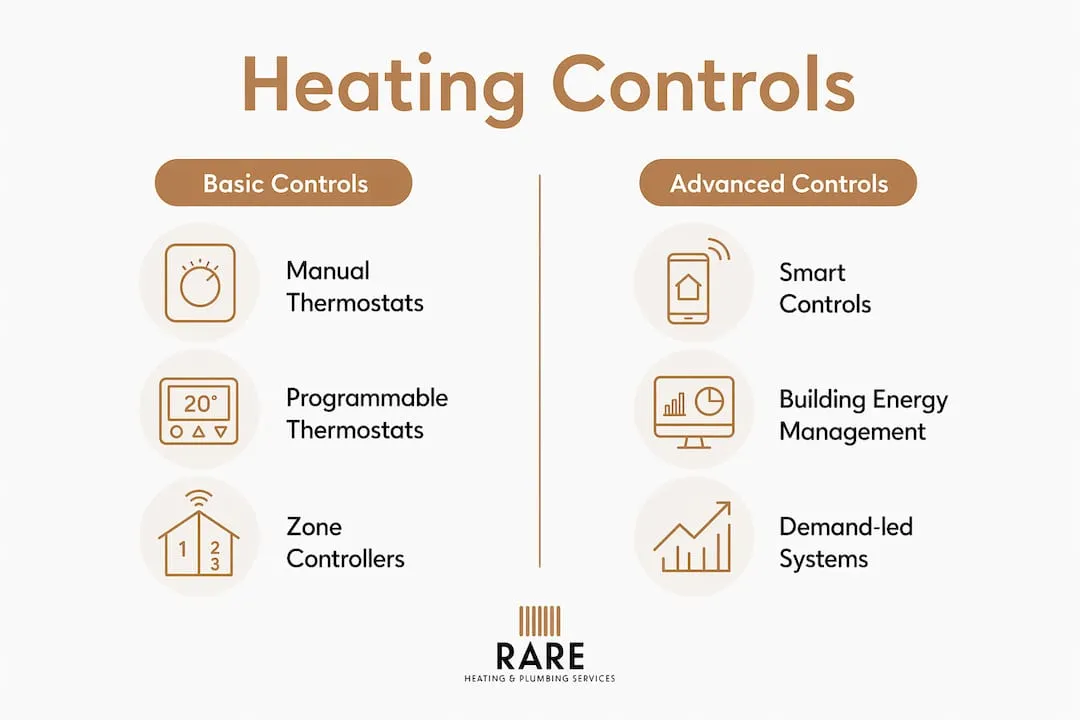
The industry term for the most capable category of office heating control is a Building Energy Management System, or BEMS. A BEMS integrates temperature sensors, occupancy data, CO2 monitoring, and time scheduling into a single platform that manages heating, ventilation, and sometimes cooling together. Simpler offices may rely on programmable thermostats or zone controllers, which offer scheduling without the full data integration of a BEMS.
Advanced building controls are now recognised as essential infrastructure for net zero targets, not optional extras. That shift in thinking reflects how much energy commercial buildings consume and how much of that consumption is avoidable with better control.
What are the main types of heating controls used in offices?
The choice of heating control technology depends on building size, existing infrastructure, and budget. Each type offers a different level of precision and data visibility.
Manual and programmable thermostats
Manual thermostats set a fixed temperature and hold it. Programmable thermostats add time scheduling, allowing the system to reduce heat overnight or at weekends. Both are low cost and simple to operate, but neither responds to actual occupancy. A programmable thermostat will heat an empty office on a bank holiday if no one updates the schedule.
Smart controls and zone controllers
Smart controls connect to building networks and can be adjusted remotely. Zone controllers divide a floor or building into independently managed areas, so a busy open-plan area and a rarely used boardroom receive different treatment. This zoning approach is one of the most cost-effective ways to reduce energy waste without a full BEMS installation. For offices considering Heatmiser installation, zone-level control is a practical entry point.
Building Energy Management Systems (BEMS)
A BEMS is the most capable option for medium to large offices. It collects data from temperature, occupancy, and CO2 sensors and uses that data to adjust heating in real time. CO2 monitoring is particularly valuable because it provides a direct proxy for how many people are in a space. A room with rising CO2 needs both more ventilation and, potentially, adjusted heating to maintain comfort.
Pro Tip: Before specifying a full BEMS replacement, check whether a retrofit IoT sensor layer over your existing controls can deliver the data granularity you need. Retrofitting controls is more cost-effective than full replacement in the majority of cases.
Payback periods for smart control upgrades typically range from 18 to 48 months. For a 1,000m² office, a full advanced system upgrade may take around four years to pay back. That timeline shortens considerably when energy prices are high or when the baseline system is poorly configured.
How do heating controls improve energy efficiency and occupant comfort?
The energy efficiency gains from well-configured heating controls are substantial. Upgrading to smart controls reduces heating energy consumption by 10–50%, with well-configured systems typically delivering 20–30% savings. That range reflects how much baseline performance varies across UK commercial offices.
Demand-led control and hybrid working
The shift to hybrid working has changed the fundamental assumptions behind office heating schedules. Office occupancy now sits at 40–60% of pre-pandemic levels on many days. A system running on a fixed Monday-to-Friday schedule heats empty desks on low-attendance days, wasting energy that demand-led controls would have avoided entirely.
Demand-led BEMS adjust services based on real-time occupancy and CO2 data rather than fixed schedules. When sensors detect that a wing of the building is unoccupied, the system reduces heat to that zone automatically. When a meeting room fills up, CO2 levels rise and the system responds by increasing ventilation and adjusting temperature setpoints. This kind of dynamic occupancy response is not possible with a programmable thermostat.
Indoor air quality and comfort
Heating controls that integrate with ventilation systems improve indoor air quality as well as temperature. CO2 levels above 1,000 parts per million are associated with reduced concentration and decision-making ability. A BEMS that monitors CO2 and adjusts fresh air supply accordingly keeps occupants alert and comfortable without over-ventilating and wasting heat. Understanding office zoning principles helps facilities teams align heating zones with workspace layouts for maximum effect.
The heating control benefits in workplaces extend to preventing both overheating and cold spots. Overheating is a common complaint in south-facing offices during winter, where solar gain adds heat that the system has not accounted for. A well-configured BEMS with solar compensation adjusts boiler output automatically, preventing the discomfort that drives occupants to open windows and waste the heat already delivered.
What are common pitfalls when managing office heating controls?
Facilities teams make predictable mistakes with heating controls. Recognising them early saves money and avoids the comfort complaints that erode staff satisfaction.
-
Neglecting system tuning after installation. Controls are often configured at commissioning and left unchanged for years. Systems frequently go untuned for a decade, by which point occupancy patterns, building use, and equipment have all changed. Performance degrades silently.
-
Skipping the observation phase. Changing setpoints without first collecting zone-level data leads to tuning errors and comfort complaints. The correct approach is to observe before adjusting.
-
Over-specifying control sequences. Complex BMS programming sequences are harder to maintain and more likely to fail. Embedding thermodynamic control at system level, with the BEMS handling supervision rather than every detail, produces more reliable outcomes.
-
Treating controls as a set-and-forget system. CIBSE TM39 guidance is explicit: active management and ongoing monitoring are required to maintain system performance. A BEMS that no one reviews is not delivering its potential.
-
Failing to involve building services professionals. Facilities managers are not always trained in control logic. Engaging a qualified heating engineer at the design and commissioning stage prevents costly errors.
Pro Tip: Schedule a quarterly controls review with your heating engineer. Review zone setpoints, check sensor calibration, and compare actual energy consumption against the previous quarter. Thirty minutes of structured review catches drift before it becomes a problem.
What practical steps can office managers take to upgrade heating controls?
A structured approach to upgrading heating controls reduces risk and delivers faster returns. The following steps reflect current best practice for UK commercial offices.
- Assess baseline performance first. Audit your current system to identify which zones are over-heated, which are under-controlled, and where energy waste is highest. This baseline shapes every subsequent decision.
- Consider a retrofit IoT layer before specifying a full BEMS replacement. Adding IoT sensors to an existing system collects zone-level data without the cost and disruption of full replacement. A heating system redesign case study illustrates how this approach works in practice for commercial properties.
- Run a 4–8 week observation phase. Collecting zone data for 4–8 weeks before changing any setpoints reduces the risk of comfort issues and tuning errors. This phase reveals actual occupancy patterns rather than assumed ones.
- Use one-way bridges when retrofitting IoT over existing BMS. One-way bridges preserve safety interlocks and avoid the need for full re-commissioning. This is the technically correct method for layering new controls over legacy systems.
- Engage qualified engineers and control contractors. Gas Safe registered engineers and specialist controls contractors bring the expertise needed to configure systems correctly. Rareplumbing’s team has over 25 years of experience in commercial heating installations across Central London.
- Plan for office fit-out changes. Refits alter airflow, occupancy density, and heat loads. Any significant change to the office layout should trigger a review of heating zone boundaries and setpoints.
- Schedule periodic recalibration. Sensors drift over time. Annual calibration checks maintain the accuracy that demand-led control depends on.
Key takeaways
Effective heating controls are the single most cost-effective intervention available to office managers seeking to reduce energy waste and improve occupant comfort simultaneously.
| Point | Details |
|---|---|
| Energy waste from poor controls | Poor controls waste 20–30% of energy in UK commercial buildings, making upgrades a high-priority investment. |
| Smart controls deliver clear savings | Upgrading to smart heating controls reduces consumption by 10–50%, with 20–30% typical for well-configured systems. |
| Hybrid working demands dynamic control | With office occupancy at 40–60%, fixed schedules waste energy; demand-led BEMS respond to actual occupancy. |
| Observe before adjusting | A 4–8 week IoT observation phase before changing setpoints prevents comfort issues and tuning errors. |
| Active management is non-negotiable | Controls left untuned for years lose performance; quarterly reviews and CIBSE TM39-aligned monitoring sustain results. |
Why heating controls deserve more attention than they get
I have seen facilities teams spend considerable budget on new boilers and insulation while leaving a decade-old BMS configuration untouched. The controls are where the real performance gap sits. A well-specified boiler running on a poorly configured schedule will always underperform a modest boiler running on a well-tuned demand-led system.
What strikes me most about the current moment is how much hybrid working has exposed the inadequacy of fixed-schedule controls. When attendance is unpredictable, the only rational response is a system that reads the building in real time. Facilities directors who have not revisited their control strategy since 2019 are almost certainly heating empty floors on low-attendance days.
The argument for simplicity in control design is also underappreciated. I have reviewed BMS configurations so complex that no one on the facilities team could explain what a given sequence was doing. When something goes wrong, nobody knows where to start. Simpler control logic, with the BEMS handling supervision rather than every micro-decision, is easier to maintain, easier to hand over, and more likely to perform as intended five years after commissioning.
The carbon case for advanced controls is equally strong. BEMS are among the most cost-effective carbon abatement measures available to commercial buildings, outperforming solar PV and insulation on a per-tonne-of-CO2-saved basis. That is not an argument against those other measures. It is an argument for sequencing correctly and not overlooking controls in the pursuit of more visible interventions.
— Paresh
Rareplumbing’s heating control services for offices
Office managers in Central London looking to upgrade or maintain their heating controls have a specialist partner in Rareplumbing. With over 25 years of experience and a Gas Safe registered team, Rareplumbing handles everything from smart control installation to full BEMS commissioning reviews for commercial properties.

A Rareplumbing membership gives facilities teams priority access to heating engineers for scheduled maintenance, sensor calibration, and seasonal system reviews. Fixed quotes are provided before any work begins, removing the uncertainty that makes planned maintenance difficult to budget. For offices ready to assess their current controls or plan an upgrade, Rareplumbing’s commercial heating specialists are available for a no-obligation consultation.
FAQ
What is the role of heating controls in offices?
Heating controls regulate when, where, and how much heat an office building delivers. They reduce energy waste, maintain occupant comfort, and enable demand-led adjustments based on occupancy and CO2 levels.
How much energy can better heating controls save?
Upgrading to smart controls reduces heating energy consumption by 10–50%, with well-configured systems typically saving 20–30%. Poor controls waste 20–30% of energy in UK commercial buildings.
What is a BEMS and does my office need one?
A Building Energy Management System (BEMS) integrates temperature, occupancy, and CO2 data to manage heating in real time. Medium to large offices benefit most, though smaller offices can achieve significant gains with smart zone controllers.
How does hybrid working affect office heating control?
Hybrid working reduces office occupancy to 40–60% on many days. Fixed-schedule controls heat empty spaces unnecessarily. Demand-led BEMS adjust output based on actual occupancy, avoiding that waste.
How often should office heating controls be reviewed?
Controls should be reviewed at least annually, with quarterly checks recommended for larger systems. CIBSE TM39 guidance supports active ongoing management rather than a set-and-forget approach.
Recommended
Talk to a specialist today.
Our Gas Safe engineers are available same-day across Central and North London. No call-out charge quoted upfront. No obligation.
Related Services