

Quick Answer
Discover the role of programmer in heating systems and how it optimizes your home's efficiency. Learn to balance heat and cost effectively.
What does a programmer actually do in a heating system?
The heating programmer is the master schedule controller for your boiler. It does not control temperature. It simply grants or denies the boiler permission to run during set time windows, leaving the room thermostat to decide whether heat is actually needed once that permission is granted.
Think of it this way: the programmer sets the hours, the thermostat sets the warmth. Without both working together, you either heat an empty house or come home to a cold one.
Per Energy Saving Trust guidance, a complete set of heating controls including a programmer, room thermostat, and thermostatic radiator valves (TRVs) costs a typical amount to install in a standard UK home. That single investment is the foundation of any efficient heating setup.
Key distinctions worth knowing:
- Programmer: controls when the boiler runs, acting as the time schedule
- Room thermostat: controls whether the boiler fires, based on air temperature
- TRVs: control heat distribution room by room, independently of the programmer
- Combi boilers need only a single-channel programmer (heating only); heat-only boilers need a two-channel system to schedule hot water separately
- From a software engineering perspective, the “programmer” is also the embedded controls engineer who writes the firmware that makes these devices function
The confusion between the physical device and the professional role is real. Technicians regularly encounter homeowners who conflate the two, which matters when diagnosing faults or specifying upgrades.
How software engineers shape modern HVAC control systems
The shift from mechanical pin-timers to embedded firmware has fundamentally changed what a controls programmer does. Today’s HVAC software engineer writes the logic that governs how a boiler, heat pump, or building management system (BMS) behaves across its entire product lifecycle, often a decade or more.
Core responsibilities in a modern HVAC programming role include:
- Writing embedded firmware in C/C++ for microcontroller-based heating control products
- Implementing communication protocols including Zigbee 3.0, BACnet, and Modbus TCP for device interoperability
- Developing control logic using IEC 61131-3 languages, particularly Structured Text, for PLC-based thermal systems
- Debugging firmware with tools such as logic analysers, oscilloscopes, and protocol analysers like Wireshark
- Balancing performance constraints with long product lifecycles, especially on battery-powered wireless controllers
- Supporting integration between boilers, heat pumps, and third-party BMS platforms
Complex systems involving heat pumps and solar thermal demand particularly sophisticated programming. Engineers at manufacturers such as Remeha/BDR Thermea work across the full development lifecycle, from architectural design through to validation, ensuring interoperability between heterogeneous devices that may come from entirely different manufacturers.
Python has become a standard secondary tool for scripting, test automation, and data handling alongside the core embedded languages.

What smart heating systems can do that fixed timers cannot
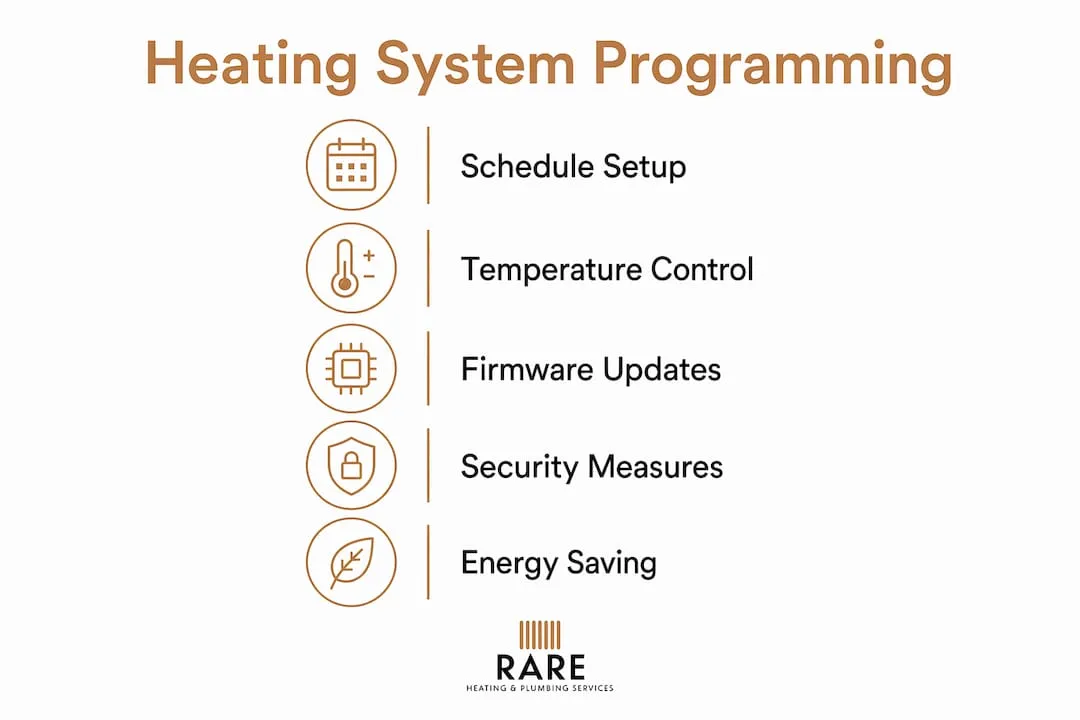
Modern programmable heating controllers have moved well beyond the simple on/off timer. A 7-day programmer lets you set independent schedules for every day of the week, with override and boost functions that activate heating outside the normal timed periods without permanently changing the schedule.
Smart systems go further still:
- Geofencing detects when occupants leave or approach home and adjusts heating accordingly
- Adaptive start learns how long the building takes to reach target temperature and fires the boiler earlier on cold mornings
- Learning algorithms build a profile of occupant behaviour over time, reducing manual input
- IoT integration connects boilers, pumps, sensors, and weather data feeds into a single event-driven control layer
- Remote access via smartphone apps lets occupants adjust schedules from anywhere
The firmware underpinning these features is considerably more complex than a fixed schedule. Engineers must write event-driven firmware that handles mesh networking behaviour, device pairing, and Zigbee security layers while maintaining low power consumption on battery devices.
Security and privacy are genuine concerns here. Smart heating systems collect occupancy data, usage patterns, and sometimes location information. Programmers must implement secure coding practices, encrypted communication, and access controls from the ground up, not as an afterthought. UKCA and CE certification requirements add another layer of compliance that firmware engineers must build into their development process.
How Rareplumbing approaches heating system programming in practice
Rareplumbing has spent over 25 years working on heating systems across Central London’s luxury residential and commercial properties. That experience translates directly into how the team approaches programmer installation and smart control integration.
A Marylebone heating system redesign handled by Rareplumbing illustrates the gap between theory and practice. Integrating a new programmer into an existing system requires more than swapping hardware. It means verifying the control sequence, confirming channel assignments match the boiler type, and testing the interaction between the programmer, room thermostat, and any TRVs before handing back to the client.
Rareplumbing’s practical approach covers:
- Heatmiser installations across Mayfair and Central London, including smart heating setup and zone configuration
- Smart heating troubleshooting, including connectivity faults between controllers and apps
- Gas Safe registered engineers on every job, maintaining the safety standards that luxury properties demand
- Fixed quotes before work begins, removing the uncertainty that comes with complex control upgrades
- 2-hour emergency response for heating faults in occupied properties
Pro Tip: If your programmer is set to “constant” and the room thermostat is turned high, the boiler has no reason to rest. Always check the programmer’s mode setting first when diagnosing a boiler that runs continuously.
For commercial properties, Rareplumbing’s commercial heating services cover the full scope from BMS-integrated control systems through to emergency boiler repairs, with the same fixed-quote transparency applied to every project.
The evolving scope of heating system programming
The programmer’s role has expanded in both directions. As a physical device, it has grown from a simple pin-timer into a networked controller capable of responding to weather data, occupancy signals, and remote commands. As a professional discipline, controls programming now sits at the intersection of embedded software, IoT architecture, and building services engineering.
Key points shaping where this goes next:
- Fixed schedules are giving way to adaptive, data-driven control that responds to real conditions rather than assumed ones
- Interoperability between devices from different manufacturers remains the hardest problem, driving demand for engineers fluent in BACnet, Modbus, and Zigbee simultaneously
- Security and privacy obligations will tighten as smart heating systems collect more occupancy and behavioural data
- Heat pump integration, including heat pump systems increasingly common across Europe, demands programming that balances thermal performance with electrical demand in ways gas boilers never required
- The energy efficiency upgrades available to UK homeowners now depend heavily on how well the control software is written and configured
UK case studies: programming driving heating innovation
Two examples from the UK market show how programmer contributions translate into real outcomes.
Heatmiser and IMI Climate Control have developed Zigbee-based heating controllers that require firmware engineers to maintain mesh network stability across dozens of paired devices in a single property. The challenge is not writing the schedule logic. It is keeping every node communicating reliably when the network topology changes as devices are added or removed.
Remeha’s commercial HVAC range, deployed across hospitals and large residential complexes in the UK and Europe, relies on embedded software engineers who work across the full development lifecycle. Their systems must integrate with third-party BMS platforms from multiple vendors, which means the programmer’s job is as much about protocol translation and interoperability testing as it is about writing control logic.
Both cases point to the same conclusion: the quality of the firmware determines the quality of the heating system, regardless of the hardware underneath it.
Key takeaways
The programmer is both a physical time-control device and a professional discipline, and the quality of the software behind modern heating controls directly determines how efficiently and reliably a system performs.
| Point | Details |
|---|---|
| Programmer as time controller | The programmer grants the boiler permission to run during set periods; it does not control temperature. |
| Full controls cost | Installing a programmer, thermostat, and TRVs in a UK home costs around £550, per Energy Saving Trust. |
| Core programming languages | HVAC firmware engineers primarily use C/C++, with Structured Text for PLC systems and Python for test automation. |
| Smart system complexity | Features like geofencing and adaptive start require event-driven firmware with Zigbee, BACnet, or Modbus integration. |
| Security obligations | Smart heating systems collect occupancy data, requiring encrypted communication and secure coding from the outset. |
FAQ
What is the difference between a heating programmer and a thermostat?
The programmer controls when the boiler is allowed to run by setting a timed schedule. The thermostat controls whether the boiler actually fires by measuring room temperature against a target.
What programming languages do HVAC controls engineers use?
HVAC firmware engineers primarily write in C/C++ for embedded microcontroller work, use Structured Text under IEC 61131-3 for PLC-based systems, and use Python for scripting and test automation.
Do smart heating programmers save energy?
Yes. Features like geofencing, adaptive start, and learning algorithms reduce unnecessary boiler firing by matching heating to actual occupancy rather than a fixed assumed schedule.
What security risks come with smart heating programmers?
Smart controllers collect occupancy patterns and sometimes location data. Engineers must implement encrypted communication protocols and access controls to prevent unauthorised access or data exposure.
Can a programmer work without a room thermostat?
Technically yes, but the boiler will run continuously throughout every programmed period regardless of room temperature. A thermostat is what stops the boiler once the target temperature is reached, making the combination far more efficient than either control alone.
Recommended
Talk to a specialist today.
Our Gas Safe engineers are available same-day across Central and North London. No call-out charge quoted upfront. No obligation.
Related Services