


Quick Answer
Discover what a communal heating system is and how it provides efficient heating and hot water to multiple homes. Learn more now!
TL;DR:
- A communal heating system distributes hot water and warmth within a building from a central heat source through shared insulated pipes. It offers benefits like lower maintenance, better safety, and access to low-carbon technology but limits residents’ ability to choose suppliers or control tariffs. New UK regulations in 2026 improve protections by ensuring transparent billing, fair pricing, and formal complaint rights for heat network customers.
A communal heating system is defined as a pipework network within a single building that distributes heating and hot water from one shared central source to multiple homes or units. The industry term for this arrangement is a “heat network,” and you will encounter both phrases used interchangeably in property and regulatory contexts. Communal systems differ from district heat networks, which span multiple buildings across a wider area. For homeowners and property managers in high-density residential or commercial buildings, understanding how this infrastructure works, what it costs, and what rights you hold under 2026 UK regulations is the foundation of every sensible decision about your property.
What is a communal heating system and how does it work?
A communal heating system uses a central heat source to supply warmth and hot water to every unit in a building through a shared network of insulated pipework. The central source can take several forms: a gas-fired communal boiler, a combined heat and power (CHP) unit, an air source heat pump, or recovered waste heat from a nearby industrial or commercial process. The choice of heat source determines both the carbon intensity of the system and the long-term running costs for every resident in the building.
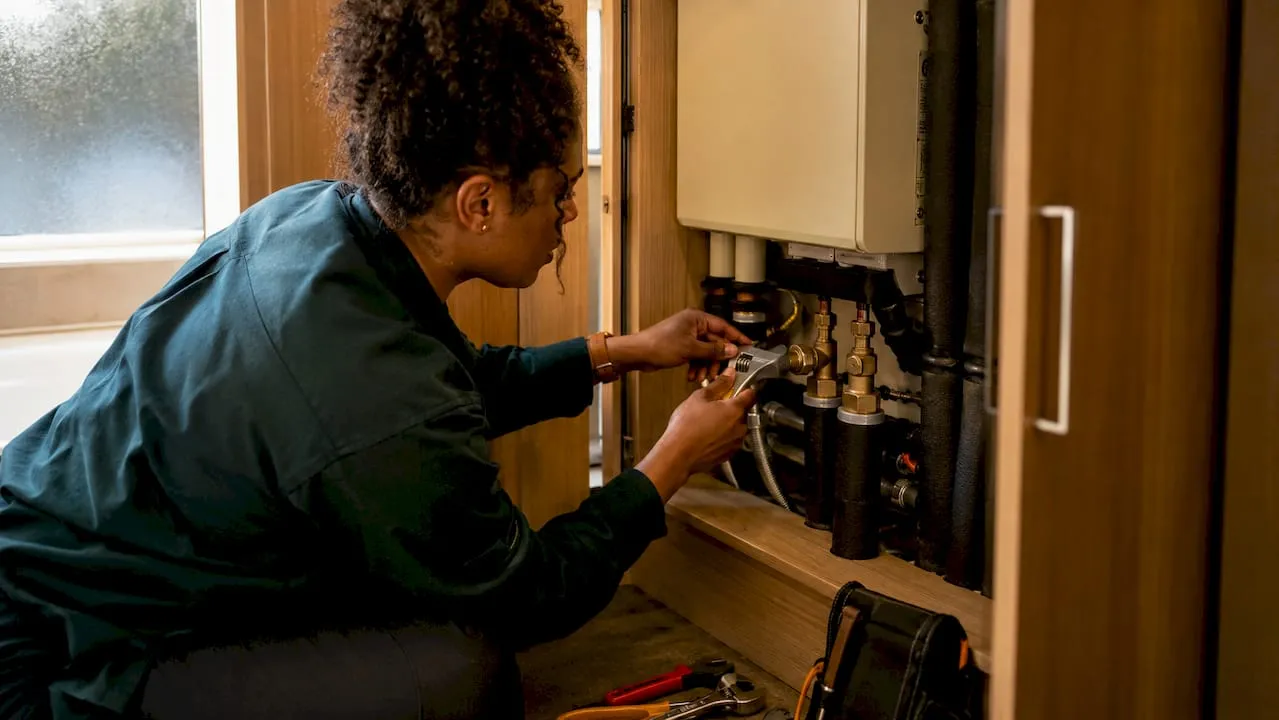
Heat travels from the central plant room through insulated pipes to each flat or unit. At the point of entry to each home, a Heat Interface Unit (HIU) transfers thermal energy from the shared network into the property’s own radiators and hot water taps. The HIU acts as the boundary between the communal infrastructure and your private home. It replaces the individual boiler entirely, which is one of the most significant practical differences between communal and individual heating arrangements.
The table below summarises the main heat source types and how they distribute heat across a building.
| Heat source | Fuel type | Distribution method | Carbon intensity |
|---|---|---|---|
| Communal gas boiler | Natural gas | Insulated pipework and HIU | Moderate |
| Air source heat pump | Electricity | Insulated pipework and HIU | Low |
| Combined heat and power (CHP) | Gas or biomass | Insulated pipework and HIU | Low to moderate |
| Waste heat recovery | Industrial surplus | Insulated pipework and HIU | Very low |
Communal systems are strictly contained within one site or building. District heat networks, by contrast, connect multiple buildings across streets or entire neighbourhoods. The distinction matters for billing, regulation, and maintenance responsibility. If your building has its own plant room, you are almost certainly on a communal system rather than a district network.
What are the main benefits and challenges of communal heating?
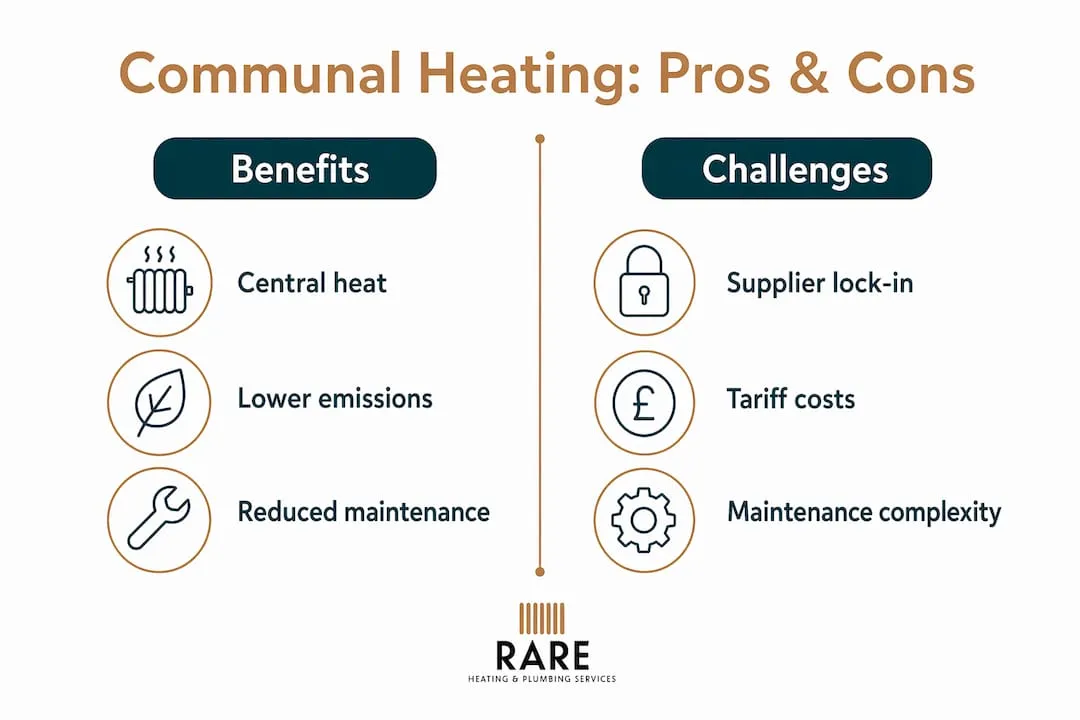
Communal heating system benefits are most visible in high-density residential buildings where installing individual boilers in every flat would be impractical, expensive, and potentially unsafe. The three strongest advantages are reduced maintenance burden, improved safety, and access to low-carbon heat sources.
Key benefits
- No individual boiler to maintain. Communal systems eliminate individual boiler costs and remove combustion equipment from inside each home. That reduces the risk of gas leaks and carbon monoxide incidents at the flat level.
- Access to low-carbon technology. Heat networks support low-carbon heat sources like heat pumps, which are difficult and expensive to install on a per-property basis. A single communal heat pump serving 50 flats is far more practical than 50 separate units.
- Professional management. A well-run communal system provides more reliable heat than ageing standalone boilers. Property managers can contract specialist engineers for planned maintenance, reducing unplanned outages.
- Sustainable urban development. Communal heating is a practical route to decarbonising dense housing stock, which is why the UK government actively supports heat network expansion as part of its net zero strategy.
Communal heating pros and cons: the challenges
The communal heating pros and cons picture is not entirely positive. The most significant drawback is loss of supplier choice. Residents cannot switch energy suppliers on a communal system because the infrastructure is owned and managed centrally. You are locked into the tariff set by your building owner or managing agent, with no ability to shop around.
Historically, tariffs often exceeded conventional gas rates, sometimes reaching 8–15p/kWh compared to standard gas rates. That gap created real financial pressure for residents on fixed incomes. The 2026 regulatory changes address this directly, but the underlying structure of locked-in pricing remains.
Pro Tip: Many homeowners assume that removing their individual boiler also removes all heating maintenance costs. It does not. The HIU inside your flat remains your responsibility, and repair bills can arrive without warning. Budget for annual HIU servicing just as you would for a traditional boiler.
What regulatory protections apply to communal heating in 2026?
The UK government introduced formal regulatory protections in 2026 specifically for heat network customers. These rules align heat network customers with gas and electricity users in terms of consumer rights, ending a long period where communal heating sat outside the standard energy regulatory framework.
“Heat network customers will receive the same protections as gas and electricity consumers, including rights around fair pricing, transparent billing, and access to a formal complaints process.” — UK Government, 2026
The practical implications for homeowners and property managers include:
- Fair pricing rules. Tariffs must be justifiable and cannot include hidden charges or excessive mark-ups above the cost of supply.
- Transparent billing. You have the right to a clear breakdown of what you are paying for, including standing charges, unit rates, and any management fees.
- Formal complaints pathway. If you believe your tariff is unfair, you can escalate through the Heat Trust or the relevant ombudsman scheme rather than relying solely on your landlord or managing agent.
- Metering requirements. Operators must provide accurate consumption data, moving away from the estimated billing that previously obscured true costs.
These protections matter most in buildings where the managing agent sets the tariff without external scrutiny. Property managers should review their billing structures now to confirm compliance. Homeowners who suspect overcharging have a clear legal route to challenge it.
How to install and manage a communal heating system effectively
Installing a communal heating system requires decisions that affect every resident for decades. The central heat source selection is the most consequential choice. Gas boilers are cheaper to install but carry long-term carbon risk as regulations tighten. Air source heat pumps cost more upfront but align with the UK’s net zero trajectory and are increasingly supported by government funding. For heritage or listed buildings, sustainable heating options require careful assessment of structural constraints before any plant room design begins.
System sizing is equally critical. An undersized central boiler or heat pump will fail to meet peak demand on cold mornings, leading to resident complaints and emergency call-outs. An oversized system wastes energy during low-demand periods. A qualified engineer should carry out a full heat loss calculation for the entire building before specifying equipment.
For property managers, the ongoing management responsibilities include:
- Annual servicing of the central plant. The communal boiler or heat pump should be serviced by a Gas Safe registered engineer every 12 months. Rareplumbing provides commercial boiler servicing for managed buildings across Central London.
- HIU maintenance coordination. While individual residents own their HIUs, property managers often coordinate access and recommend approved engineers to maintain consistency across the building.
- Pipework inspections. Insulated distribution pipework should be checked periodically for heat loss, corrosion, and joint integrity.
- Billing audits. With 2026 regulations now in force, property managers must verify that tariff structures meet the new transparency requirements.
Pro Tip: Set up a heating maintenance concierge arrangement with a specialist engineer. A single point of contact for all communal heating issues reduces response times, keeps maintenance records in one place, and gives residents a clear escalation route when something goes wrong.
Communal heating vs individual heating comes down to scale and building type. For a single family home, an individual boiler remains the simpler and more controllable option. For a block of 20 or more flats, a communal system almost always delivers better efficiency, lower per-unit maintenance costs, and a clearer path to low-carbon heat. The comparison between communal and individual systems is worth reviewing carefully before committing to either approach during a refurbishment or new build.
For those evaluating running costs alongside other heating options, understanding how different heating technologies compare on tariffs can help frame the financial case for or against a communal network.
Key takeaways
A communal heating system is the most practical route to low-carbon heat in high-density buildings, but it requires careful management, transparent billing, and proper HIU maintenance to deliver on its promise.
| Point | Details |
|---|---|
| Definition and scope | A communal system serves multiple units within one building via shared pipework and a central heat source. |
| Heat source determines costs | The choice between gas, heat pump, or waste heat sets both carbon intensity and long-term running costs for residents. |
| HIU responsibility | Residents own and must maintain the HIU in their flat, even though the communal boiler is removed. |
| 2026 regulatory protections | UK regulations now give heat network customers the same billing transparency and complaint rights as gas and electricity users. |
| Management is the deciding factor | A well-managed communal system outperforms individual boilers; a poorly managed one creates persistent resident dissatisfaction. |
Communal heating: what 25 years of plant rooms taught me
I have walked through a lot of plant rooms over the years, and the pattern is consistent. The communal heating systems that work well are not necessarily the ones with the newest equipment. They are the ones with a property manager who treats the central boiler like a critical asset rather than a background utility. When maintenance is deferred, the whole building feels it simultaneously, which creates a very different kind of pressure compared to one flat losing its boiler.
The shift towards heat pumps in communal systems is real and accelerating. What concerns me is that many buildings are being retrofitted with heat pumps sized for theoretical peak loads rather than actual resident behaviour. The result is a system that performs beautifully in an engineer’s calculation and struggles on a cold January morning. Proper heat loss surveys, not assumptions, are the only reliable basis for sizing.
The 2026 regulations are a genuine improvement for residents, but they do not solve the underlying tension between communal efficiency and individual control. Residents who move from a house with their own boiler to a flat on a communal system often feel a loss of autonomy that no tariff transparency rule fully addresses. Property managers who acknowledge this openly, and who communicate proactively about maintenance schedules and billing changes, retain far fewer complaints than those who treat the system as invisible infrastructure.
My advice to any homeowner or property manager considering a communal system: get the heat source decision right first, build in a maintenance contract from day one, and never assume residents understand what an HIU is or why it matters.
— Paresh
Rareplumbing’s communal heating expertise for managed properties
Rareplumbing works with property managers and building owners across Central London on commercial heating installations and ongoing maintenance for communal systems. With over 25 years of experience and a Gas Safe registered team, Rareplumbing provides fixed quotes before any work begins, so there are no billing surprises for you or your residents.

From initial system design and heat source selection through to annual servicing and HIU coordination, Rareplumbing covers the full lifecycle of a communal heating system. Every job comes with a 2-hour emergency response guarantee for managed buildings in Central London. Contact Rareplumbing to discuss your building’s requirements and receive a transparent, fixed-price assessment.
FAQ
What is the difference between communal and district heating?
A communal heating system serves multiple units within a single building from one central source. A district heat network connects multiple buildings across a wider area through a larger shared infrastructure.
Is communal heating efficient?
Communal heating is efficient when the central heat source is well-matched to the building’s demand and properly maintained. Heat pumps and waste heat recovery make communal systems significantly more carbon-efficient than individual gas boilers.
Who is responsible for HIU maintenance?
The resident is responsible for maintaining the Heat Interface Unit inside their property. Property managers often coordinate access to approved engineers, but the cost and upkeep obligation sits with the individual homeowner or leaseholder.
Can residents switch energy suppliers on a communal system?
Residents cannot switch suppliers on a communal heating system. The tariff is set centrally by the building owner or managing agent, though 2026 UK regulations now require that tariff to be fair and transparently billed.
What rights do communal heating customers have in 2026?
The 2026 UK regulations give heat network customers the same protections as gas and electricity users, including rights to transparent billing, fair pricing, and access to a formal complaints process through the Heat Trust or an ombudsman scheme.
Recommended
Talk to a specialist today.
Our Gas Safe engineers are available same-day across Central and North London. No call-out charge quoted upfront. No obligation.
Related Services