
Quick Answer
Discover what is a heating controls upgrade and how it can boost efficiency and comfort, saving you up to £200 a year on energy bills.
TL;DR:
- A heating controls upgrade involves installing devices that regulate your heating system’s timing, temperature, and zones to enhance efficiency and comfort.
- This process can reduce heating bills by 10 to 20 percent, saving most households between £100 and £200 annually.
A heating controls upgrade is the installation or enhancement of devices that regulate your heating system’s timing, temperature, and zonal settings to improve efficiency and comfort. The industry term for this process is “heating controls optimisation,” and it covers everything from a basic programmer swap to a full smart thermostat installation. A correctly installed set of controls can reduce heating bills by 10–20%, saving a typical UK household £100–£200 every year. For homeowners and property managers in Central London, where energy costs are high and comfort expectations are higher, this is one of the most cost-effective improvements available.
What is a heating controls upgrade made up of?
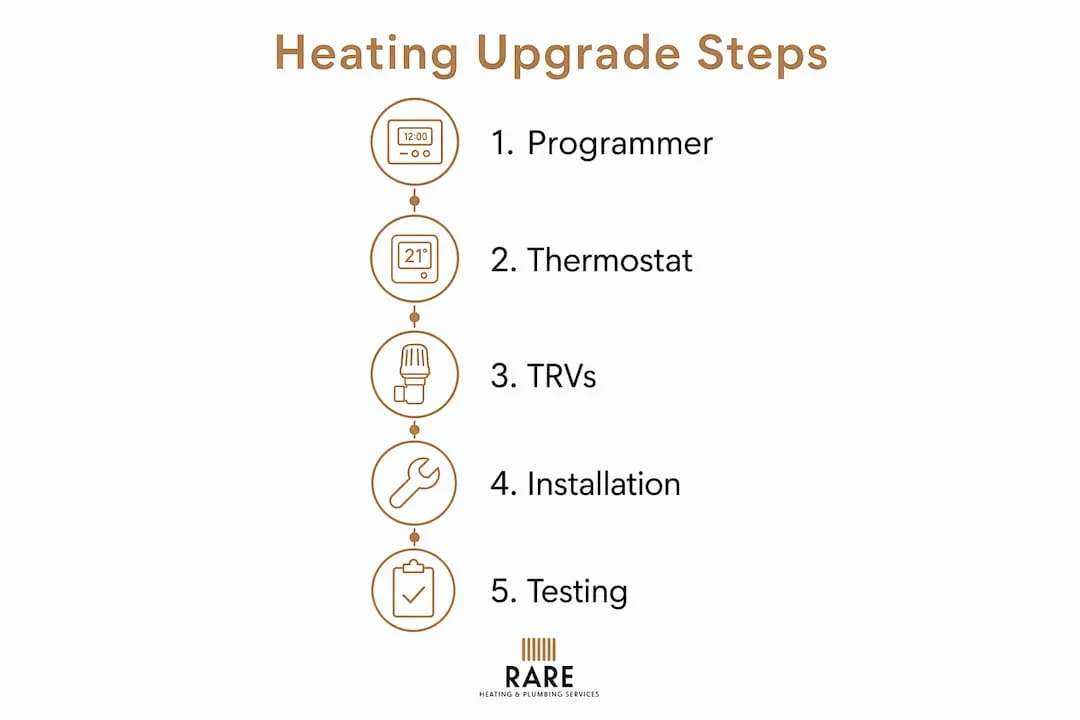
A standard heating controls upgrade involves three core components working together: a programmer, a room thermostat, and thermostatic radiator valves (TRVs). Each device plays a distinct role, and the combination of all three delivers the greatest efficiency gains.
- Programmer or timer. This schedules when your boiler fires up and shuts down. A basic mechanical timer is the entry point; a digital programmer gives you separate weekday and weekend schedules.
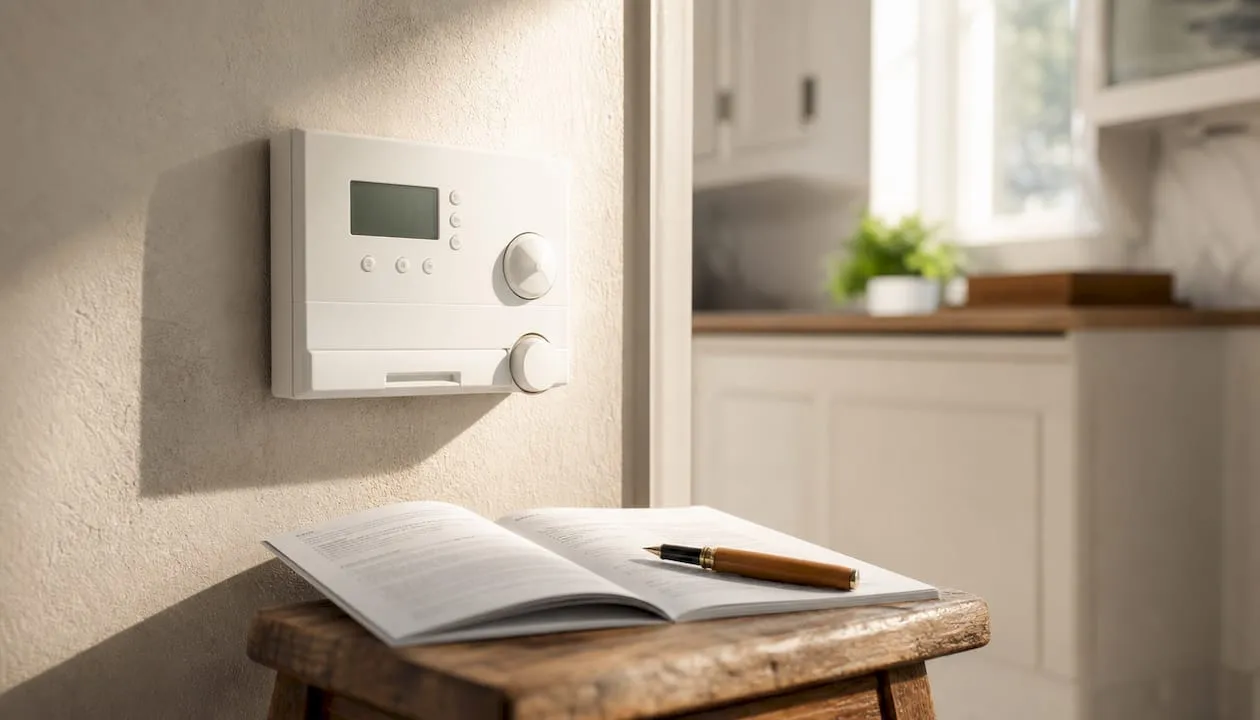
- Room thermostat. This measures the air temperature in a reference room and signals the boiler to stop once the target temperature is reached. Without one, your boiler runs on a fixed cycle regardless of how warm the house already is.
- Thermostatic radiator valves (TRVs). Fitted to individual radiators, TRVs enable room-level temperature control, so a spare bedroom stays cooler than a living room without any manual adjustment.
- Wiring centre or relay box. Older properties often need one of these to connect modern controls to an existing boiler. A qualified installer will assess this during the survey.
- Optional smart controls. These sit on top of the standard setup and add remote access via a smartphone app, learning algorithms, and geofencing.
| Component | Typical function | Approximate cost |
|---|---|---|
| Digital programmer | Schedules heating on/off times | £30–£80 |
| Room thermostat | Controls overall temperature | £50–£150 |
| TRVs (set of 5) | Room-by-room temperature control | £60–£150 |
| Smart thermostat | Remote access, learning, geofencing | £150–£300 |
| Wiring centre | Connects controls to boiler | £20–£60 |
Pro Tip: If your property has multiple zones, such as a basement flat and upper floors, ask your installer about zone valves. These let each zone run on its own schedule and temperature, which is far more efficient than a single thermostat for the whole building.
How does upgrading heating controls improve efficiency and cut costs?
Better controls match your heating output to your actual needs. Without a thermostat, a boiler runs until its internal sensor is satisfied, which often means rooms overheat and energy is wasted. With a full set of controls, the system stops the moment the target temperature is reached.
The numbers make the case clearly. Turning a room thermostat down by just 1°C saves approximately £65 and cuts carbon dioxide emissions by 230kg annually. That single adjustment costs nothing beyond the initial installation of the thermostat itself.
Heating controls are the vital last step after insulation. Without them, even a well-insulated home wastes energy because the boiler has no precise signal to stop. Controls close the loop between the heat you generate and the comfort you actually need.
The behavioural side matters as much as the hardware. Keeping thermostats on automatic mode between 18°C and 21°C is more efficient than switching to manual and adjusting by hand. Manual operation almost always leads to overheating because people compensate for perceived coldness by turning the dial too high, then forgetting to turn it back down.
TRVs add another layer of precision. A bedroom set to 16°C while the living room runs at 20°C means the boiler does less work overall. Heat regulation through controls is the final step that makes insulation improvements pay off fully, because TRVs are essential to fully benefit from insulation upgrades. Without them, insulated rooms simply overheat rather than use less energy.
What does a heating controls upgrade cost, and what does installation involve?
Cost is the first question most homeowners ask, and the answer is more reassuring than many expect. A full upgrade for a standard three-bedroom property costs between £200 and £500, including parts and labour. That figure covers a programmer, room thermostat, and a set of TRVs, fitted by a qualified engineer.
Key installation considerations include:
- Boiler compatibility. Most modern boilers built within the last 10–15 years can be retrofitted with modern controls, so a full boiler replacement is rarely necessary just to upgrade the controls.
- Wiring and relay boxes. Older systems may need a wiring centre to connect new digital controls. This adds a small cost but avoids compatibility problems.
- Combined upgrades. If a boiler replacement is already planned, doing both at once is worth considering. A combined boiler and controls upgrade delivers 7–13 additional SAP points, improving your EPC rating more than either measure alone.
- Component lifespan. Heating control components last approximately 4–5 years, compared to around 14 years for a boiler. Build this into your maintenance planning so controls are refreshed on schedule.
- Gas Safe registration. Any engineer connecting controls to a gas boiler must be Gas Safe registered. Always verify this before work begins.
Pro Tip: Ask for a fixed quote before any work starts. Reputable installers, including Rareplumbing, provide written quotes so you know the exact cost before a single wire is touched. This protects you from bill surprises on what should be a straightforward job.
What types of heating control systems are available?
The spectrum runs from a basic mechanical timer to a fully connected smart system. Understanding where each type sits helps you choose the right level for your property and lifestyle.
Traditional mechanical controls are the starting point. A simple dial timer and a manual thermostat give you on/off scheduling and a rough temperature ceiling. They are reliable and cheap, but offer no flexibility once set.
Programmable thermostats step up from there. These let you set different temperatures for different times of day, seven days a week. They suit households with predictable routines and are the minimum standard recommended for any property seeking an improved EPC rating.
Smart heating control systems represent the current ceiling of residential technology. Features typically include:
- Remote control via a smartphone app, so you can adjust heating from anywhere
- Learning algorithms that study your routine and adjust schedules automatically
- Geofencing, which detects when you leave or approach home and adjusts the heating accordingly
- Integration with voice assistants and home automation platforms
Smart thermostats offer convenience and user-side savings through automation and learning features. Their EPC rating contribution, however, is similar to that of standard wired controls. This is a point many homeowners miss: if your goal is purely to improve your EPC score, a well-installed standard programmer and thermostat achieves nearly the same result as a premium smart system. If your goal is comfort, flexibility, and lower bills through smarter behaviour, a smart system earns its cost.
For properties with underfloor heating or multiple zones, smart controls become significantly more valuable. Zone-by-zone scheduling through a single app removes the need to adjust multiple thermostats manually, which most occupants simply do not do consistently. You can also explore energy-efficient heating options that complement a controls upgrade, particularly in rooms where supplementary heat sources make sense.
A Heatmiser installation is one example of a smart control system well suited to multi-zone London properties, offering precise scheduling and remote access through a dedicated app.
Key takeaways
A heating controls upgrade is the most cost-effective way to cut energy bills and improve comfort without replacing your boiler.
| Point | Details |
|---|---|
| Core components | A programmer, room thermostat, and TRVs together deliver the greatest efficiency gains. |
| Bill savings | A full set of controls can reduce heating bills by 10–20%, saving £100–£200 annually. |
| Typical cost | A standard three-bedroom upgrade costs £200–£500, far less than a boiler replacement. |
| Smart controls | Smart thermostats add convenience and user savings but do not significantly improve EPC ratings beyond standard controls. |
| Maintenance cycle | Control components last 4–5 years; plan replacements within your regular maintenance schedule. |
Why I think most homeowners underestimate this upgrade
People tend to focus on the boiler when they think about heating efficiency. I understand why. A boiler is the most visible and expensive part of the system, so it feels like the logical place to invest. But in my experience, the controls are where the real waste happens.
A well-serviced boiler connected to a basic mechanical timer and no TRVs will still overheat rooms, run at the wrong times, and cost far more to run than it should. The boiler is doing exactly what it is told. The problem is that nobody is telling it the right thing. Controls fix that.
The other mistake I see regularly is homeowners who install a programmable thermostat and then leave it in manual mode because they never set up the schedule. The hardware is there, but the benefit is not. If you are going to invest in an upgrade, take the time to programme it properly, or choose a smart system that learns your routine and does it for you.
Pairing a controls upgrade with regular boiler servicing and good insulation is the combination that genuinely moves the needle on energy bills. Controls alone are powerful. Controls plus a well-maintained boiler plus insulation is the full picture. I would always recommend tackling them together rather than in isolation.
— Paresh
Heating controls upgrades with Rareplumbing
Rareplumbing has over 25 years of experience installing and upgrading heating controls across Central London’s residential and commercial properties. Every job starts with a fixed quote, so you know the cost before work begins.
Whether you need a straightforward thermostat and TRV installation or a fully connected smart system for a multi-zone property, Rareplumbing’s Gas Safe registered engineers handle the full process. Book a consultation with a heating engineer in London to get a clear assessment of what your property needs and what it will cost. For ongoing peace of mind, a Rareplumbing membership covers annual servicing and priority response, keeping your controls and boiler performing at their best year-round.
FAQ
What does a heating controls upgrade include?
A heating controls upgrade typically includes a programmer, a room thermostat, and thermostatic radiator valves (TRVs). Smart thermostats and wiring centres may also be added depending on the property and boiler type.
How much does a heating controls upgrade cost in the UK?
A full upgrade for a standard three-bedroom property costs between £200 and £500, covering parts and installation by a qualified engineer.
Will upgrading heating controls improve my EPC rating?
A full set of controls can improve your EPC rating, and combining a controls upgrade with a new boiler delivers 7–13 additional SAP points. Smart thermostats alone do not add significantly more EPC credit than standard wired controls.
How long do heating control components last?
Heating control components have a service life of approximately 4–5 years, compared to around 14 years for a boiler. Replacing them on schedule keeps your system running efficiently without the cost of a full boiler replacement.
Do I need to replace my boiler to upgrade my heating controls?
No. Most boilers built within the last 10–15 years are compatible with modern controls and can be retrofitted without a boiler replacement.
Recommended
Talk to a specialist today.
Our Gas Safe engineers are available same-day across Central and North London. No call-out charge quoted upfront. No obligation.
Related Services